From App Layer to Edge Layer: What the Shift Signals
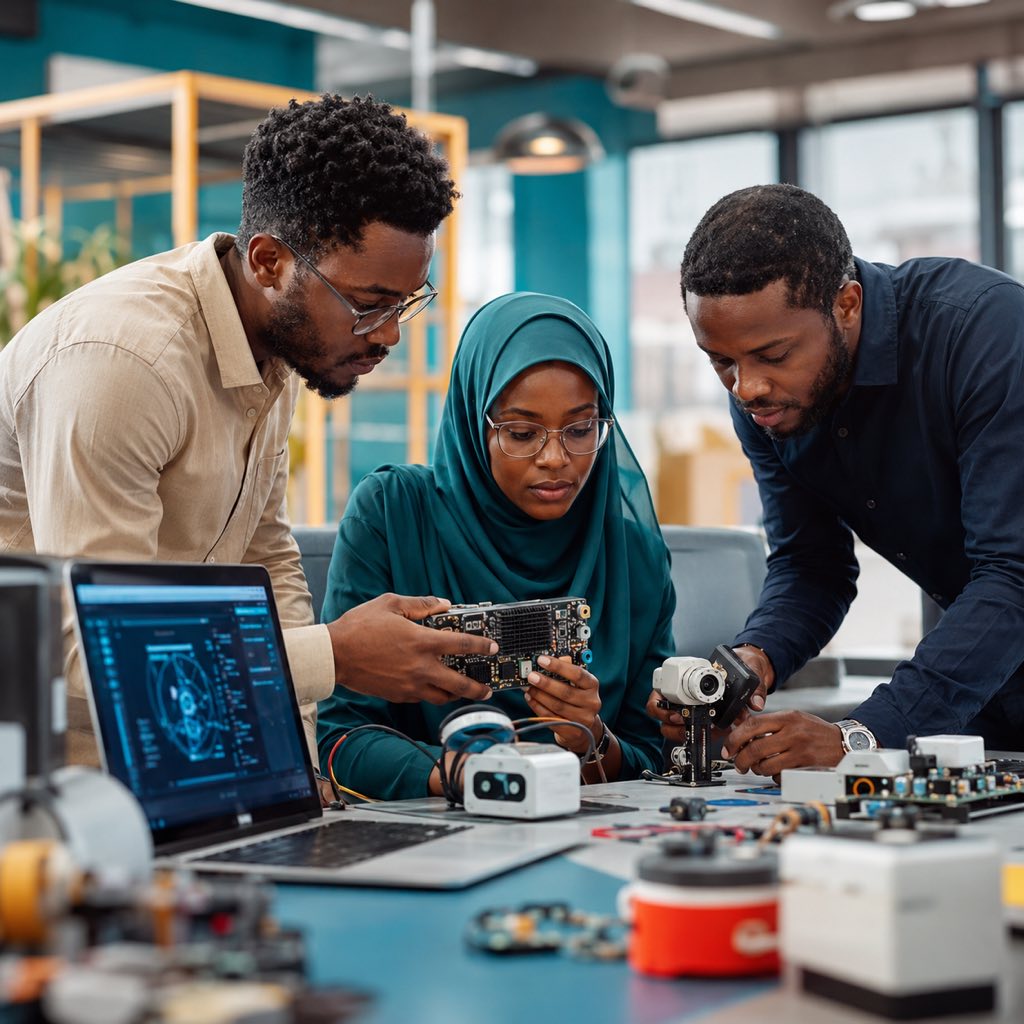
Africa’s tech startup ecosystem built its first generation of scale companies on software: mobile payments, ride-hailing, e-commerce logistics, and B2B SaaS. The infrastructure — chips, sensors, embedded systems, robotics — was imported. Qualcomm’s Make in Africa program, now in its fourth cohort, is betting that the next generation of African tech leadership will come from companies that build at the hardware level.
The 2026 cohort selection, announced in April, drew a record 1,200 applications from 45 countries. Ten companies were selected — a 0.8% acceptance rate that rivals the most competitive accelerator programs globally. Wassim Chourbaji, Qualcomm’s President for Middle East and Africa, noted that the rising application numbers reflect “improving solution sophistication” in the African deep-tech ecosystem, not merely increasing awareness of the program. That distinction matters: more applications that are better quality suggests a genuine maturation of the hardware startup layer, not just growing familiarity with a funding opportunity.
The selected startups span nine countries and cover domains from assistive robotics and poultry farm management to solar-powered fish feeding and AI-powered cocoa quality assessment. What unites them is a commitment to solving African-specific problems with African-local technology stacks — including edge AI inference running on Qualcomm chips rather than cloud-dependent architectures that require stable connectivity.
The 2026 Cohort: Ten Startups, Nine Countries, One Clear Theme
The ten selected companies illustrate the range and geographic spread of the program:
Zerobionic (Kenya) builds assistive robotics for people with mobility challenges — one of the first African startups to commercialize a prosthetic AI platform using edge inference rather than cloud processing, enabling function in environments without reliable connectivity.
Sesi Technologies (Ghana) applies AI vision to cocoa quality assessment, a domain where accurate grading directly affects smallholder farmer income. The company uses on-device inference to assess bean quality at collection points in rural areas where cloud connectivity is unreliable.
QualiKeeper Investments (Zambia) deploys AIoT systems for livestock monitoring in rural areas, using sensor fusion and edge processing to detect animal health anomalies without requiring continuous internet access.
Anatsor (Nigeria) and D-Olivette Labs (Nigeria) address poultry farm management and crop optimization respectively — both applying data-driven AI to agricultural productivity at a scale where traditional approaches have failed.
MVUTU (Congo), TWave (Uganda), and SafeSip (Tanzania) tackle post-harvest loss, automated fish feeding, and safe water access — three of Sub-Saharan Africa’s highest-impact humanitarian-commercial problem spaces.
Amperra Charging Company (Namibia) builds AI-driven EV charging infrastructure — a sector where African-designed hardware will need to work in grid-unstable environments that European charging hardware is not engineered for.
Mindora Corporation (Zimbabwe) develops assistive Braille technology for visually impaired users, combining embedded AI with specialized hardware for a population that global tech companies have systematically under-served.
Advertisement
What Founders Should Take Away From This Program
The Make in Africa program’s structure reveals more than a list of selected companies. It reflects a specific thesis about what African deep-tech startups need to succeed — and that thesis has direct implications for founders building in adjacent domains.
1. Prioritize Edge Inference Over Cloud Dependency for African Market Fit
The most consistent thread across the 2026 cohort is that all ten startups are building for environments where cloud connectivity is unreliable, expensive, or absent. This is not a consolation prize — it is a deliberate architectural choice that creates market defensibility. A cocoa grading AI that requires continuous 4G connectivity is unusable at 80% of collection points in rural Ghana. One that runs inference on a Qualcomm chip without network access works everywhere. Founders in agricultural AI, healthcare, and logistics should treat edge-first architecture as a competitive requirement rather than a technical nicety. Qualcomm’s ecosystem of edge AI hardware — including the Arduino UNO Q and VENTUNO Q boards provided to cohort members — makes this technically feasible at startup cost levels.
2. Secure IP Before Scaling — Patent Costs Are Now Covered
One persistent barrier for African deep-tech founders is intellectual property protection. Filing patents in multiple jurisdictions costs $15,000 to $50,000 for a comprehensive filing — prohibitive for a pre-revenue hardware startup. The Make in Africa program’s partnership with L2Pro Africa and Adams & Adams to cover £4,000 in patent legal fees per startup is a direct response to this gap. Founders in hardware and embedded AI who are not actively building IP portfolios are building moats made of sand. When a larger company decides to replicate a successful edge AI product, the only durable protection is a patent portfolio. The window to file foundational IP is early in product development — not at Series A when the product is already in market and the prior art clock has been running. Any African deep-tech founder applying to Make in Africa or similar programs should make patent filing part of the program deliverable, not an afterthought.
3. Target Humanitarian-Commercial Domains That Global Companies Have Abandoned
The 2026 cohort’s domain selection — cocoa grading, livestock monitoring, Braille technology, post-harvest loss reduction — shares a common characteristic: these are markets too small or operationally complex for global tech companies to address profitably with generic products, but large enough at continental scale for a purpose-built African solution. The combined addressable market for agricultural AI optimization in Sub-Saharan Africa, assistive technology for the continent’s estimated 26 million visually impaired people, and post-harvest loss reduction (which costs African farmers an estimated $48 billion annually) vastly exceeds the individual revenue projections that make these markets look unattractive to San Francisco or Shenzhen product teams. Founders who pick their domain based on “what global companies are ignoring” will find less competition, more mission-aligned capital, and more forgiving customers than those competing head-on with well-funded international players.
The Structural Lesson
The Make in Africa program’s fourth cohort marks a transition in the African deep-tech narrative from “African startups need capital” to “African startups need the full stack.” Capital alone cannot build a hardware company. What the 2026 cohort received — free development hardware, technical mentorship, business coaching, IP funding, and a £4,000 stipend — is a recognition that the barriers to deep-tech startup success in Africa are not primarily financial. The €100 million equivalent that SAP committed to partner deployment at Sapphire shows how enterprise software vendors are making comparable bets; Qualcomm’s hardware-layer investment in Africa follows the same logic: the company that equips the ecosystem captures the platform loyalty that generates decades of component sales and licensing revenue.
According to Qualcomm’s business news coverage, the program’s framing around an intensifying IP race reflects a harder-edged concern: as African deep-tech solutions begin to work at scale, international companies are paying attention. The companies best positioned to capture the value they create are those that have filed patents, built proprietary datasets, and established customer relationships before the international attention arrives.
The 1,200 applications from 45 countries signal that African founders understand this. The question is whether the supporting ecosystem — corporate programs, government procurement, patient capital — can scale fast enough to match the ambition of the cohort now forming.
The domain coverage of the 2026 cohort is also a signal about where African deep-tech is maturing. Seven of the ten companies operate in agriculture, food security, or natural resource management — sectors where Africa’s structural challenges are largest and where locally designed, edge-deployed AI solutions have the clearest defensibility advantage over imported products. Post-harvest food losses in Sub-Saharan Africa are estimated at $48 billion annually by the Food and Agriculture Organization. Livestock disease in East Africa costs farmers $1 billion or more per year in losses. These are not marginal problems that a San Francisco product team will prioritize — they are continent-scale problems that create space for African-built, African-owned solutions. The Make in Africa program’s selection logic implicitly acknowledges this: by funding the companies targeting the hardest, most locally-specific problems, Qualcomm is investing in the segment of African deep-tech with the least international competition and the most durable market position.
Frequently Asked Questions
How does the Qualcomm Make in Africa program differ from standard accelerator programs?
The key differences are hardware-centricity and equity-free structure. Standard accelerators typically take 5–10% equity in exchange for capital, mentorship, and network access, and they are agnostic about whether portfolio companies build hardware or software. Make in Africa explicitly targets edge AI, IoT, and connectivity hardware companies, provides physical development boards rather than just cash, and takes no equity. The £4,000 completion stipend and £4,000 patent fee coverage are structured as program support rather than investment — preserving the founders’ full cap table while providing the specialized support that hardware startups need at early stage.
What makes edge AI particularly important for African market conditions?
Edge AI — inference running on a local device rather than a remote cloud server — is architecturally suited to African market conditions because it does not require reliable broadband connectivity to function. In Sub-Saharan Africa, 4G coverage reaches roughly 70% of the population but actual reliable data connectivity is significantly lower in rural and peri-urban areas. A livestock monitoring system that sends data to a cloud server for processing fails whenever the connection drops; one that processes sensor data on a local Qualcomm chip and only syncs results when connectivity is available works in all conditions. This connectivity-independence is a functional requirement for any AI product targeting agricultural, healthcare, or utility applications outside major African cities.
Is there a pathway for program alumni to access follow-on funding?
The Make in Africa program includes access to Qualcomm for Good’s Social Impact Fund for one cohort winner per cycle, providing additional funding beyond the standard support package. Beyond that, the program’s network — including L2Pro Africa, Adams & Adams, and Qualcomm’s partner ecosystem — provides warm introductions to impact investors and development finance institutions active in the African tech space. Alumni from previous cohorts have used the program’s technical credibility and IP filings as leverage in conversations with investors who are otherwise cautious about hardware startup risk profiles.
Sources & Further Reading
- Qualcomm Make Africa Selects 10 Startups for 2026 — Further Africa
- Qualcomm Unveils Startup Selection for Make in Africa 2026 — The BFT Online
- Nairobi’s Zerobionic Joins Qualcomm’s 2026 Make in Africa Cohort — PC Tech Magazine
- Qualcomm Taps Nigerian Startups for Elite Africa Deep-Tech Cohort — BusinessDay Nigeria
- Qualcomm’s 2026 AI Push Gives Africa’s Deep Tech Startups a Major Boost — African Leadership Magazine
🔗 Related Intelligence

Looking East: Why Africa’s AI Startups Are Choosing Alibaba Over Silicon Valley

Google Accelerator Africa Class 10: The 15 AI Startups Picked to Lead the Continent

Africa’s AI Map: 207 Startups, Three Hubs, and the New Builders Behind Them

Google’s Africa Accelerator Class 10: 15 AI-First Startups, 2,600 Applications, 8 Countries