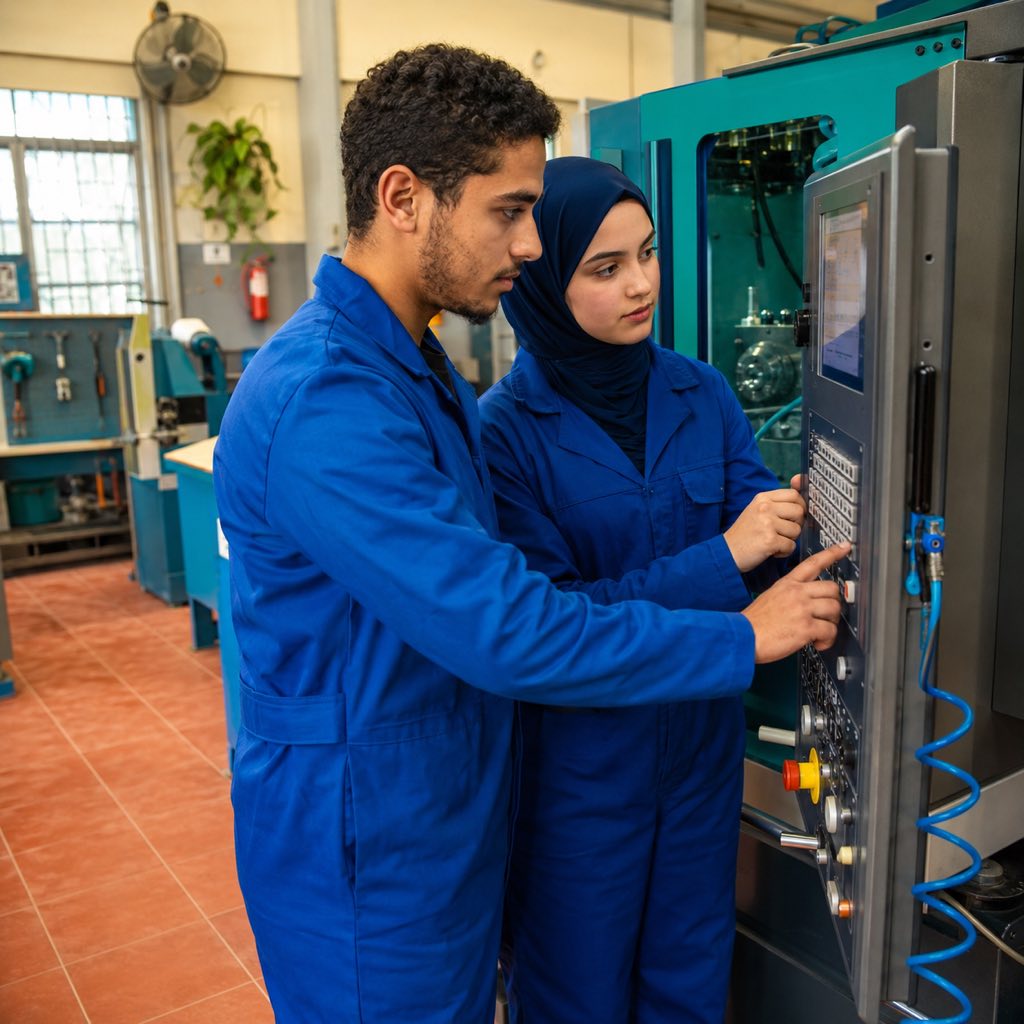
Algeria Enters the Global Vocational Stage
The ceremony on April 7, 2026 at INFEP’s El Biar campus was both a milestone and a marker of distance still to close. Algeria became WorldSkills International’s 90th member — the first step in a process that will expose Algerian TVET graduates to global competency benchmarks for the first time. Minister of Vocational Training Nassima Arhab described the moment as “Algeria stepping confidently onto the global stage of skills excellence, with a strong vision.”
WorldSkills’ official announcement situated the accession within a deliberate strategy: Morocco and Tunisia had joined WorldSkills Africa structures in preceding years, and Algeria’s October 2025 accession to WorldSkills Africa preceded the global membership by six months. The sequencing was intentional — regional competition experience before global exposure. Algeria’s inaugural national competition, held in Oran in November 2025, drew 550 competitors across 45 skills and six sectors, attracting 30,000 visitors. That scale, for a first-ever national competition, signals institutional readiness beyond a ceremonial membership.
The three specialties selected for WorldSkills Shanghai 2026 — Drywall and Plastering Systems, Mobile Applications Development, and Automotive Technology — were chosen using criteria developed with WorldSkills Germany. The inclusion of Mobile Applications Development is significant: it is Algeria’s explicit statement that its TVET system is pursuing digital credentials alongside traditional trades, and that it intends to compete for recognition in the discipline where global employer demand is growing fastest.
Advertisement
What INFEP’s Modernization Actually Covers
1. Map the 500+ specialties to current labour market demand — and pressure for honest assessment
Algeria’s TVET system currently covers more than 500 specialties across fields including agriculture, construction, healthcare, ICT, and manufacturing. According to the APS coverage of Algeria’s WorldSkills accession, the system has recently established 18 Centers of Excellence and is modernizing to address economic diversification and growing labour market demands through strengthened apprenticeships, updated infrastructure, and inclusion initiatives.
The honest question that WorldSkills membership now forces is which of those 500+ specialties have curriculum content that matches 2026 employer demand versus which reflect a 2010 or 2015 snapshot of the economy. The answer matters because the employment outcome data for TVET graduates across North Africa shows a significant gap between the completion rate (high) and the job placement rate in the trained specialty (substantially lower). WorldSkills’ own competition framework — which scores performance against global standards defined by industry practitioners, not textbook authors — creates a non-negotiable audit mechanism. Algerian competitors who reach Shanghai 2026 will have their performance benchmarked against those of Singapore, Germany, and South Korea. The gap, if significant, becomes visible data.
That visibility is a feature, not a bug. Identifying the exact performance gap in Mobile Applications Development against global competitors provides actionable intelligence for curriculum reform that three years of internal assessment data would not generate.
2. Connect the 12-week AI programme to WorldSkills digital specialty tracks
Algeria’s Ministry of Vocational Training launched a 12-week AI training programme in April 2026, combining eight weeks of intensive instruction with four weeks of applied project work with real startups. As reported by TechAfrica News, the programme is housed within the business incubator at the Centre of Excellence in the Digital Economy in Sidi Abdellah, and targets a competency-based approach “focused on project-oriented learning, experiential education, and simulation of complex professional environments.”
The connection between this programme and WorldSkills Shanghai 2026’s Mobile Applications Development track is not coincidental — it is a signpost. Both initiatives reflect the same Ministry understanding: that traditional TVET certificate programs in ICT, while necessary, need to be complemented by shorter, project-intensive pathways that mirror how digital employers actually evaluate candidates. An Algerian graduate who has built a functional mobile application through the 12-week incubator programme and a graduate who has completed a two-year ICT certification are not equivalent in the eyes of a private-sector employer. WorldSkills’ skills competition framework, by rewarding demonstrated output over credential accumulation, is creating institutional permission to prioritize the project-intensive model.
Starting in September 2026, the initiative will provide vocational trainees with high-quality instruction in cloud computing, cybersecurity, and AI, culminating in a joint diploma from the Ministry and Huawei — a credential that will carry direct private-sector recognition in the enterprise tech market.
3. Build the employer partnership governance before the next national competition in 2027
Algeria’s Oran national competition in November 2025 attracted 30,000 visitors, but the participation of private-sector employers as judges, curriculum partners, and practicum providers remains nascent. The WorldSkills model at its most effective — as demonstrated by Singapore and South Korea, both of whom used WorldSkills membership as a mechanism for industrial skills upgrading — requires employers to be structurally integrated into training design, not just invited to competitions as spectators.
The window before WorldSkills Shanghai 2026 and the subsequent 2027 national competition is the right moment to formalize employer participation frameworks. Concretely: nominating employer representatives to specialty-specific curriculum review panels for each of the digital specialties, establishing practicum placement quotas for the 18 Centers of Excellence, and creating a Ministry-coordinated employer advisory council that meets at minimum quarterly with authority to revise specialty competency standards.
The Horizons DZ coverage of Algeria’s WorldSkills accession noted that Algeria’s accession was framed as a strategic commitment to quality, not a ceremonial exercise. Holding that framing requires the employer governance infrastructure to be in place before the 2027 competition cycle begins — otherwise, the national competition results will continue to reflect what instructors teach rather than what industry needs.
What the WorldSkills Accession Means Beyond Competition
WorldSkills membership is a competition framework and a reform mechanism, but its most durable impact in member countries has been normative: it creates a shared language of competency standards that allows employers, training institutions, and workers to communicate about skills in concrete, verifiable terms.
In Singapore’s case, WorldSkills membership in the 1990s preceded a systematic skills-upgrading initiative that, over fifteen years, transformed the country’s workforce from primarily low-wage manufacturing to high-value services and technology. The mechanism was not the competition itself but the competency benchmarking process that the competition institutionalized — giving employers, government, and training providers a common calibration point for what “skilled” actually means.
Algeria’s starting position is different — larger population, more diversified industrial base, different labour market dynamics — but the mechanism is the same. WorldSkills membership gives Algeria’s Ministry of Vocational Training, its 18 Centers of Excellence, and its private-sector partners a shared external standard against which to measure progress. The critical variable is whether that standard gets embedded in curriculum design and employer hiring practices, or remains a competition event that happens every two years without affecting the other 364 days of training activity.
Frequently Asked Questions
What specialties is Algeria competing in at WorldSkills Shanghai 2026?
Algeria will debut at WorldSkills Shanghai 2026 in three specialties: Mobile Applications Development, Drywall and Plastering Systems, and Automotive Technology. The selection was made using criteria developed with WorldSkills Germany. Mobile Applications Development is the key digital specialty — it benchmarks Algerian TVET graduates against global competitors from Singapore, South Korea, and Germany in the discipline with the highest private-sector hiring demand.
What is INFEP and what role does it play in Algeria’s vocational training system?
INFEP (Institut National de la Formation et de l’Enseignement Professionnels) is Algeria’s National Institute of Vocational Education, situated in El Biar, Algiers. It oversees curriculum standards, instructor training, and institutional governance across Algeria’s 500+ vocational specialties. INFEP was the deliberate choice of venue for the WorldSkills accession ceremony in April 2026, signalling that the institution is positioned as the anchor for the broader TVET modernization agenda. The 18 Centers of Excellence that Algeria recently established report through the broader MVET system that INFEP helps to govern.
What is the 12-week AI vocational programme and who can enroll?
Launched in April 2026 by the Ministry of Vocational Training and Education, the 12-week programme is based at the Centre of Excellence in the Digital Economy in Sidi Abdellah. It combines eight weeks of intensive AI and digital skills training with four weeks of applied project work with real startups. From September 2026, expanded tracks in cloud computing, cybersecurity, and AI will culminate in a joint diploma from the Ministry and Huawei. The programme is designed for vocational trainees pursuing a competency-based, project-intensive alternative to traditional multi-year ICT certification programs.
—
Sources & Further Reading
- Algeria Joins WorldSkills as Its 90th Member — WorldSkills International
- Algeria Joins WorldSkills — Algérie Presse Service
- A New Contender Enters the WorldSkills Stage — Horizons DZ
- Algeria Launches 12-Week AI Training Programme — TechAfrica News
- WorldSkills Shanghai 2026 — Official Site
- Algeria Launches National AI Training Program — Ecofin Agency
🔗 Related Intelligence

IIoT & Industry 4.0: New Digital Career Paths Opening for Algeria’s Industrial Workers

DeepX Summit: How Algiers Became MENA’s First DeepTech Venture Factory

Algeria’s Tech Skills Demand Gap: What Private Sector Employers Actually Need in 2026

Algeria’s Remote Tech Talent: Building Career Pathways in the Global Digital Economy