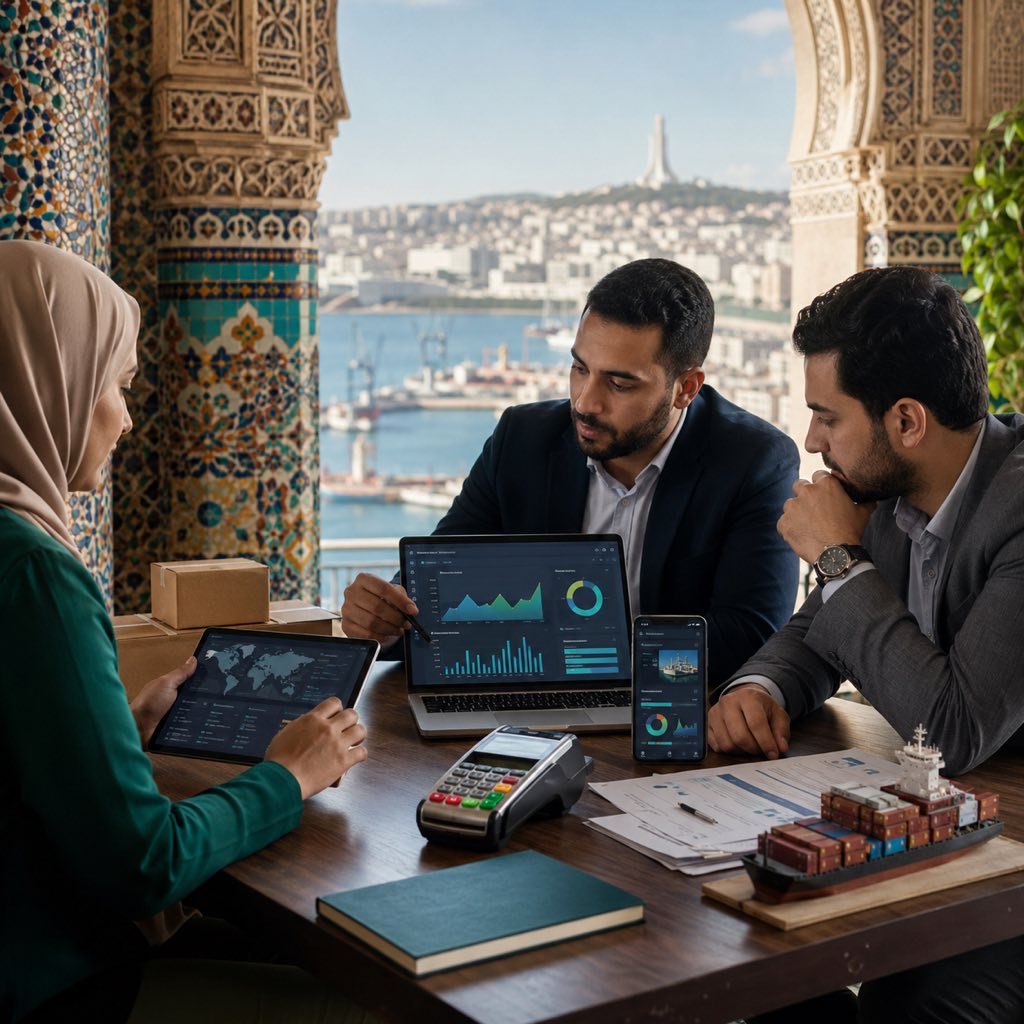
Algeria’s SMEs Are Running on Empty
An Algerian furniture manufacturer in Blida wins a contract with a large public construction company. The contract is worth 8 million dinars. The payment terms are 90 days. The manufacturer needs to buy raw materials now. The bank requires property as collateral — which the manufacturer leased, not owned. The FGAR guarantee fund is available in principle, but the application process takes months. The manufacturer either misses the contract or borrows informally at punitive rates.
This scenario, repeated tens of thousands of times across Algeria every month, is the operational reality of the country’s SME sector. Algeria’s MSMEs generally rely on internal sources for financing, and when they look for external finance, they face rejection from banks due to the absence of high collateral. The SME credit guarantee fund (FGAR) exists precisely to bridge this gap, but its uptake has been limited by process complexity and geographic concentration.
The result is a structural working capital deficit that constrains growth across every productive sector. Across Africa, SMEs account for more than 90% of businesses and over 60% of employment and GDP — yet face an annual financing gap of US$300 billion, according to Afreximbank. Algeria’s share of that gap is not published as a standalone figure, but the country’s trade finance digitization rate of 15-20% — compared to 72% in the UAE — signals a market where the problem is large and the tools to address it are nascent.
The Factoring Window: What Happened in Algiers in November 2025
For Algeria, the signal that the trade finance moment has arrived was the Factoring Exposition and Workshop that Afreximbank held in Algiers during IATF2025, organized in partnership with FCI under the auspices of the Bank of Algeria and attended by approximately 100 participants from across Africa.
Factoring — the practice of selling unpaid invoices to a finance provider in exchange for immediate working capital — is the instrument best suited to Algeria’s SME credit problem precisely because it does not require property collateral. The financing decision is based on the creditworthiness of the buyer (the large company or public entity that owes the payment), not on the assets of the small supplier. In a market where SMEs are asset-poor but have strong buyer relationships with creditworthy state-owned enterprises and large corporates, factoring unlocks working capital that would be unavailable through any traditional loan.
Africa’s factoring volumes have already demonstrated this potential. Factoring volumes on the continent more than doubled from €21.6 billion in 2017 to €50 billion in 2024, with nearly 200 factoring companies now operating across Africa. Afreximbank’s target — scaling volumes to €240 billion, equivalent to 10% of Africa’s continental GDP — represents a 380% increase from current levels. Algeria, as one of Africa’s largest economies, has a proportionate share of that addressable opportunity.
The IFC separately expanded its Global Supply Chain Finance Program from $1 billion to $3 billion, citing a global SME trade finance gap of $2.5 trillion — a figure that doubled between 2017 and 2025. The expansion is focused on emerging market economies, which face scarcer supply chain finance than traditional trade finance, making North Africa a priority target region.
Advertisement
What Algerian Fintech Founders Should Build Right Now
1. Invoice Factoring Platforms That Use Public Sector Buyer Strength as the Credit Signal
Algeria’s public sector is, paradoxically, the best asset an SME fintech founder can target. Sonatrach, Algerie Telecom, public hospitals, and state construction companies are creditworthy buyers who generate enormous volumes of outstanding invoices owed to SME suppliers. The credit decision for a factoring product is not “can this SME repay?” but “can Sonatrach pay its own invoices?” — a question with an obvious answer.
Founders should build platforms that onboard SME suppliers to major public-sector buyers, digitize the invoice verification process (reducing it from weeks to hours), and provide working capital advances of 70-90% of invoice face value within 48 hours of verification. The factoring fee (typically 1-4% of invoice value) represents an extremely attractive margin profile relative to the credit risk being assumed.
2. Embed Supply Chain Finance in Sector-Specific B2B Platforms
Algeria already has emerging vertical B2B platforms in agriculture (digital marketplace for farmers), construction materials (nascent procurement portals), and pharmaceutical distribution. Each of these represents a natural channel for embedded supply chain finance — the platform knows the buyer and seller, the transaction history, and the invoice amounts without requiring additional documentation.
Founders building in agritech, procurement SaaS, or distribution management software should embed invoice discounting as a line of business from day one. At the platform level, the marginal cost of adding financing is low; at the revenue level, financial services typically generate 3-5x higher gross margins than pure SaaS subscription fees. The reference model is Faire, the B2B wholesale marketplace, whose advertising business and net payment terms for retailers (essentially supply chain financing) now account for more than 5% of its $600 million annual revenue at dramatically higher margins than its marketplace transaction fees.
3. Partner with Afreximbank and PAPSS Rather Than Building Settlement Infrastructure from Scratch
Algeria’s Bank of Algeria joined the Pan-African Payments and Settlement System (PAPSS) in 2025. PAPSS is designed precisely to enable intra-African trade finance by providing a shared payment and settlement layer that eliminates the need for correspondent banking. For Algerian fintech founders building trade finance products, this means the settlement infrastructure for cross-border factoring (servicing Algerian exporters selling to West African buyers, for example) already exists without requiring the startup to build it.
Afreximbank’s accelerator program also provides direct access to trade finance expertise, correspondent banking relationships, and co-financing facilities that would take years and tens of millions of dollars to replicate independently. The strategic posture for an Algerian trade finance fintech is to build the SME-facing front end and distribution layer, and partner for the settlement and balance sheet.
4. Navigate the Bank of Algeria Sandbox as the Regulatory Entry Point
Algeria’s fintech regulatory sandbox, operationalized through Instruction 06-2025, is the fastest path to market for a trade finance product. The sandbox allows testing of payment and financial services under a temporary operating license — eliminating the multi-year full-licence acquisition process for early-stage validation. Loop, the first payment startup to apply for a PSP licence under the new framework, demonstrated that the Bank of Algeria will engage with novel financial products provided they are structured appropriately.
Founders should engage the sandbox specifically for invoice discounting products. The core regulatory question — does a factoring company require a PSP licence, a credit institution licence, or a new fintech licence category? — needs to be answered in collaboration with regulators rather than in isolation. Early engagement protects against the risk of building a product that later requires a licence category that is still being defined.
The Structural Lesson
The Algiers IATF2025 factoring workshop was not an academic event. It was Afreximbank signaling, with institutional weight and in collaboration with the Bank of Algeria itself, that the factoring window is open for Algeria.
The structural conditions are aligned in a way they have not been before: a regulatory sandbox that accepts novel fintech applications, a Pan-African settlement system that reduces cross-border transaction costs, an Afreximbank that is willing to co-finance and provide correspondent bank access, and a $300 billion continental SME financing gap that grows larger every year that traditional banking fails to close it.
The firms that win the Algerian trade finance market will not be the ones that wait for the regulatory environment to be perfect. They will be the ones that enter the sandbox now, build the invoice verification and disbursement infrastructure with real SME suppliers and real public-sector buyers, and use that proof of concept to attract the co-financing that scales the book. In trade finance, the operational moat — the buyer-supplier network and the invoice data — is far more defensible than any technology or algorithm.
Frequently Asked Questions
What is invoice factoring and why is it well suited to Algeria’s SME sector?
Invoice factoring allows an SME to sell its outstanding invoices (receivables) to a financing company in exchange for immediate working capital — typically 70-90% of the invoice value within 48 hours. The financing decision is based on the creditworthiness of the buyer (the company that owes the payment), not the SME’s own assets. This is ideal for Algeria because SME suppliers often work with creditworthy state-owned enterprises and large corporates but lack the property collateral that traditional bank loans require.
What did Afreximbank’s 2025 IATF factoring event signal for Algeria?
Afreximbank held a dedicated Factoring Exposition and Workshop in Algiers during IATF2025, organized with FCI under the auspices of the Bank of Algeria. This signals institutional readiness at the highest level — the Bank of Algeria co-hosted an event promoting a financial product that its regulatory framework would need to accommodate. Combined with Africa-wide factoring volumes doubling from €21.6 billion in 2017 to €50 billion in 2024, the event signals that Algeria’s trade finance formalization moment has arrived.
How does Algeria’s fintech regulatory sandbox help trade finance startups?
The Bank of Algeria’s sandbox, formalized through Instruction 06-2025, allows payment and financial service startups to test products under a temporary operating licence — avoiding the multi-year process of acquiring a full credit institution or payment service provider licence. For a trade finance startup, this means validating the invoice verification, disbursement, and collection workflow with real buyers and suppliers before committing to the full regulatory compliance stack. Loop’s PSP licence application in 2025 demonstrated that the Bank of Algeria will engage constructively with novel fintech products structured within the sandbox framework.
—
Sources & Further Reading
- Factoring Volumes Must Reach €240bn to Close SME Financing Gap, Afreximbank Says — Global Trade Review
- Afreximbank Steps Up Efforts to Promote Factoring in Africa During IATF2025 — Afreximbank
- Scaling Up Supply Chain Finance Could Unlock Billions for SMEs — IFC
- The Role of FinTech in Overcoming MSMEs’ Financing Gap in Algeria — ResearchGate
- Algeria’s Fintech Ecosystem in 2026: Building Momentum — The Fintech Times
- Algeria Receives First Fintech Licence Request from Loop — Ecofin Agency
🔗 Related Intelligence

Algeria SME Credit Gap: How B2B Fintech Lending Can Unlock Business Growth
Algeria’s Digital Services Export: How SMEs Earn Hard Currency via New Fintech Corridors
Algeria Fintech Strategy 2024-2030: Cashless Targets, Sandbox Launch, and What Comes Next
Algeria’s 46% Payment Surge: How SMEs Can Capture the Digital Revenue Wave