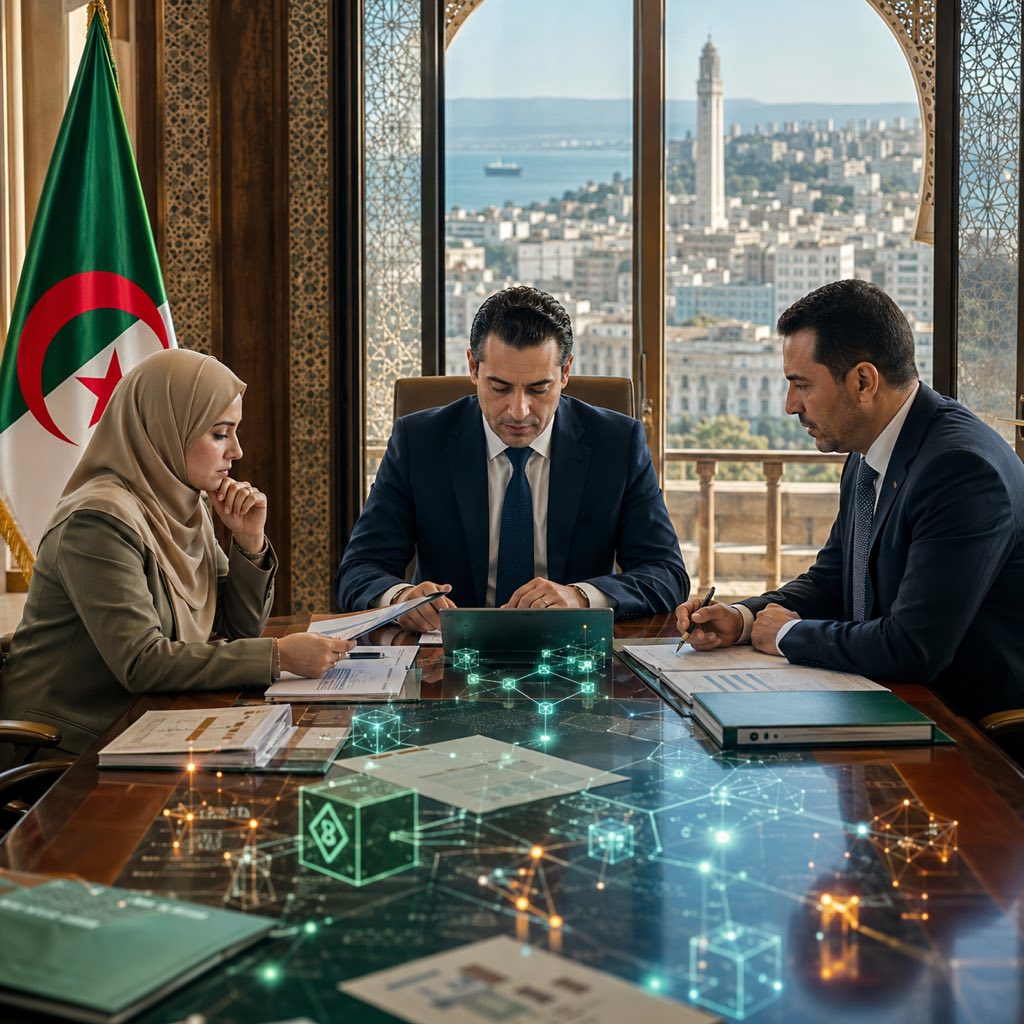
What the Ban Actually Prohibits — and What It Does Not
Law 25-10, published in Algeria’s Official Journal No. 48 on July 24, 2025, is one of the world’s most comprehensive cryptocurrency prohibitions. According to Lightspark’s legal analysis of Algeria, the law criminalizes possession, trading, mining, promotion, wallet operation, and any intermediary services related to digital assets — defined broadly to include Bitcoin, Ethereum, stablecoins, and utility tokens.
The law’s enforcement coalition is multi-agency: the Bank of Algeria, the Ministry of Finance, the Financial Intelligence Unit (CTRF), ARPCE (the telecom regulator), and law enforcement bodies all have authority to investigate and prosecute violations. Penalties range from 200,000 to 1,000,000 DZD for first-time violations and include prison sentences for activities involving money laundering or terrorism financing.
What Law 25-10 does not prohibit is blockchain as an underlying technology. The law’s prohibition is tied to three elements: a digital asset denominated in value, currency-like functions (payment, investment, speculation), and public or permissionless network participation. A permissioned blockchain that records supply chain events, verifies document authenticity, or manages digital identity claims — with no tradeable token and no currency function — does not meet the statutory definition of the prohibited activity.
This is not a loophole. It is the structure of the law. Algerian regulators consciously drew the line at currency speculation, not at distributed ledger technology itself, consistent with the FATF framework that drove the ban in the first place. The Digital Policy Alert’s Algeria digest confirms that Algeria’s approach aligns with the FATF’s guidance distinguishing high-risk virtual asset service providers (prohibited) from enterprise DLT applications (not in scope).
Three High-Value Blockchain Applications That Fit the Legal Frame
1. Supply Chain Provenance and Authenticity Verification
Algeria’s industrial economy — dominated by Sonatrach, Sonelgaz, and large public enterprises in steel, pharmaceuticals, and agriculture — generates enormous volumes of supply chain transactions where provenance and authenticity are commercially significant. A permissioned blockchain recording the origin, handling history, and certification status of goods (from pharmaceutical batches to oil equipment components) creates an immutable audit trail without any token or currency element.
The commercial model is an enterprise SaaS subscription or a per-transaction API fee paid by the supply chain participants — manufacturers, logistics operators, customs authorities, and quality certifiers. No token is issued; no public network is involved; the blockchain is a database with cryptographic integrity properties. UNCTAD’s investment policy monitor for Algeria notes Algeria’s increasing focus on import substitution and domestic production verification — exactly the context in which supply chain provenance technology creates regulatory and commercial value.
The target sales channel for supply chain blockchain in Algeria is enterprise procurement — specifically, the large public enterprises and their tier-1 suppliers that face increasing documentation requirements for quality and origin certification. A pilot with a single Sonatrach subsidiary or a pharmaceutical importer creates the reference case needed to expand across the supply chain.
2. Digital Identity and Credential Verification
Algeria’s digital identity infrastructure is actively developing — national ID cards, professional certifications, academic credentials, and business registration documents are all moving toward digital formats. A permissioned blockchain managing the issuance and verification of these credentials solves a genuine institutional pain point without any currency element.
The application: a university issues a digitally signed credential on a permissioned blockchain. An employer or licensing body can verify the credential’s authenticity in seconds without contacting the issuing institution. The blockchain provides tamper-evidence; the institution retains control of issuance. No token, no trading, no currency function — pure identity infrastructure.
Algeria Invest’s analysis of digital banking conditions and perspectives highlights the identification and KYC challenge as a central bottleneck for financial inclusion. A blockchain-based credential layer could serve as the identity verification foundation for digital banking products, mobile wallets, and e-government services — without any of the currency functions that Law 25-10 prohibits. The commercial model is a per-verification fee or a government procurement contract.
3. Document Authentication for Legal and Administrative Processes
Algeria processes millions of official documents annually — notarial acts, property registrations, commercial contracts, import licenses, professional qualifications. Forgery and document fraud create friction and cost across both public and private sectors. A permissioned blockchain anchoring the hash of a digitally signed document creates a tamper-evident audit trail that any authorized party can verify in real time.
This application has a natural government procurement pathway: the Ministry of Justice, the Ministry of Commerce, ANIREF (the national investment agency), or individual wilayas could procure a document authentication system as an infrastructure investment. The startup’s role is to build the platform, manage the cryptographic infrastructure, and provide the verification API. Revenue is a combination of implementation fees, annual maintenance contracts, and per-verification API pricing for private-sector users.
Advertisement
How to Structure a Legally Defensible Blockchain Product in Algeria
The practical distinction between a compliant blockchain application and a prohibited crypto product comes down to three design choices that should be documented before development begins.
First, the network must be permissioned — access is granted by a central authority (the startup, the enterprise client, or a consortium), not open to any participant. Public blockchain networks like Ethereum are operationally prohibited because they require interoperating with a public virtual asset ecosystem. Private networks using established permissioned blockchain frameworks present no such issue.
Second, the application must have no tradeable token. The Law 25-10 prohibition centers on “digital assets” — items that can be purchased, sold, held as investment, or used for speculation. A system that records events (supply chain checkpoints, credential issuances, document hashes) without issuing any tradeable asset is not operating in the prohibited space. If a business model requires any form of on-chain incentive mechanism, legal counsel should be obtained before implementation.
Third, the commercial terms must be in Algerian dinars or other recognized currencies. Payment for blockchain services — subscriptions, API fees, implementation contracts — must occur through the regulated financial system. No payment in cryptocurrency or stablecoin, even as an intermediate settlement mechanism, is permissible under Law 25-10.
The Structural Lesson
Law 25-10 is ultimately about controlling the intersection of technology and monetary sovereignty — a concern that every central bank globally shares, whether or not they respond with a blanket prohibition. The FATF grey listing, which drove the law’s timing, is specifically about AML/CTF risk from pseudonymous, cross-border value transfer — not about distributed database technology.
Algerian fintech builders who treat the crypto ban as an end-state rather than a boundary condition will miss the genuine technology market that the legal clarity creates. The prohibition eliminates speculative and currency applications but leaves permissioned enterprise blockchain fully accessible. In markets where the regulatory boundary is ambiguous — as it is in most countries — the compliance risk premium is high and enterprise adoption is slow. In Algeria, the boundary is clear: build applications that serve business process integrity, not currency speculation, and the technology is entirely legal.
The 2026 opportunity is to build reference implementations in the three verticals — supply chain, digital identity, document authentication — establish pilot clients in the public or private sector, and be positioned as the domestic expertise center when broader digital transformation contracts come to market. The founders who understand Law 25-10 precisely enough to work confidently within it will have a clean field; those who wait for the legal environment to become “more permissive” will find the reference positions already occupied.
Frequently Asked Questions
Can an Algerian startup use Ethereum or Solana as the underlying blockchain network for a compliant application?
No. Public blockchain networks like Ethereum and Solana require interoperating with a public virtual asset ecosystem — nodes participate in a network where the native token (ETH, SOL) has monetary value and can be bought, sold, or held. Law 25-10’s prohibition extends to operating infrastructure that is part of a digital asset ecosystem, even if the startup’s specific application does not involve trading. Compliant Algerian blockchain applications should use permissioned frameworks: Hyperledger Fabric, Quorum, or private deployments of public blockchain clients with full access control. Legal counsel should review the architecture before deployment.
Does Law 25-10 prevent Algerian startups from working with international blockchain companies as technology partners?
Law 25-10 prohibits Algerians from participating in virtual asset activities — not from using blockchain software developed internationally. An Algerian startup can license Hyperledger Fabric (developed under the Linux Foundation), use IBM Blockchain Platform (an enterprise product), or engage a European system integrator to help build a permissioned network — as long as the resulting application does not involve a tradeable digital asset or currency function. The prohibition is activity-based, not technology-source-based.
What is the safest first industry vertical for an Algerian blockchain startup to target in 2026?
Document authentication for the legal and administrative sector is the safest and most direct entry point. The enterprise client (a ministry, a notarial chamber, or a wilaya administration) is well-defined; the use case is purely integrity-oriented with no currency element; the government procurement pathway is established; and the competitive landscape is essentially empty of domestic providers. A working pilot with a single notarial chamber or a wilaya document registration office creates a public-sector reference that accelerates adoption across the market.
—
Sources & Further Reading
- Is Crypto Legal in Algeria? — Lightspark
- Digital Banking in Algeria: Conditions, Requirements, and Perspectives — Algeria Invest
- Algeria Issues Decrees Related to New Investment Law — UNCTAD Investment Policy Monitor
- Digital Policy Alert Algeria Digest — Digital Policy Alert
- Algeria Data Protection and Cybersecurity Laws — CMS Law
🔗 Related Intelligence

Algeria’s Crypto Ban: What Law 25-10 Means for Blockchain, Fintech, and Innovation

Algeria Post-Crypto-Ban: CBDC Research and the Enterprise Blockchain Question

Algeria’s Crypto Ban: How Law 25-10 Reshapes Fintech Product Strategy in 2026

Algeria’s Crypto Ban Under Law 25-10: Regulated Digital Finance Channels That Remain Open