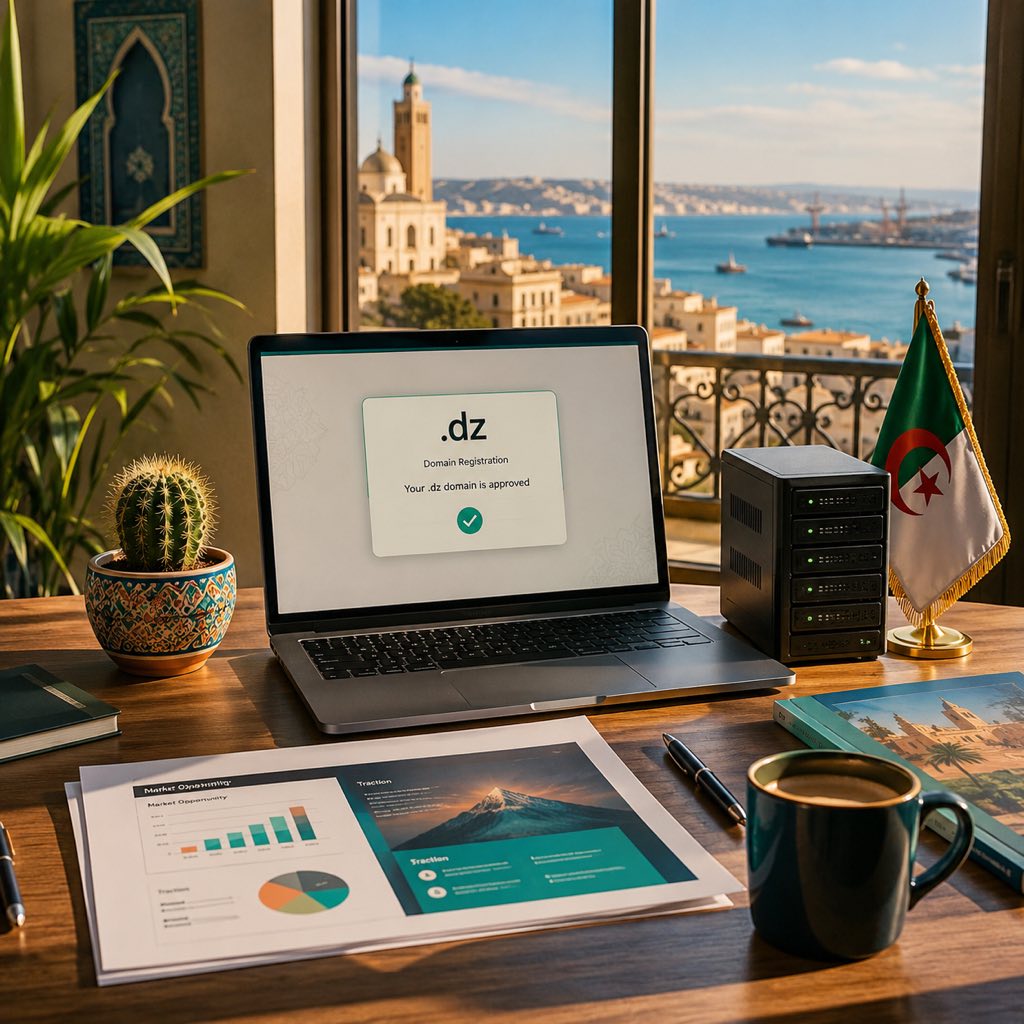
The Law That Changed Algeria’s E-Commerce Landscape
Eight years after its passage, Law No. 18-05 of May 10, 2018 on electronic commerce is no longer dormant. Algerian authorities have moved from promulgation to enforcement, and every online retailer, marketplace operator, and SaaS platform serving Algerian customers now faces a clear compliance checklist anchored on two non-negotiable requirements: local server hosting and a registered .dz domain.
The law’s rationale is data sovereignty. Algeria’s approach mirrors frameworks adopted by countries like Singapore and Nigeria — preserving national control over commercial data flows while creating a structured domestic digital infrastructure ecosystem. The Regulatory Authority of Post and Telecommunications (ARPT) underpins the framework, responsible for licensing, fair-competition oversight, and consumer protection in digital services.
For startups and investors, the critical question is not whether this rule applies — it does — but what it concretely requires and what opportunities it unlocks for the providers that support compliance.
What the Mandate Actually Requires
The hosting mandate under Law 18-05 applies to two categories of online operators:
- Sites with a .dz registered domain — regardless of physical server location, the mandate applies
- Sites selling goods or services to Algerian residents — even without a .dz domain, if the business targets Algerian consumers, Algerian law governs the data
For practical purposes, any serious Algerian e-commerce operator needs both: a .dz domain registered through ARPT-approved registrars, and hosting infrastructure physically located within Algerian territory. The DLA Piper Data Protection Guide for Algeria confirms that data localization is embedded in the country’s broader cyber-regulatory framework, extending beyond e-commerce into all sectors handling personal data of Algerian nationals.
Beyond the domain and hosting requirements, compliant platforms must:
- Register with the National Center for the Commercial Register (CNRC) — operating without registration exposes operators to fines and goods confiscation
- Generate electronic invoices meeting national standards
- Integrate certified payment gateways (SATIM is the primary certified provider)
- Maintain transparent pricing, return policies, and GDPR-equivalent privacy notices under Algerian data law
The CMS Expert Guide to Algeria’s Cyber and Data Laws provides additional depth on the data protection overlay, including retention rules and cross-border transfer prohibitions.
Advertisement
What Algerian E-Commerce Startups Should Build For
1. Register the .dz Domain Before Building the Platform
The .dz domain registration process runs through ARPT-approved entities and requires documentation of commercial registration with CNRC. The sequence matters: CNRC registration first, then domain registration, then platform deployment. Founders who build their platform on generic TLDs (.com, .store) and plan to “switch later” routinely discover that replatforming costs 3-5x more than starting correctly. Algeria’s Ministry of Post and Telecommunications guide sets out the approved process, including technical specifications for domain delegation. Start the CNRC registration in parallel with the product build — the administrative process typically takes 2-4 weeks.
2. Select a Locally-Accredited Hosting Provider from Day One
Local hosting is not optional or upgradeable later without service disruption. Several Algerian data center operators now offer compliant infrastructure: Algérie Télécom (the incumbent), DJAWEB, and a growing cohort of private colocation providers. Evaluate on three dimensions: SLA uptime (target ≥99.9%), bandwidth capacity for peak retail periods (Ramadan traffic can spike 3-4x), and security certifications. A provider’s ISO 27001 or equivalent certification is worth requiring contractually — it signals baseline infrastructure maturity and aligns with the cybersecurity overlay in Algeria’s digital regulatory stack.
3. Build the SATIM Payment Integration Before Launch
Non-integration with SATIM (Société d’Automatisation des Transactions Interbancaires et de Monétique) — Algeria’s certified interbank payment system — is the most common compliance gap for early-stage e-commerce platforms. SATIM is not one among many options; it is the mandated payment infrastructure for domestic transactions. The integration API is available for developer testing. Budget 3-6 weeks for SATIM certification testing and compliance sign-off. International payment processors (Stripe, PayPal) are not authorized as standalone domestic payment solutions under Law 18-05’s payment provisions.
4. Document Your Data Flows for Inspection Readiness
Algeria’s enforcement shift from passive to active means inspections are a real operational risk, not a theoretical one. Prepare a data flow map — showing where customer data is collected, stored, processed, and retained — before your first commercial transaction. The Digital Policy Alert Algeria digest documents Algeria’s evolving enforcement posture, including increased coordination between ARPT, the CNRC, and tax authorities. An undocumented data flow is treated as a non-compliant one. Appoint an internal compliance contact and maintain a register of data processing activities — this is now table stakes for any funded Algerian startup.
The Opportunity Side: What the Mandate Creates
The local hosting mandate is generating structural demand for Algerian infrastructure and compliance services — demand that domestic startups and investors are well-positioned to capture.
Hosting and colocation is the most immediate opportunity. Every foreign e-commerce brand entering Algeria (international fashion retailers, SaaS platforms, digital media companies) needs a compliant local hosting arrangement. The market for managed compliance hosting — bundled with CNRC registration advisory and ARPT domain management — does not yet have a dominant player.
Legal-tech compliance tooling is the adjacent opportunity. A platform that automates the CNRC registration workflow, ARPT domain delegation, and SATIM integration checklist — and provides ongoing monitoring for regulatory changes — would address the friction point that delays most new entrants by 4-8 weeks.
Certified payment infrastructure is also expanding. SATIM’s API ecosystem is open for integration partners, and a fintech startup building a developer-friendly SATIM wrapper with modern SDK tooling would reduce the 3-6 week integration timeline by 60-70%.
Where This Fits in Algeria’s 2026 Digital Infrastructure Build
The hosting and .dz domain mandate does not stand alone — it is one layer of Algeria’s multi-year digital sovereignty program. The January 2026 presidential decree No. 26-07, which mandated cybersecurity structures in all public institutions, signals that the government’s posture is consistently moving toward sovereign digital infrastructure across all sectors.
For e-commerce founders, this means the compliance bar is likely to rise, not fall, over the next 24 months. The smart move is to build to a higher compliance standard than currently required — treating ARPT’s current rules as a floor, not a ceiling. For infrastructure investors, the mandate creates a durable demand driver that is policy-anchored and not subject to the typical market cycle volatility.
Algeria’s e-commerce market is at an early but accelerating stage. The U.S. Commercial Service’s Algeria Digital Economy guide identifies the sector as one of the highest-growth areas in the Algerian economy — and the hosting mandate effectively creates a protective ring around domestic providers who build the right infrastructure now.
Frequently Asked Questions
What exactly does “local hosting” mean under Algeria’s Law 18-05?
Under Law No. 18-05, local hosting means that the servers physically storing your platform’s data and serving your application must be located within Algerian territory. Using cloud services from foreign providers (AWS Europe, Google Cloud, Azure) without a locally-sited instance does not satisfy this requirement. Operators must contract with an Algerian data center or colocation provider, such as Algérie Télécom’s infrastructure arm or certified private operators.
Can a foreign company sell to Algerian customers without a .dz domain?
The law applies to any platform selling to Algerian residents, regardless of where the company is incorporated. However, operating at scale in Algeria without a .dz domain also creates practical issues: Algerian customers are more likely to trust a .dz domain, payment processing via SATIM requires local commercial registration, and CNRC registration (required for all commercial operators) implicitly ties the business to Algerian jurisdiction. In practice, serious operators register both the CNRC entity and the .dz domain.
What are the penalties for non-compliance with Law 18-05?
Engaging in e-commerce without CNRC commercial registration exposes operators to financial fines and confiscation of goods. Hosting violations and domain non-compliance can trigger operational suspension orders from ARPT. While the law does not publish a fixed fine schedule for hosting violations, enforcement actions have increased through 2025-2026, with coordination between ARPT, CNRC, and tax authorities reducing the practical gap between violation and consequence.
Sources & Further Reading
- Algeria E-Commerce Law 2026: Comprehensive Guide — Ecommaps
- DLA Piper Data Protection Guide for Algeria — DLA Piper
- Digital Policy Alert: Algeria — Digital Policy Alert
- CMS Expert Guide: Data Protection and Cybersecurity in Algeria — CMS Law
- Algeria Digital Economy Guide — U.S. Commercial Service / Trade.gov
- E-Commerce in Algeria — Reality and Challenges (Law No. 18-05) — ResearchGate
🔗 Related Intelligence

E-Commerce in Algeria: The .com.dz Domain Requirement, Trade Registry

Algeria’s E-Commerce Regulation: What Platform Operators Must Know in 2026

Algeria Foreign Platform Mandate: Local Rep and Hosting Rules as a B2B Opportunity

Algeria E-Procurement Portal: Digital Tender Access for Startups and SMEs in 2026