The Milestone That Changes the Story
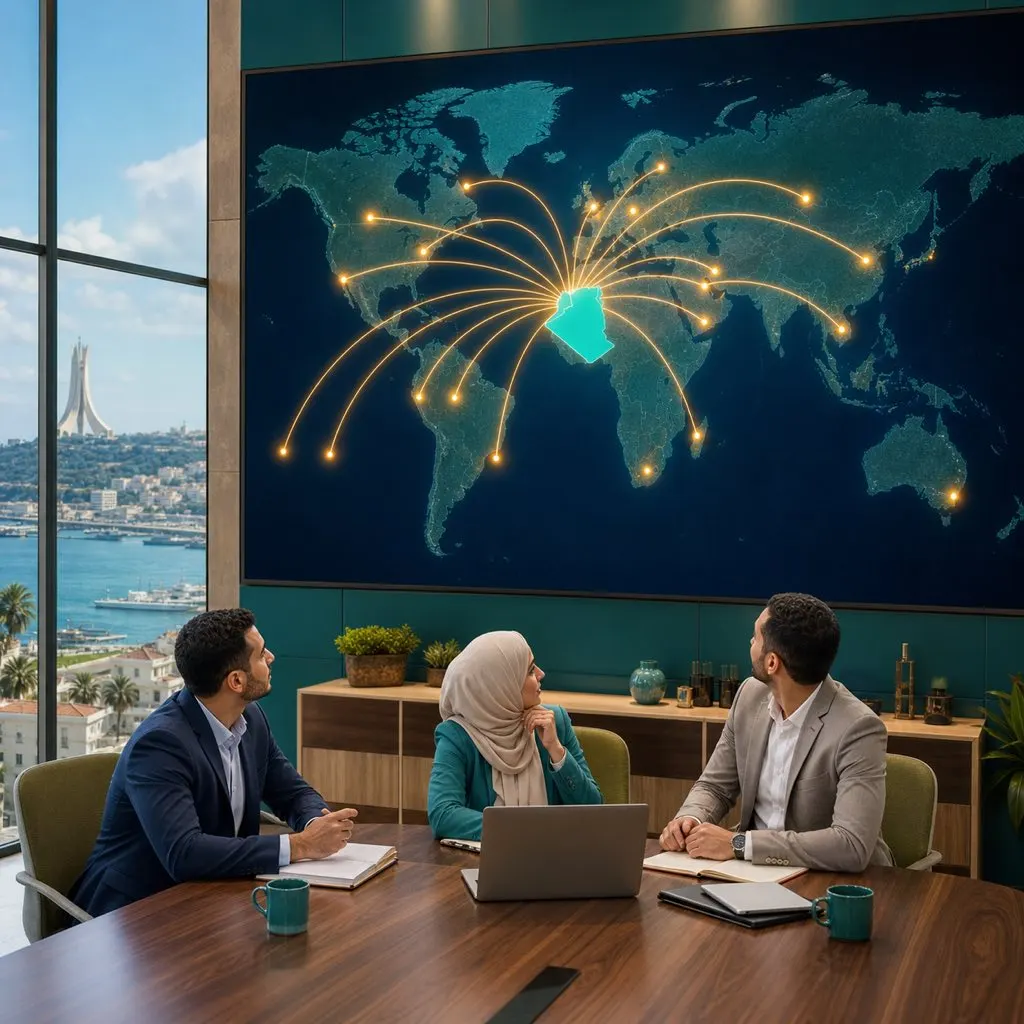
For years, the most common critique of Algeria’s startup ecosystem was that it turned inward — building for a captive domestic market without the ambition or the infrastructure to scale beyond its borders. That narrative has quietly expired. As of 2025, more than 50 Algerian tech companies have established active international presence across at least 19 markets, spanning eight European countries, five Arab and African regions, and six markets in the Americas, according to a landmark export drive coordinated between the Ministry of Foreign Trade and leading state-adjacent institutions.
The signal that crystallised this shift came in December 2025, when travel-tech platform Völz closed a 600 million DZD ($5 million) growth round led by Tell Group and industrial holding Groupe Industriel Babahoum Algérie (GIBA). The round triggered the first successful exit for the Algerian Startup Fund (ASF), which recovered its position at a 3.35x return on investment — the clearest proof yet that the state-backed venture vehicle launched under Executive Decree No. 20-254 can generate liquidity for its portfolio. Völz’s model is instructive: it solves Algeria’s chronic currency control problem by letting users book international flights while paying in Algerian Dinar, with cash-on-delivery rails for the unbanked. It didn’t go global by ignoring Algeria’s constraints — it went global by productising them.
Meanwhile, Yassir, the country’s best-known export, operates in 45 cities across 6 countries, with 8 million users and 100,000 active drivers and merchants — all built on the back of a $150M Series B closed in November 2022 (led by BOND) and total funding reaching approximately $200M. These are not anomalies. They are reference points.
What the 19-Market Push Actually Looks Like
The geographic expansion documented in 2026 is not primarily a tech-startup story — it sits at the intersection of the broader non-oil export acceleration that President Tebboune has designated as a strategic pillar, with 2026 named a “pivotal year for export acceleration.” The export drive spans 35 product categories from agri-food to industrial manufacturing, with companies like Tosyali Algeria, Condor Electronics, and Brandt Algeria leading the charge in hard goods. But tech and service companies are riding the same institutional momentum.
Key facts verified from the current wave:
- 13 wilayas are now active export logistics nodes — Tizi Ouzou, Oran, Annaba, Sétif, and Béjaïa among the most active
- The Ministry of Foreign Trade under Minister Kamel Rezig is coordinating access to priority trade fair slots for labeled startups
- Tech-adjacent exports — software services, SaaS platforms, e-commerce logistics — are being classified alongside physical goods under the non-hydrocarbon export framework
TemTem, the ride-hail and logistics platform, provides another concrete reference: it raised a $4M Series A and now operates across 21 of Algeria’s 48 wilayas with over 200,000 clients and 4,000 active drivers. International expansion is the next stated chapter for the team. The Algerian Startup Fund, with its 2.4 billion DZD capital base and portfolio of over 100 funded startups across 20 sectors, is explicitly designing follow-on investment rounds to support the international phase, offering tiers of 2 million, 5 million, and up to 20 million DZD.
Advertisement
Why Now — and Why This Cohort Is Different
Three structural changes explain why 2025–2026 is a different era from the 2019–2021 era of aspirational internationalism that produced little tangible revenue outside Algeria.
First, the regulatory framework has matured. Executive Decree 20-254 — the founding instrument of the Startup Label system — grants labeled companies VAT and customs exemptions on R&D equipment, R&D tax deductions of up to 30% of expenses (capped at 200 million DZD annually), and access to dedicated public procurement quotas. Free patent filing and trademark registration through INAPI for labeled startups removes a major barrier to protecting IP before entering foreign markets. These are concrete advantages that didn’t exist five years ago.
Second, the funding stack is deeper. The ASF now sits alongside the 1.5 billion DZD Algerie Telecom AI Fund (launched February 2025) and the FCPR private VC framework (minimum 50 million DZD) — meaning a founder can sequence from label-stage angel money through growth capital within a single domestic ecosystem before needing to approach foreign VCs. The Völz exit validates the return trajectory.
Third, the talent pool has broadened. Algeria’s 7,800 registered companies on the startup.dz platform (of which 2,300 hold formal Startup Label status) represent a generation of founders with direct exposure to international sales cycles via the Algerian Startup Expedition Program (ASEP), which provides fully-funded immersion trips to global innovation hubs for labeled founders with demonstrated growth potential.
What Founders Should Do to Reach Market 20
1. Solve a Currency or Banking Constraint — Then Export the Solution
Völz’s playbook is the most replicable template in the ecosystem: identify a friction point in Algeria’s financial infrastructure (currency controls, unbanked population, FX conversion barriers), build a product that resolves it domestically, and discover that the same friction exists in Morocco, Senegal, Côte d’Ivoire, and dozens of other markets. According to data from the Algeria tech ecosystem overview, fintech raised $200 million in 2024 — the single largest sector — precisely because these frictions are monetisable at scale. Founders in logistics, payments, and travel should audit their own constraint-solving IP before pitching a foreign expansion story that ignores their structural edge.
2. Secure the Startup Label Before the First Cross-Border Deal
The Label Startup under Decree 20-254 is not a badge of honour — it is a procurement key. Labeled startups qualify for public procurement quotas in Algeria and, increasingly, benefit from bilateral frameworks that Algeria is negotiating with African Union member states. Founders who delay labeling until after their first international deal forfeit the IP protection incentive (INAPI free filing), the R&D tax deduction, and the ASF follow-on eligibility. The Ministry of Knowledge Economy processes applications within three months; the three-year renewable window starts from approval date. Get the label before the pitch deck goes to a Casablanca or Dubai investor.
3. Use ASEP as a Market Research Sprint, Not Just Networking
The Algerian Startup Expedition Program sends founders to innovation hubs abroad with a mandate to meet investors and accelerators. The highest-return founders treat each ASEP trip as a structured market validation exercise: arrive with a defined hypothesis (“sub-Saharan logistics operators will pay $X/month for our dispatch software”), schedule at least five customer conversations, and return with a signed letter of intent or a documented rejection with reasons. Founders who use ASEP as a tourism exercise miss its core value — the program’s alumni network is the fastest route to MENA-based angel syndicates and African Development Bank-backed accelerators.
4. Build Localisation Into the Product Roadmap Before Scaling
The 19-market push is geographically diverse but linguistically complex — Arabic, French, English, and sub-Saharan languages all appear in the target market list. Algerian startups have a natural advantage in Arabic-French bilingual product design, but founders systematically underinvest in localisation infrastructure (UI strings, payment method routing, local customer support) before signing partnership agreements. TemTem’s expansion across 21 domestic wilayas before moving internationally is the correct sequencing model: localisation muscles built at home are cheaper to flex abroad than ones acquired under expansion pressure.
The Structural Lesson
The 50-company international cohort is significant not because the number is large — it isn’t, relative to Morocco’s 100+ globally active startups or Tunisia’s export-oriented fintech cluster — but because of what produced it. The Völz exit, the ASF’s 3.35x return, the ASEP cohorts, and the 2024 funding surge to $650 million (a 60% year-on-year increase) are all downstream of a single bet made in September 2020: that labeling startups as a formal economic category, exempting them from legacy corporate constraints, and backing them with state venture capital would generate exportable companies within five years. That bet has paid out. The next five years will test whether the infrastructure built for 2,300 labeled startups can scale to the Ministry’s 20,000-by-2029 target — and whether the founders who internationalized in wave one can pull the next cohort through the door they opened.
Frequently Asked Questions
What is the Algerian Startup Fund and how does it support international expansion?
The Algerian Startup Fund (ASF) is a state-backed venture vehicle with 2.4 billion DZD in capital, managing a portfolio of over 100 startups across 20 sectors. It recorded its first successful exit in December 2025 when travel-tech company Völz raised $5M, generating a 3.35x return for the fund. ASF offers tiered follow-on rounds (2M, 5M, up to 20M DZD) specifically designed to support the international growth phase, making it the primary domestic capital source for founders before they approach foreign investors.
How many Algerian startups have expanded internationally and which markets are they targeting?
As of 2025, over 50 Algerian tech and tech-adjacent companies have established international presence across 19 markets, including eight European countries, five Arab and African regions, and six Americas markets. Yassir is the most prominent example, operating in 45 cities across 6 countries with 8 million users. The Ministry of Foreign Trade is coordinating priority trade fair access for labeled startups as part of the 2026 non-hydrocarbon export acceleration program.
What does the Startup Label under Decree 20-254 actually provide?
The Startup Label, governed by Executive Decree No. 20-254 (September 2020), grants labeled companies: VAT and customs exemptions on R&D equipment, R&D tax deductions up to 30% of expenses (capped at 200M DZD/year), access to dedicated public procurement quotas, free patent and trademark registration through INAPI, simplified business creation with no minimum capital, and access to the Algerian Startup Expedition Program. The label is valid for three years and renewable once; companies must be under eight years old and hold at least 50% individual or approved-fund ownership.
—
Sources & Further Reading
- Algeria’s Public Startup Fund Scores First Exit as Travel-Tech Völz Raises $5M — Launch Base Africa
- Algeria Startup Ecosystem in 2025: A Year of Resilience and Transformation — Stats & Market Insights
- Made in Algeria Scales Global Markets: Landmark Export Drive Reaches 19 Countries — DzairTube
- Algeria Tech & AI Startup Scene — AlgeriaTech
- The 6 Most Important Mechanisms Every Algerian Startup Should Know in 2025 — LeanCubator