The Structure of the Bet
The investment announced in April 2026 is more complex than a single headline number suggests. The $40 billion total breaks into two tranches: $10 billion deployed immediately at a $350 billion Anthropic valuation, and a further $30 billion contingent on Anthropic meeting “certain performance targets” — terms that remain undisclosed but likely include model capability benchmarks, enterprise revenue milestones, and deployment scale thresholds.
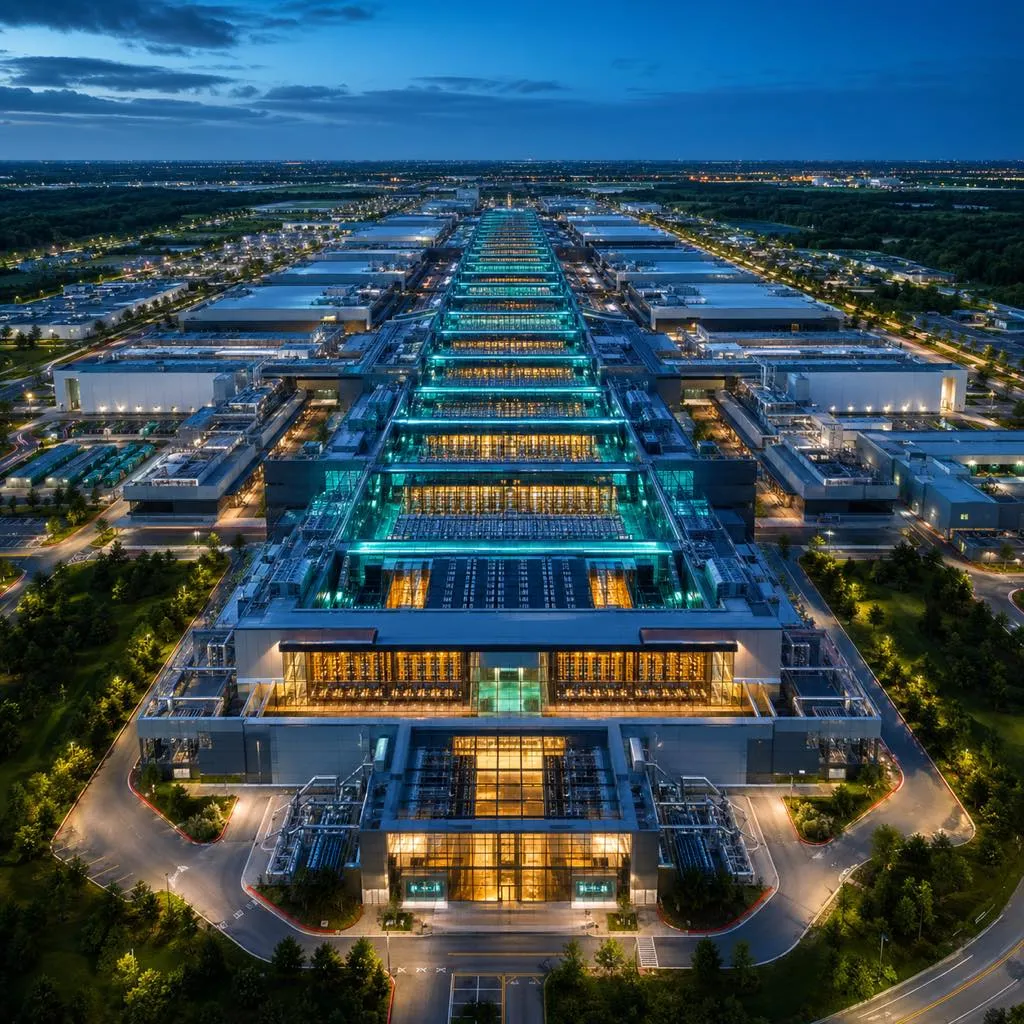
The compute component may be more significant than the cash. Google Cloud is committing 5 gigawatts of computing capacity to Anthropic over five years — a figure that, for context, equals roughly 10% of Google’s entire current global cloud infrastructure capacity. This is layered on an earlier partnership with Broadcom announced in April 2026, which provides 3.5 gigawatts of TPU-based capacity starting in 2027, through a custom-chip arrangement that bypasses NVIDIA’s GPU supply chain constraints.
The combined compute commitment — 5 GW Cloud + 3.5 GW Broadcom TPU from 2027 — positions Anthropic with infrastructure depth that few organizations outside hyperscalers can access. OpenAI, which closed its own $40 billion funding round in early 2025 (valuing OpenAI at $300 billion at the time), has been building its own compute infrastructure through the Stargate programme with Oracle and SoftBank. The AI infrastructure race is now a two-team competition, with each team backed by a distinct compute stack.
Three Signals Hidden in the Structure
The investment structure encodes strategic information beyond the headline valuation. Three signals matter for enterprises and observers trying to understand what this alliance actually represents.
Signal 1: Performance-Contingent Tranches Are a Control Mechanism
The $30 billion contingent tranche is not standard venture or growth equity. Performance-contingent investment at this scale gives Google meaningful influence over Anthropic’s strategic priorities — the specific targets will determine whether Anthropic’s next development cycle prioritizes capability (to hit revenue benchmarks) or safety (to maintain its brand differentiation). Anthropic’s public commitment to Constitutional AI and its conservative ASL safety framework has been its primary enterprise differentiation. If the performance targets are primarily revenue-driven, the contingency structure creates pressure to accelerate deployment at the expense of the extended safety evaluation cycles that produced Claude’s distinctive risk profile. This tension is not theoretical — it is structurally embedded in the deal.
Signal 2: Compute Is the New Equity
Google is not just writing a check — it is providing the infrastructure that makes Anthropic’s next-generation models possible. In 2026, training a frontier-class model requires sustained access to tens of thousands of high-memory accelerators at costs that are only accessible through hyperscaler partnerships or sovereign compute programs. By committing 5 gigawatts over five years, Google is providing what amounts to an infrastructure subscription that Anthropic could not self-fund at any realistic equity valuation. The implication: the AI compute layer is becoming the primary leverage point in the AI stack. Whoever controls the compute controls the capability roadmap. For enterprises evaluating AI vendor independence, the question is no longer “who trained the model?” but “whose infrastructure runs it?”
Signal 3: Enterprise Trust in Claude Is Now Mediated by Google’s Commercial Interests
Anthropic’s Claude has been positioned — and purchased — by enterprise compliance and legal teams as the “safety-first” alternative to OpenAI. The reasoning: Anthropic’s Constitutional AI methodology, its ASL framework, and its reported willingness to withhold dangerous models (Claude Mythos 5, a 10-trillion-parameter model that triggered ASL-4) gave regulated-industry buyers confidence that the model’s outputs are more conservative and auditable. Google’s deep financial and infrastructure entanglement changes the independence calculus. Google is a direct competitor to enterprise software vendors that use Claude (Salesforce, SAP, ServiceNow have all announced Claude integrations). When the primary infrastructure provider is also a direct competitor to key customers, the independence signal that justified Claude’s enterprise premium weakens.
Advertisement
What Enterprise Leaders Should Do About It
1. Build a Two-Vendor AI Strategy Before Consolidation Closes the Window
The OpenAI-Microsoft and Anthropic-Google alliances now cover the two dominant enterprise AI platforms. The window for establishing a genuine two-vendor strategy — maintaining meaningful commercial relationships with both — is narrowing. Enterprises that consolidate entirely on one platform this year will be negotiating renewals from a weaker position in 2027 when the competitive dynamics of the two-horse race have crystallized. Establish production workloads on both platforms now, even if the split is 80/20. The 20% commitment to the secondary vendor is an option, not a cost — it preserves leverage and provides a documented migration path if the primary vendor’s pricing, safety posture, or reliability shifts materially.
2. Re-evaluate Claude’s Safety Premium in the Context of the Google Relationship
If your enterprise chose Claude over GPT-5.5 specifically for its safety profile — conservative output calibration, ASL framework, willingness to decline outputs — the $40 billion Google alliance should prompt a re-evaluation of whether that safety premium is durable. This is not a conclusion that the safety profile has changed: Claude’s Constitutional AI methodology remains intact. It is an instruction to re-examine the assumption that Anthropic’s safety posture will remain fully independent from the commercial interests of its primary infrastructure provider over a 5-year investment horizon. Factor this uncertainty into your 2026–2028 AI vendor roadmap.
3. Watch the Compute Concentration Metric, Not Just the Model Benchmark
Enterprise AI procurement in 2024–2025 was driven by benchmark comparisons: which model scores higher on MMLU, HumanEval, or domain-specific evaluations? The Google-Anthropic compute alliance makes a different metric more important: compute concentration. Who controls the infrastructure that trains and runs the model you depend on? A model trained and served on Google’s infrastructure, by a company 85%+ funded by Google (combining the existing ~30% stake with the new commitment), is a different vendor-independence proposition than a model trained by an independent research organization. For regulated-industry buyers — financial services, healthcare, government — this concentration question has legal and procurement implications that pure capability benchmarks do not capture.
4. Pressure Both Vendors for Contractual Independence Guarantees
As Google’s financial commitment to Anthropic deepens, enterprise buyers should seek explicit contractual guarantees of model independence: confirmation that Claude’s output policies, content restrictions, and safety thresholds cannot be unilaterally changed by Google under the investment agreement. Similarly, enterprises on OpenAI’s Microsoft-integrated stack should seek guarantees that OpenAI’s API terms are not subject to unilateral revision at Microsoft’s direction. These guarantees are more difficult to enforce than to secure in writing — but the act of requesting them surfaces the specific contractual provisions that govern the vendor relationship, and the response (or non-response) from vendors is itself informative.
The Antitrust Question
The Google-Anthropic alliance will attract antitrust scrutiny in at least three jurisdictions: the US (FTC and DOJ have open AI-competition investigations), the EU (Digital Markets Act and the European Commission’s ongoing Big Tech AI review), and the UK (CMA). The specific concern: if Google controls the infrastructure of the #2 enterprise AI provider while also operating Google Cloud as a competing AI platform, it has structural incentives to throttle Anthropic’s performance parity or delay infrastructure availability during critical periods. The compute-as-equity model is new enough that existing regulatory frameworks were not designed for it — but the competitive dynamics are not structurally different from a dominant platform acquiring a would-be competitor while maintaining the appearance of independence.
For enterprises, the regulatory uncertainty is itself a risk factor. A finding that the Google-Anthropic relationship constitutes an anticompetitive arrangement could require structural remedies — forced divestiture of compute commitments, mandated API interoperability — that disrupt enterprise integrations built on the current arrangement. Include this regulatory scenario in your AI vendor risk matrix alongside the more familiar concerns of model deprecation and pricing changes.
Frequently Asked Questions
Why is Google investing in Anthropic when it has its own Gemini model?
Google is running a two-front AI strategy: Gemini as a consumer and enterprise platform under Google’s direct control, and Anthropic as a safety-differentiated enterprise alternative that captures a different buyer segment (compliance-focused enterprises that prefer Claude’s conservative output profile). The Anthropic investment also gives Google strategic information on frontier AI development approaches and secures a major portion of Anthropic’s compute spend on Google Cloud infrastructure. This is not inconsistent — it is the same logic as a platform company owning both a direct product and a strategic stake in a complementary competitor.
What does Anthropic’s $350 billion valuation mean for enterprise AI pricing?
Anthropic’s $350 billion valuation implies significant expected future revenue growth — far beyond current enterprise API pricing levels. To justify this valuation at standard revenue multiples, Anthropic needs to scale enterprise Claude usage by an order of magnitude over the next 3–5 years. This means pricing pressure is likely to increase, not decrease, as Anthropic seeks to demonstrate the revenue trajectory required by its performance-contingent investment targets. Enterprises locking in multi-year Claude contracts now may benefit from pricing certainty before the valuation pressure drives rate increases.
How does the Google-Anthropic alliance affect open-weight AI alternatives?
The alliance accelerates the compute concentration that makes frontier closed models harder to replicate with open-weight approaches. However, DeepSeek V4-Pro’s April 2026 release at $3.48/million tokens — performing within 3–6 months of frontier — demonstrates that open-weight models continue to close the performance gap. The practical implication for enterprises: open-weight models (DeepSeek, Llama, Mistral) become more strategically valuable as a hedge against closed-model vendor concentration, not less.
—