Algeria Hosts a Premier AI and Business Research Forum
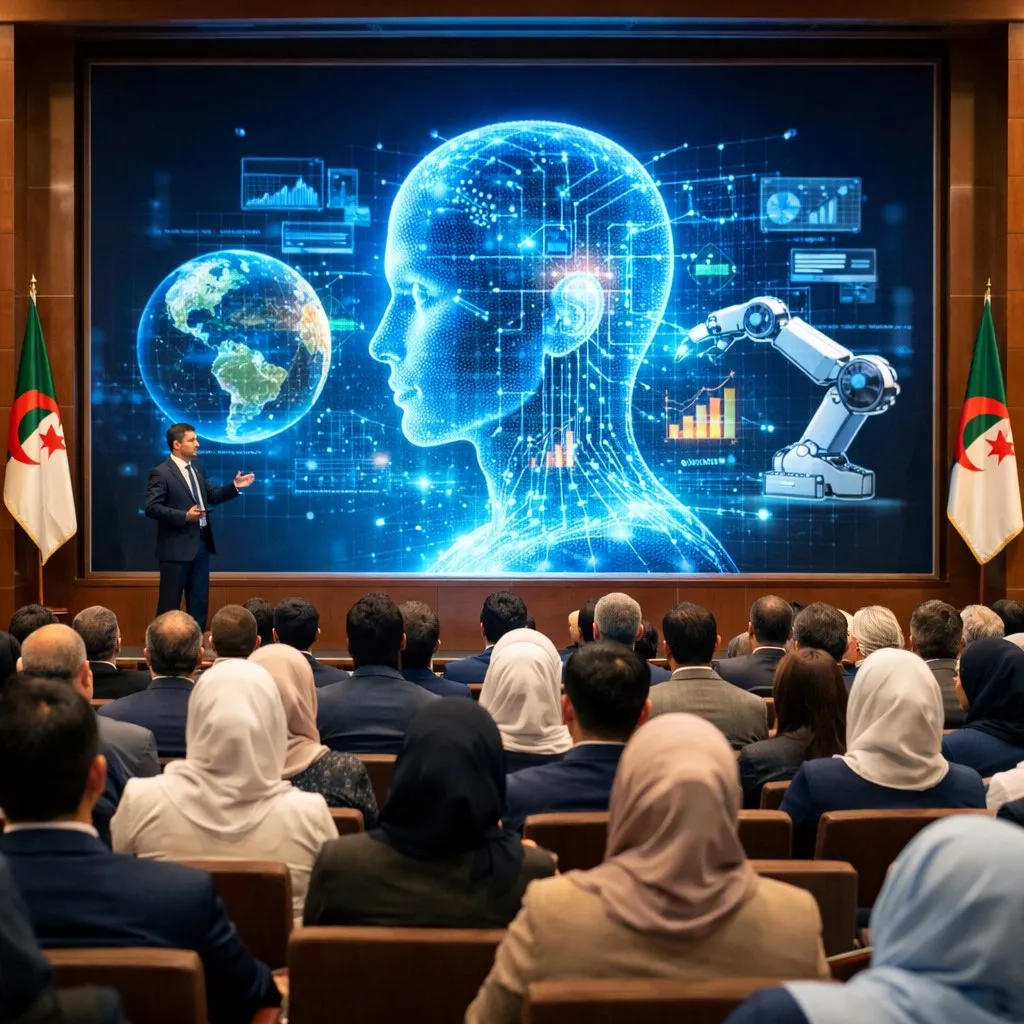
The International Conference on Artificial Intelligence Applications in Business Administration (ICAIABA 2026) opens on April 13-14, 2026, at the University of Biskra. Organized by the Faculty of Economics, Commerce, and Management Sciences, the conference positions Algeria as a venue for serious academic discourse at the intersection of AI and business management — a combination that is reshaping enterprise operations worldwide but remains underexplored in MENA-focused research.
ICAIABA 2026 is not a trade show or startup pitch event. It is a peer-reviewed academic conference where original, unpublished research papers undergo rigorous double-blind review before acceptance. All accepted full papers will be published as proceedings through Atlantis Press, part of the Springer Nature publishing group — one of the world’s most respected academic publishers. This publication pathway gives Algerian and MENA researchers international visibility and indexing in major academic databases.
Conference Scope and Research Themes
The conference targets AI applications across the full spectrum of business administration disciplines. Key research themes include AI in strategic management and corporate decision-making, machine learning applications in human resources and talent analytics, AI-powered marketing automation and consumer behavior analysis, deep learning for financial management and risk assessment, natural language processing for business intelligence, and AI-driven supply chain optimization.
What distinguishes ICAIABA from generic AI conferences is its explicit MENA focus. Papers must address how AI applications function within the economic, regulatory, and cultural context of the Middle East and North Africa region. This means grappling with realities like limited local training data for Arabic-language NLP, regulatory frameworks still catching up with AI deployment, and enterprise technology adoption patterns that differ substantially from Western markets.
Why Biskra Matters for Algeria’s AI Ecosystem
The University of Biskra — officially Mohamed Khider University — is among Algeria’s most active research institutions in the southern regions. Hosting an international Springer-indexed conference signals the university’s ambition to position itself as a research hub beyond the traditional dominance of Algiers, Oran, and Constantine in Algeria’s academic landscape.
Biskra’s selection also reflects a deliberate policy of distributing knowledge-economy events across Algeria’s territory. The SNTN-2030 digital strategy emphasizes that AI and digital transformation should not remain concentrated in coastal cities. With 32,000+ students and growing investment in IT infrastructure, the University of Biskra represents the kind of inland academic institution that Algeria needs to activate to build a nationally distributed AI talent pipeline.
The conference has attracted participation from Istanbul Gedik University (through Erasmus exchange programs), indicating international academic interest that extends beyond the Francophone research networks that traditionally dominate Algeria’s academic partnerships.
Advertisement
Submission Standards and Academic Rigor
ICAIABA 2026 enforces strict submission standards. Papers must not exceed 10 pages including figures and references, with this limit strictly enforced to comply with Atlantis Press formatting requirements. All submissions undergo double-blind peer review — meaning neither authors nor reviewers know each other’s identities — the gold standard for academic integrity.
The submission process follows international norms: authors submit through the conference management system, papers are assigned to at least two independent reviewers with domain expertise, and acceptance decisions are based on originality, methodology, relevance, and presentation quality. Rejected papers receive detailed reviewer feedback, contributing to research quality development even when individual submissions are not accepted.
For Algerian researchers, publication in Springer Nature proceedings is particularly valuable. It provides citable, indexed outputs that count toward academic career advancement under Algeria’s university evaluation system, where international publications carry significantly more weight than domestic conference papers.
AI in Business Administration: The MENA Context
The conference addresses a genuine knowledge gap. While Western literature on AI in business is extensive, research grounded in MENA economic realities remains sparse. Key contextual differences include the dominant role of state-owned enterprises and public sector employment in MENA economies, particularly Algeria where Sonatrach alone represents over 20% of GDP. The informal economy represents a substantial portion of business activity, creating data gaps that challenge AI models trained on formal sector data. Arabic-language business communications require NLP systems that handle dialectal variation, code-switching with French (especially in Maghreb countries), and right-to-left text processing.
Enterprise AI adoption in MENA also faces distinct barriers: smaller average company sizes limit in-house AI expertise, cloud computing infrastructure is less mature than in Western markets, and regulatory clarity around AI-powered business decisions varies widely across the region.
Implications for Algeria’s Digital Economy
ICAIABA 2026 arrives at a pivotal moment for Algeria’s AI ambitions. The country’s National AI Council, chaired by Professor Merouane Debbah, is actively shaping policy. The AI Supercomputing Center under construction in Oran will provide computational resources. And the SNTN-2030 strategy explicitly calls for AI integration across government and enterprise operations.
What Algeria needs alongside infrastructure and policy is a body of locally relevant research — studies that test AI models against Algerian business data, evaluate AI tools in Algerian regulatory contexts, and produce insights that practitioners can actually implement. ICAIABA 2026 aims to seed exactly this kind of research.
The conference also serves as a networking platform, connecting Algerian doctoral students and early-career researchers with established international academics. These connections are particularly valuable for collaborative research projects that can access computational resources and datasets not available within Algeria.
Sources & Further Reading
- ICAIABA 2026 Official Website — University of Biskra
- ICAIABA 2026 Call for Papers — University of Biskra
- ICAIABA 2026 Submission Guidelines — University of Biskra
- ICAIABA 2026 Announcement — Istanbul Gedik University
- ICAIABA 2026 Conference — CFA Point
Frequently Asked Questions
What is ICAIABA 2026?
ICAIABA 2026 is the International Conference on Artificial Intelligence Applications in Business Administration, hosted by the University of Biskra on April 13-14, 2026. It focuses on AI research applied to business management in the MENA region.
Where will accepted papers be published?
All accepted full papers will be published as proceedings through Atlantis Press, which is part of the Springer Nature publishing group. This ensures international visibility and indexing in major academic databases.
Who can participate in the conference?
The conference is open to researchers, doctoral students, and academics from all countries. It has attracted interest from institutions across the MENA region and beyond, including European universities through Erasmus partnerships.