The 939 Billion Dinar Milestone
In February 2026, Algeria’s financial authorities revealed a number that would have been unthinkable five years earlier: electronic payment transactions had reached 939 billion dinars in 2025, representing a 46% increase from 643.8 billion dinars in 2024. For a country where cash has been king since independence, the trajectory is nothing short of extraordinary.
The growth is not coming from a single channel. Online payments surged by a staggering 179% in a single year, reaching 145 billion dinars across more than 27 million transactions in 2025. Point-of-sale (POS) terminal payment values doubled to 89.5 billion dinars. Even ATM withdrawals — still the dominant use of bank cards in Algeria — saw a 19% increase, with over 235 million valid transactions totaling more than 4,397 billion dinars. December 2025 alone marked an exceptional peak of 3.6 million transactions worth 65.27 billion dinars, driven largely by the exclusively online payment of AADL 3 housing program installments.
Behind these numbers lies a fundamental shift in how Algerians interact with their money. The country’s electronic payment terminal (TPE) fleet grew from 68,140 units in December 2024 to 78,774 units by December 2025, a net addition of over 10,000 terminals in twelve months. QR code mobile payment transactions rose 60% year-on-year in the first half of 2024, reaching 26.7 million operations worth 19.6 billion dinars. By end of 2025, intra-bank QR code transactions had reached 69.3 million operations for a total value of 57.3 billion dinars.
The acceleration is all the more remarkable when viewed against the historical baseline. In Q1 2021, there were just 1,782,213 online transactions carried out by CIB and Edahabia cards — a figure that represented a 340% increase over the same period in 2020, but was still negligible in absolute terms. By Q1 2024, mobile payment operations alone had surged to over 12.5 million transactions, a 71% jump from 7.6 million in Q1 2023. The curve is not just growing — it is steepening.
But the real story is not in what has been achieved. It is in what the government plans to do next.
The Five-Pillar Strategy: How Algeria Plans to Kill Cash
On October 18, 2025, then-Bank of Algeria Governor Salah Eddine Taleb made an announcement in Washington that sent a clear signal to the entire financial ecosystem: Algeria would become a cashless society by 2028. The National Payments Committee (NPC), established in 2024 to drive the digitization of financial transactions, had developed a comprehensive roadmap to achieve this goal.
Finance Minister Abdelkrim Bouzred subsequently unveiled the government’s five-pillar strategy in an official response to parliament, laying out the architecture of Algeria’s cashless future:
Pillar 1 — Regulatory Reform: The foundation of the strategy is a complete overhaul of the legal and regulatory framework governing electronic payments. The reform aims to integrate new technologies, formally recognize digital banks and payment service providers (PSPs), and ensure transaction security meets international standards. In August 2025, the Bank of Algeria issued Instruction No. 06-2025, formally establishing rules for PSPs covering digital wallets, agent networks, and consumer protection. This is not cosmetic — it is a structural rewrite of the rules that have kept Algeria’s financial system rooted in paper and cash.
Pillar 2 — Payment Infrastructure: The second pillar focuses on upgrading Algeria’s electronic payment infrastructure through investment in cybersecurity, the creation of national data centers to enhance system resilience, and the launch of the “Mobile Switch” platform — which became operational in June 2024 — to ensure interoperability across all banking institutions.
Pillar 3 — Financial Inclusion: Expanding access to banking services for the millions of Algerians who remain outside the formal financial system. According to the World Bank, 57% of Algerian adults and 71% of women still lack access to even the most basic transaction accounts, while only 16% of adults use digital payments.
Pillar 4 — Merchant Digitization: Incentivizing businesses — especially small merchants, market vendors, and service providers — to adopt electronic payment acceptance. As of 2023, only 3% of businesses were equipped for digital payments.
Pillar 5 — Consumer Education: Building digital literacy and trust in electronic payment systems among the general population.
These measures have already shown early results. Algeria reached a 71% increase in digital financial transactions in the first quarter of 2024 compared to the same period the prior year — a data point that suggests the strategy’s constituent parts are gaining traction even before full implementation.
The strategy is ambitious. But it is backed by legislative force.
The Finance Act 2025: Cash Bans That Bite
The government is not merely encouraging electronic payments. It is making cash illegal for certain transactions.
The Finance Act 2025, enacted in November 2024, bans cash payments for real estate transactions (both built and unbuilt property), vehicle and machinery purchases through concessionaire distributors, insurance premium payments, and luxury goods including yachts and pleasure boats. From January 1, 2025, all such transactions must go through banking and financial circuits using non-cash payment methods — cheques, transfers, or electronic payments. The law also increases stamp duties on cash payments while providing full exemptions for electronic payment receipts.
The motivation is transparent: Algeria’s informal economy is estimated at 30-45% of GDP depending on the methodology used, with the informal sector providing livelihoods for millions of workers who operate entirely in cash. A massive volume of fiduciary currency — exceeding 8,300 billion dinars as of 2023 — circulates outside the banking system. Currency in circulation represents approximately 33-35% of total money supply (M2), far above international norms.
The cash bans target the transactions where the largest sums of untracked money change hands. Real estate, in particular, has long been a vehicle for moving informal economy funds. By forcing these transactions through banks, the government aims to simultaneously combat money laundering, reduce tax evasion, and bring households into the formal financial system.
But banning cash at the top end of the economy is the easy part. The harder challenge is at the bottom — the millions of small merchants, market stalls, and service providers who have never had a payment terminal and cannot afford one.
DZMobPay: From 7 Banks to 15 — The Mobile Payment Expansion
Algeria’s mobile payment infrastructure has been building momentum since January 2025, when the DZMobPay system launched with seven banks and Algerie Poste. The system enables QR code-based payments that work across banking institutions — a customer of BNA can pay a merchant who banks with CPA, with the transaction settling in seconds.
The initial participating institutions included BNA, CPA, BDL, BEA, CNEP-Banque, Algeria Gulf Bank (AGB), and Al Salam Bank, with Algerie Poste offering access through its Baridi Mob application. By the end of 2025, BADR and Fransabank Algerie joined the network, bringing the total to nine. As of November 2025, the system had attracted 79,130 users and 11,873 merchants since its launch.
But the GIE Monetique (Groupement d’Interet Economique de la Monetique), which manages Algeria’s interbank payment infrastructure, has announced plans to extend interoperability to 15 banking establishments in 2026. This expansion will bring nearly every major Algerian bank into the DZMobPay ecosystem, creating a truly universal mobile payment network.
The interoperability is the critical feature. Previous mobile payment attempts in Algeria failed because they were siloed — a BNA customer could only pay BNA merchants. DZMobPay eliminates this friction. A customer scans a QR code, the payment processes regardless of which bank either party uses, and the merchant receives credit. No hardware required on the merchant side beyond a printed QR code.
For the country’s more than 20 million active bank card holders — 16.2 million Edahabia cards and 4.3 million CIB cards as of April 2025 — DZMobPay represents the first real alternative to cash for everyday transactions.
Advertisement
SoftPos: The Game-Changer for Small Merchants
But the most transformative technology in Algeria’s cashless arsenal has not yet launched. SoftPos — the ability to turn any NFC-enabled smartphone into an electronic payment terminal — is scheduled for deployment by end of 2026.
To understand why SoftPos matters, consider the economics of payment acceptance in Algeria today. A traditional TPE (terminal de paiement electronique) costs between 30,000 and 80,000 dinars to purchase or lease, plus monthly connectivity and maintenance fees. For a small merchant earning 50,000 dinars per month — a vegetable seller at a local market, a VTC driver, a street-food vendor — this investment is prohibitive. The result: Algeria’s 78,774 TPE terminals serve a country of 46 million people, a ratio that leaves vast swaths of the economy cash-only by default.
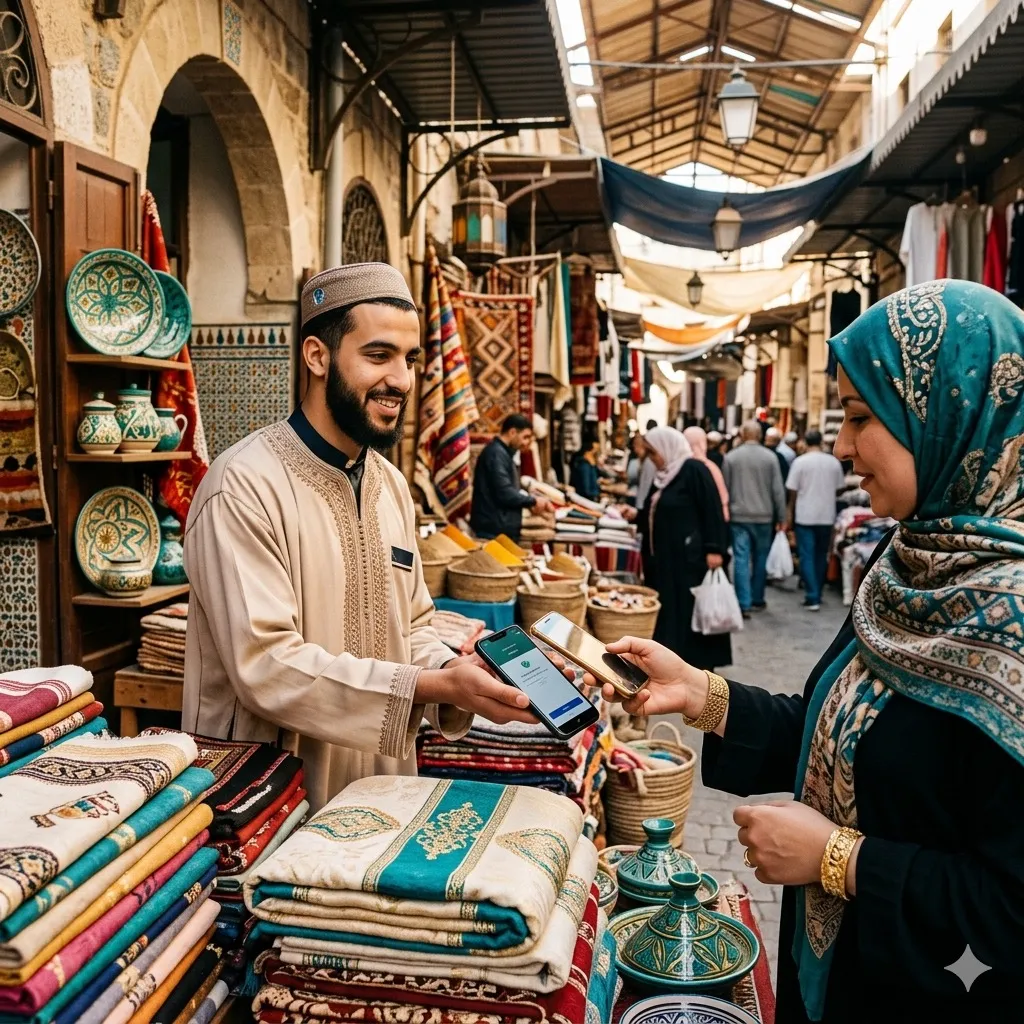
SoftPos eliminates the hardware barrier entirely. A merchant downloads an app, registers their bank account, and their existing smartphone becomes a contactless payment terminal. A customer taps their bank card or NFC-enabled phone against the merchant’s device, and the transaction completes. No dedicated hardware. No upfront investment. No maintenance contracts.
The technology is already proven in the region. Egypt’s Central Bank greenlit full SoftPos rollout in February 2026 after a two-year pilot phase, and the technology has been deployed across Europe, the Gulf states, and parts of Southeast Asia. Algeria’s implementation, managed by GIE Monetique, will be among the first in North Africa.
The potential impact is enormous. If even a fraction of the country’s estimated 1.5 million small businesses adopt SoftPos, the number of payment acceptance points could multiply several-fold within months of launch — dwarfing the current TPE fleet.
For specific use cases, the impact could be transformative: VTC drivers who currently handle cash in traffic, delivery personnel who manage COD payments, market vendors who deal exclusively in bills and coins, freelancers and independent professionals who have no payment infrastructure. SoftPos turns every one of them into a digital payment endpoint.
The implications for Algeria’s e-commerce sector are equally significant. The country’s online commerce ecosystem is heavily dependent on Cash on Delivery (COD), with merchants absorbing the financial risk of refused deliveries and double shipping costs. SoftPos could enable a hybrid model where delivery personnel accept contactless card payments at the door — preserving the convenience of home delivery while eliminating the cash handling, counterfeit risk, and exact-change problems that plague COD operations. For delivery companies like Yalidine, Maystro, and ZR Express, equipping drivers with SoftPos-enabled smartphones rather than cash collection pouches would reduce operational risk and accelerate the reconciliation of daily collections.
The Scale of the Challenge: 8,000 Billion Dinars Outside Banks
The ambition is clear. The question is whether the infrastructure and cultural shift can happen fast enough.
Algeria’s cash economy is not a minor inefficiency — it is a structural feature of the national economy. Over 8,300 billion dinars circulated outside the banking system in 2023, a figure that has risen steadily from approximately 5,438 billion dinars at end of 2019. The informal sector accounts for a significant share of Algeria’s non-hydrocarbon economy, providing livelihoods for millions of workers who operate entirely in cash.
The parallel foreign exchange market compounds the problem. While the official exchange rate hovers near 151-152 dinars per euro, the parallel market trades at approximately 260-280 dinars per euro — a premium exceeding 70%. This dual-rate system creates powerful incentives to keep transactions off the books, as formal banking channels use the official rate while real economic activity often references the parallel rate.
Banking penetration itself remains a challenge. The overall banking penetration rate is less than 50%, meaning that roughly half the adult population does not have a bank account. Even among those who do, many use their accounts primarily for salary deposits and ATM withdrawals, rarely engaging with electronic payment features.
The trust deficit is real. Research on Algerian consumer behavior consistently identifies distrust of electronic payment security as a primary barrier to adoption. Years of limited digital payment infrastructure have created a chicken-and-egg problem: merchants do not invest in payment terminals because customers pay cash, and customers do not adopt digital payments because merchants do not accept them.
What Must Go Right for 2028
The 2028 cashless target is aggressive by any measure. Singapore’s Smart Nation initiative, launched in 2014, achieved majority-digital payment status only after nearly a decade of sustained investment. Algeria is attempting a comparable transformation in three years, starting from a far lower baseline.
Several critical factors will determine whether the target is achievable:
SoftPos must launch on time and at scale. The end-2026 timeline is tight, and any delay pushes merchant adoption into 2027, leaving barely twelve months before the 2028 target. GIE Monetique must ensure the technology works reliably across Algeria’s diverse smartphone fleet and mobile network conditions.
The 15-bank DZMobPay expansion must deliver seamless interoperability. Technical issues with QR code payments — failed transactions, delayed settlements, user interface confusion — could undermine trust at the exact moment the government is asking consumers to abandon cash.
Consumer education must reach beyond urban centers. Algeria’s digital payment adoption is concentrated in Algiers, Oran, and Constantine. The wilayas of the interior and south — where cash dominance is most entrenched — require targeted outreach campaigns in Arabic and Tamazight.
The Finance Act cash bans must be enforced. Legislation without enforcement is merely aspirational. Real estate transactions, in particular, have long involved under-the-table cash payments that supplement official declared prices. Whether tax authorities have the capacity and political will to enforce the new rules will determine whether the bans change behavior or become dead letters.
Cybersecurity infrastructure must keep pace. Algeria’s 2025-2029 National Cybersecurity Strategy mandates security audits for critical infrastructure including financial systems. With Kaspersky recording more than 70 million cyberattacks targeting Algeria in 2024, a single high-profile security breach in the payment system could set adoption back by years.
Lessons from Global Cashless Transitions
Algeria is not the first country to pursue an aggressive cashless agenda, and the experiences of other nations offer both encouragement and cautionary lessons.
Saudi Arabia set a 70% cashless transaction target for 2030 as part of Vision 2030, starting from a baseline of roughly 36% in 2019. By leveraging mandatory merchant payment acceptance rules, aggressive fintech licensing, and a national digital identity system, the Kingdom reached 70% cashless transactions by 2023 — hitting its target seven years early. The Saudi experience suggests that regulatory mandates combined with infrastructure investment can accelerate adoption faster than market forces alone.
Singapore, often cited as the gold standard for digital payments, achieved its cashless transition through a decade-long, multi-stakeholder approach. The PayNow system — Singapore’s equivalent of DZMobPay — launched in 2017 and reached 4.9 million registrations by end of 2020 in a population of about 5.9 million, by linking mobile numbers to bank accounts. The lesson for Algeria: interoperability and simplicity are more important than the number of features.
Kenya’s M-Pesa demonstrates that mobile payments can leapfrog traditional banking infrastructure entirely. Launched in 2007, M-Pesa now processes transactions with a value that exceeds Kenya’s annual GDP. But M-Pesa succeeded in an environment of extremely low banking penetration — Algeria’s situation is different, with an established but underutilized banking sector.
The common thread across all successful transitions is sustained political commitment, consistent regulatory pressure, and a relentless focus on reducing friction for end users. Algeria’s five-pillar strategy echoes these elements. Whether it can execute at the speed required to meet its 2028 target will depend on implementation discipline as much as policy design.
The Bigger Picture: Digital Economy Transformation
Algeria’s war on cash is not happening in isolation. It is one front in a broader digital economy transformation that includes the country’s accession to the Pan-African Payment and Settlement System (PAPSS) in August 2025, the hosting of the Intra-African Trade Fair (IATF2025) in Algiers in September 2025, and the government’s stated ambition to diversify the economy beyond hydrocarbons.
The 939 billion dinar milestone matters because it proves that the infrastructure works and that Algerians will use electronic payments when the option exists. The 179% surge in online payments is particularly telling — it suggests that digital commerce demand was always there, waiting for the infrastructure to catch up.
The SoftPos launch in late 2026 could be the tipping point. By removing the hardware barrier that has kept millions of small merchants locked into cash-only operations, it addresses the single biggest structural obstacle to cashless adoption. If a vegetable seller at Bab El Oued market can accept payment with the same phone he uses for WhatsApp, the cashless society stops being a government aspiration and starts being a lived reality.
The 2028 target may be ambitious. But the trajectory — from 643.8 billion to 939 billion in a single year, from 7 banks to 15, from dedicated TPE hardware to any smartphone — suggests that Algeria’s war on cash is not merely declared. It is being fought on every front simultaneously.
Frequently Asked Questions
How did Algeria’s e-payment volume surge from 643 billion to 939 billion dinars in a single year?
The 46% year-over-year increase to 939 billion dinars in 2025 was driven by the government’s five-pillar cashless strategy, the expansion of the DZMobPay mobile payment platform, and the growing network of electronic payment terminals managed by GIE Monetique. The push included mandatory digital payment acceptance for certain merchants and the integration of digital wallets with the national banking infrastructure, creating multiple channels for electronic transactions beyond traditional card payments.
What is SoftPos technology and why could it be a breakthrough for Algeria’s millions of small merchants?
SoftPos (Software Point of Sale) turns any NFC-enabled smartphone into a contactless payment terminal, eliminating the need for dedicated hardware. For Algeria, where traditional POS terminal deployment has been slow due to cost and logistics barriers, SoftPos could bring millions of small merchants — from neighbourhood epiceries to market vendors — into the digital payment ecosystem. The technology is expected to launch by end-2026 and could dramatically accelerate the government’s 2028 cashless target by removing the hardware bottleneck that has limited acceptance points.
How does Algeria’s cashless strategy address the estimated 6,000+ billion dinars circulating outside the banking system?
Algeria’s massive informal cash economy — with trillions of dinars circulating outside banks — is being targeted through a combination of incentives and mandates. The five-pillar strategy includes expanding DZMobPay adoption, deploying SoftPos to lower the barrier for merchant acceptance, requiring digital payment options in specific sectors, and building financial literacy programs. The goal is to make digital payments so convenient and ubiquitous that cash becomes less practical, gradually channeling informal liquidity back into the formal banking system by the 2028 deadline.
Sources & Further Reading
- E-payments: 939 billion dinars in 2025, up 46% — Algeria Invest
- Aim is to go cashless by 2028, says Bank of Algeria Governor — APS
- Algeria Declares War on Cash: A National Plan — News Tunisia
- Paiement mobile: l’interoperabilite elargie a 15 banques en 2026 — Algerie Eco
- Real estate, vehicle, and insurance transactions: end of cash — Algeria Invest
- CBE greenlights full rollout of SoftPos — Enterprise Egypt
- How digital financial services can provide a path toward economic recovery in Algeria — World Bank
- Algeria: Significant Surge in Mobile Payments in Q1 2024 — Mobile Money Africa
- What solutions to the gap between official and parallel exchange rates — Financial Afrik
- Bank of Algeria joins PAPSS network — Afreximbank
- Saudi Central Bank: Driving Transformation in Digital Payments — International Banker
- Algeria’s Payment Rails & How They Work — Transfi