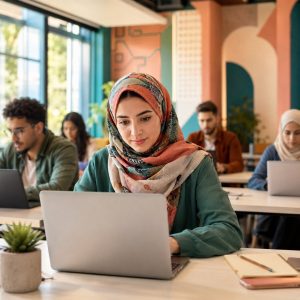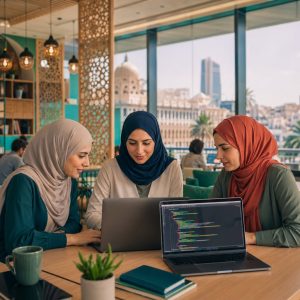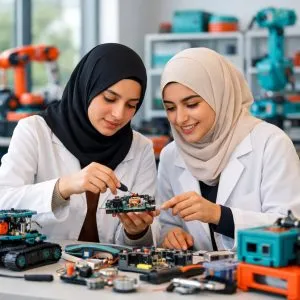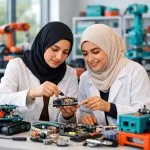
By several measures, Algeria is a genuine outlier on gender and education. More than 60% of university students are women. In STEM fields specifically, women earn roughly 41% of degrees — a figure that exceeds most countries celebrated for gender equality. In engineering, the share reaches 48.5%, the highest in the Arab world. And in the natural sciences, mathematics, and statistics, women earn close to 70% of postgraduate degrees — a figure that dwarfs the OECD average of 54% and surpasses many Nordic benchmarks.
The World Economic Forum’s Global Gender Gap Report 2025 captures Algeria’s paradox in two numbers: an Educational Attainment sub-index score of 0.974 (near-perfect parity) alongside an Economic Participation and Opportunity score of just 0.463. Algeria ranks 141st out of 148 economies overall. Men participate in the formal workforce at nearly four times the rate of women. Female employment in the technology sector, while growing, remains well below the share that Algeria’s educational achievement would predict. The pipeline is full; the funnel is broken somewhere between graduation and employment.
Understanding where the gap occurs — and what can close it — is the central question this article addresses.
Algeria’s Educational Achievement: The Global Context
To appreciate Algeria’s situation, it helps to understand how unusual its educational gender profile is globally. The WEF Global Gender Gap Report 2025 documents persistent gaps in STEM education across most of the world. Even in Nordic countries often celebrated for gender equality, women represent less than 35% of ICT graduates — Finland manages just 19.2%, Norway 20.3%. In the United States, women earn approximately 20% of computer science degrees.
Algeria’s roughly 41% female share of STEM graduates, and 48.5% in engineering specifically, represents a structural inversion of this global pattern. Researchers have termed this the “gender equality paradox” — the observation that some countries with lower overall gender equality indices paradoxically produce higher proportions of female STEM graduates than highly egalitarian nations. Several factors explain Algeria’s position:
Historical investment in female education: Post-independence Algeria made universal education a national priority. Girls’ enrollment rates grew rapidly from the 1970s onward, supported by free university education and student stipends that reduced economic barriers. Today, women represent more than 60% of all university students and earn around 50% of degrees in exact sciences such as physics, chemistry, and mathematics.
Cultural alignment of education with female achievement: In many Algerian families, academic achievement is understood as an appropriate and respected pathway for daughters, even in households with more conservative social norms around work and public life.
Relative safety and structure of university environments: For families concerned about daughters’ safety in mixed professional environments, universities offer a more controlled setting than many workplaces.
STEM as a prestige pathway: In Algeria, as in other North African and Middle Eastern contexts, STEM fields — particularly medicine, pharmacy, and engineering — carry high social prestige. For ambitious young women from middle-class families, these are natural aspirations.
The result is an educational system that consistently produces more female STEM graduates than almost any comparable country. The question is what happens next.
The Workforce Gap: Where Does the Pipeline Break?
The gap between female STEM graduation rates and female workforce participation (roughly 17% of the formal workforce) is one of the starkest contradictions in Algeria’s development profile. No reliable gender-disaggregated employment data exists for Algeria’s technology sector specifically, but the inference is clear: with women earning 41–50% of STEM degrees and constituting under 17% of the labor force, there is a massive drop-off between education and employment. Multiple filtering mechanisms operate at different career stages:
The graduation-to-employment gap: Many female STEM graduates do not enter technology employment directly after graduating. Some pursue public sector roles (teaching, administration, health services) that offer more flexibility and social acceptability. Others marry and shift to managing households, particularly in the first years after graduation when social expectations of young women are most intense.
The transport and safety barrier: Commuting to technology companies in industrial zones, business districts, or locations far from home is a genuine constraint for women in many Algerian cities. Poor public transport infrastructure, safety concerns on late-evening commutes, and family reluctance to support long-distance daily travel create real barriers.
The maternal penalty: Unlike in many European systems, Algeria lacks comprehensive publicly funded childcare for children under 3. For women who become mothers, the choice between continued professional employment and caregiving is made without institutional support — and many choose or are pushed toward caregiving, with career interruptions that are difficult to reverse.
Workplace culture: Technology company cultures in Algeria, as in many markets, can default to norms that are less inclusive of women — informal social dynamics that exclude, assignment patterns that bypass women for high-visibility projects, leadership structures that lack female role models, and in some cases explicit bias in hiring decisions.
Entrepreneurship barriers: Female entrepreneurs face additional layers of difficulty. Access to finance is more limited — lenders are more skeptical of female borrowers, and informal investment networks often exclude women. Family approval for business activities is sometimes required or socially expected. The FCPR venture capital framework is gender-neutral in design but not in practice: the networks through which deals flow remain predominantly male.
Bright Spots: Where Women Are Making Inroads
Despite the structural barriers, women are making measurable progress in Algeria’s technology sector, and several domains deserve attention.
Fintech and digital banking: Algeria’s financial sector, undergoing rapid digitalization, has historically employed more women than traditionally male-dominated sectors like construction or heavy industry. Fintech roles — product management, UX research, data analysis, compliance — attract female graduates in meaningful numbers.
Public sector IT: Government digitalization programs have created IT roles within ministries, agencies, and public institutions where employment conditions (regular hours, formal HR processes, parental leave entitlements) are more compatible with the constraints many female professionals navigate.
Healthcare technology: Digital health startups and hospital IT departments attract female workers from both technology and healthcare backgrounds. The intersection of these two domains is one where Algeria’s high female enrollment in medicine and biology programs creates a natural pipeline.
Education technology: Edtech startups developing content in Arabic, French, and Tamazight for Algerian learners disproportionately attract female talent — perhaps because education is a domain where female professional authority is socially recognized.
Remote and freelance work: The global expansion of remote work has created opportunities for Algerian women who face geographic or family constraints that prevent commuting to a central office. Software developers, UX designers, digital marketers, and data analysts working remotely for international clients can earn international wages while remaining based at home — a model that sidesteps some of the structural barriers while creating others (professional isolation, lack of mentorship, difficulty building local networks).
Women Founders and Entrepreneurs
Algeria’s startup ecosystem, while still young, includes a growing number of female founders — but from a very low base. As of 2018, Algeria had approximately 150,000 women entrepreneurs (excluding liberal professions and agriculture), representing just 7.6% of the country’s 1.96 million total entrepreneurs. Though that figure grew 25% between 2013 and 2018, the starting point remains stark. Only 10% of women entrepreneurs obtained funding from Algeria’s main public support agencies (ANSEJ/CNAC), with most relying on self-financing.
These numbers mirror a regional pattern: across MENA, only 10% of tech startup founders are women — the lowest rate of any global region. Globally, the figure is 15%.
The national startup labeling system (governed by Decree 20-254) is gender-neutral in its criteria — startups are evaluated on innovation, scalability, and viability regardless of founder gender. But the underlying networks through which opportunities flow — introductions to investors, invitations to pitch competitions, informal mentorship from experienced entrepreneurs — are less neutral. Female founders consistently report greater difficulty getting early meetings with investors, being asked different questions during due diligence (more about risk mitigation; less about growth ambition), and receiving smaller initial investments than male-founded companies seeking comparable capital.
Several initiatives are working to change this:
Women-focused accelerator programs: Organizations like Algeria’s women entrepreneurship associations run programs specifically designed for female founders, providing training, network access, and mentorship from experienced women entrepreneurs.
International programs: Global programs like the Tony Elumelu Foundation entrepreneurship program, Google for Startups, and regional initiatives from the EU and African Development Bank all explicitly target gender balance in their Algerian cohorts.
Female role model visibility: Coverage of successful Algerian women in tech — founders, CTOs, lead engineers, researchers — in media like ALGERIATECH helps normalize female success in the sector and signals to younger women that these careers are achievable.
Advertisement
Case for Action: The Economic Argument
The gender gap in Algeria’s technology workforce is not just a social equity issue — it is an economic inefficiency with measurable costs.
Algeria faces a significant technology skills shortage. Employers report difficulty filling cybersecurity, cloud, and AI roles. The vocational training system is expanding to address this. But the fastest and most cost-effective way to expand the talent pool is to close the conversion gap between female STEM graduates and technology employment.
If even 20% of Algeria’s female STEM graduates who currently do not enter technology employment were to do so, the country’s technology workforce would grow by an estimated 15,000–25,000 additional professionals over five years — without building a single new university or training center.
The McKinsey Global Institute estimates that closing gender gaps in labor force participation could add 11–26% to global GDP, with the Middle East and North Africa region showing the highest potential gains at up to 47%. For Algeria, with a GDP approaching $270 billion, even a fraction of that potential represents tens of billions of dollars in economic gains — an extraordinary case for gender inclusion that transcends any individual equity argument.
What Needs to Change: A Policy and Ecosystem Agenda
Childcare infrastructure: Publicly funded or subsidized childcare for children ages 0–3 is the single policy change that would most directly enable female workforce participation across all sectors, including technology. This is also the most resource-intensive, requiring sustained political commitment and budget allocation.
Flexible work mandates: Regulatory requirements for large employers to offer flexible working arrangements — remote options, flexible hours, job sharing — would reduce the logistical barriers that prevent many women from combining professional and family roles.
Gender-disaggregated data: Algeria’s technology sector lacks reliable gender-disaggregated employment data. Without knowing precisely where women are (and aren’t) in the technology workforce, it is impossible to target interventions effectively. A national tech sector gender audit would be a valuable starting point.
Mentorship networks: Structured mentorship programs connecting senior female tech professionals with junior women entering the sector have demonstrable impact on retention and advancement. These require institutional support — from companies, industry associations, or government programs — to reach scale.
Investment in role model visibility: Media coverage, awards programs, and public platforms that celebrate female achievement in technology normalize these career paths and expand the reference set for young women considering their futures.
Entrepreneurship finance reform: Specific financing instruments for female-founded startups — female-focused angel networks, equity crowdfunding with gender balance criteria, blended finance facilities from development banks — can address the funding gap that female entrepreneurs disproportionately face. Increasing the share of women accessing public entrepreneurship funds beyond the current 10% should be an explicit policy target.
A Word to Young Algerian Women in Tech
The structural barriers are real. The workforce gap is real. But the trajectory is moving in the right direction, and the opportunities in Algeria’s technology sector are genuine and growing.
Cybersecurity, cloud engineering, AI development, data analysis, and product management are domains where technical skill, not social network or gender, is the primary determinant of professional impact. These are also domains where Algeria has a structural supply shortage — which means that women who develop deep expertise in these areas will find not just employment but genuine career leverage.
The pioneer effect is real: every female CTO, every female founder who builds a successful company, every senior female engineer who mentors a junior colleague makes the next woman’s journey slightly easier. The investment in being visible, in taking up space, and in opening doors for those behind you is not just personal — it is structural change in action.
Conclusion
Algeria has achieved something rare in the world: an educational system where women earn nearly half of STEM degrees and dominate postgraduate enrollment in the natural sciences. The failure to convert this educational achievement into workforce participation is not a reflection of women’s capabilities or ambitions — it is a reflection of institutional gaps, cultural norms, and structural barriers that are real but not immutable.
The WEF’s numbers tell the story with brutal clarity: Educational Attainment at 0.974, Economic Participation at 0.463. That 0.511-point gap represents hundreds of thousands of talented women whose potential contributions to Algeria’s technology sector remain unrealized.
The economic case for closing the gap is compelling. The tools for doing so are known. What is needed is the political will to build childcare infrastructure, modernize workplace regulations, develop female-focused support programs, and — perhaps most importantly — change the cultural narrative that treats female career ambition as secondary to family roles.
Algeria’s technology future cannot be built at full potential without the full participation of half its talent.
Frequently Asked Questions
What is women in tech in algeria?
Women in Tech in Algeria: A Global Leader in Education, Lagging in the Workplace covers the essential aspects of this topic, examining current trends, key players, and practical implications for professionals and organizations in 2026.
Why is women in tech in algeria important for Algeria?
This topic is significant for Algeria because it intersects with the country’s digital transformation goals, economic diversification strategy, and growing technology ecosystem. The article provides specific context for Algerian stakeholders.
How does algeria’s educational achievement: the global context work?
The article examines this through the lens of algeria’s educational achievement: the global context, providing detailed analysis of the mechanisms, trade-offs, and practical implications for stakeholders.
Sources & Further Reading
- Benchmarking Gender Gaps 2025 — World Economic Forum Global Gender Gap Report
- Latest Women in STEM Statistics for 2025 — Women in STEM Network
- 100+ Women in STEM Statistics 2025 — AIPRM
- How Some Countries Are Bucking the Tech Gender Gap — Geneva Solutions
- Share of Graduates by Field, Female (%) — World Bank Gender Data Portal
- Global STEM Workplace 2025 — Society of Women Engineers
- Algerian Women Break Men’s Monopoly of Engineering — Al-Fanar Media
- Algeria Has the Highest Rate of Women Engineers — Algerian Women in Science
- ICT Education: A Statistical Overview — Eurostat
- McKinsey Global Institute: Power of Parity
- Algeria GDP — Trading Economics
- Exploring the Gender Gap: Women in STEM Today — Global Souths Hub
- Against the Odds: Women Entrepreneurs in Algeria — Carnegie Endowment
- Only 15% of Tech Startup Founders Are Female — Startup Genome
- Challenges Facing Algerian Women in the Labor Market — JOBSdz
- Gender Equality Paradox — Wikipedia