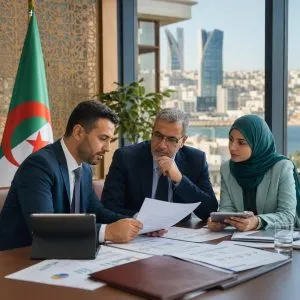
On February 1, 2026, Algeria’s financial regulator COSOB — the Commission d’Organisation et de Surveillance des Opérations de Bourse — announced that labeled startups would face zero fees to list on the Algiers Stock Exchange through 2028. It was a policy announcement that made headlines. But the real story lies in the details: which fees are actually waived, what still costs money, and which Algerian startups are genuinely ready to make use of this window.
What the Policy Actually Means
The measure was jointly announced by COSOB, the Société de Gestion de la Bourse des Valeurs (SGBV, the exchange operator), and Algérie Clearing (the securities depository). It applies exclusively to startups holding the official “start-up” label issued by the Ministry of Knowledge Economy — a pool of approximately 2,300 companies out of 7,800 registered on the startup.dz platform.
The fee waiver covers three specific cost categories:
- Regulatory approval fees — COSOB’s visa fee for reviewing and approving the offering prospectus
- Listing admission fees — the SGBV’s charge for formally admitting securities to trading
- Securities administration fees — Algérie Clearing’s ongoing charges for custody, management, and administration of listed shares
The fundraising amount must not exceed DZD 500 million (approximately $3.85 million at current rates), and all transactions must be initiated between 2026 and 2028. The segment used must be the Growth compartment — the Bourse d’Alger’s dedicated pathway for high-potential emerging companies.
How the COSOB Growth Segment Actually Works
The Growth segment is not a light-touch listing. To qualify, a company must be structured as a joint-stock company (SA — Société par Actions), a legal form that requires a minimum capital base and a board of directors. The minimum value of distributed capital securities must be at least 10 million DZD, and those shares must be held by a minimum of 50 shareholders or at least 3 professional (institutional) investors.
This is the first filter that eliminates most Algerian startups: the majority are still SARLs (limited liability companies) or early-stage entities without audited accounts. Converting to SA status requires notarial work, restructuring capital tables, and engaging statutory auditors — steps that take 3–6 months and cost between 500,000 and 2,000,000 DZD even before the listing process begins.
The ongoing obligations after listing are also substantive. Listed companies must publish semi-annual financial reports, maintain continuous disclosure to COSOB of any material changes in business, hold annual general assemblies with proper shareholder governance, and appoint an approved statutory auditor (commissaire aux comptes) certified by the professional association.
The Full Cost of Listing — Even With Waivers
The fee waiver is real, but it does not make an IPO free. Here is a realistic cost map for a startup attempting to list on the Growth segment in 2026:
One-time costs (pre-listing):
- Legal fees for SA conversion, prospectus preparation, and legal opinions: 1.5–3 million DZD
- Statutory auditor certification of historical accounts (minimum 3 years required): 500,000–1.5 million DZD
- Financial intermediary fee (the authorized broker required to manage the offering): 1–3% of amount raised
- Investor relations and financial communications: 500,000–1 million DZD
Waived one-time costs:
- COSOB prospectus visa fee: ~200,000–500,000 DZD
- SGBV listing admission fee: ~300,000–700,000 DZD
- Algérie Clearing setup fee: ~100,000–300,000 DZD
Annual ongoing costs post-listing:
- Statutory auditor (annual): 800,000–2 million DZD
- Compliance officer or external compliance advisory: 500,000–1.5 million DZD
- Shareholder communications and investor day costs: 300,000–600,000 DZD
On a DZD 500 million raise, the waived fees represent roughly 0.2–0.3% of capital raised. The total cost of listing — including legal, audit, broker, and PR — more likely ranges from 3–7% of the amount raised. This is competitive with international markets but non-trivial for a startup raising at the bottom of the permitted range.
Who in Algeria Could Actually List Now?
Of 2,300 labeled startups, the realistic IPO-eligible pool in 2026–2028 is narrow. A company needs at minimum: 3 years of audited accounts, SA legal form, DZD 10M+ in distributed capital, revenue demonstrating growth trajectory, and a credible business plan justifying the public listing. Applying these filters generously, perhaps 20–40 startups are structurally eligible today. Of those, COSOB has reported that approximately five companies are currently interested and two had submitted formal applications by February 2026.
Ayrade — Algeria’s most pipeline-ready IPO candidate — operates in data center hosting, cloud computing, cybersecurity, and CRM/ERP integration. The company submitted its IPO application in March 2025 and is seeking capital to finance data center expansion. Ayrade’s infrastructure focus aligns with government digitalization priorities, which typically makes institutional investors more comfortable.
INSAG Education Group — a network of specialized institutes in management, marketing, finance, and technology — announced in October 2025 its intention to pursue a direct listing (introduction directe) on the Growth segment without a public share offering. A direct listing differs from an IPO: no new shares are issued, existing shareholders simply make their shares tradeable. It reduces capital raised to zero but creates a liquid trading history and improves governance visibility, which INSAG appears to prioritize as part of a broader transparency strategy.
Diar Dzair — Algeria’s largest e-commerce platform integrating Islamic digital financing, with DZD 2.4 billion in revenue in 2024 — had its listing application received by COSOB for review. The company, which partnered with Jumia for BNPL services in June 2025, is by far the highest-revenue candidate in the pipeline, making it the most credible growth story for institutional investors.
Advertisement
Moustachir: What the First IPO Revealed
Moustachir — an online consulting platform connecting businesses with expert consultants across legal, AI, and export advisory fields — became Algeria’s first startup IPO in December 2024. The process was revealing.
The offering was 120% oversubscribed: 149,615 shares were demanded against 125,000 offered at 760 DZD each, with 306 total subscribers. The operation raised 94.625 million DZD. The subscriber breakdown — 257 retail investors, 29 Moustachir employees, and 20 legal entities — shows that retail demand drove the transaction, not institutional capital.
For founders, Moustachir’s IPO revealed three key things. First, there is genuine retail investor demand for startup shares in Algeria — investors who were previously limited to bank deposits, government bonds, and a handful of legacy listed companies. Second, the process required meticulous preparation: Moustachir spent approximately 18 months converting to SA form, appointing auditors, and preparing its prospectus before listing. Third, post-IPO discipline matters: Moustachir set specific revenue targets (DZD 55M+ for 2025, DZD 187M+ by 2028) that it will be publicly accountable to deliver.
Morocco’s Growth Market: The Honest Benchmark
Morocco’s Casablanca Stock Exchange (Bourse de Casablanca) offers Algeria’s policymakers their most relevant comparison point. Morocco’s market has 77 listed companies — approximately 7–8 times Algeria’s current number — and sees 1–2 IPOs per year despite a significantly more developed institutional investor base.
The most instructive 2024 cases: fintech Cash Plus raised MAD 750 million in a heavily oversubscribed offering, and health company Vicenne raised MAD 500 million with a 64x oversubscription ratio. Both were mid-size, profitable companies with 5+ years of operating history — not early-stage startups. Morocco’s Growth Market does not have a specific startup waiver equivalent; Moroccan startups typically pursue private equity or regional VC before considering an IPO.
Algeria’s DZD 500 million cap (~$3.85M) is notably smaller than Morocco’s typical Growth Market transactions (MAD 500M+ = ~$50M), reflecting a different stage of market development. The Algeria program is targeting earlier-stage companies at lower valuations — a logical starting point given the market’s depth.
The Investor Demand Problem
Moustachir’s oversubscription is encouraging but must be contextualized. The transaction was small (DZD 95M), the company was well-known in tech circles, and the retail investor base was partly drawn by novelty. The deeper question is whether Algeria’s institutional investor pool — mutual funds (OPCVM), insurance companies, and pension funds — can provide the liquidity backbone for a functioning startup equity market.
Algeria’s mutual fund industry is small relative to GDP; insurance companies hold largely fixed-income and real estate assets; pension funds (CNAS, CASNOS) have historically invested in government bonds. Developing a startup equity culture among institutional allocators requires policy changes beyond fee waivers — specifically, regulatory permission for insurance and pension funds to hold listed startup equity, and the development of a secondary trading market with sufficient daily volume.
The 43% surge in Algiers Stock Exchange market capitalization in H1 2025 suggests investor confidence is growing, but the base remains thin.
The 2026–2028 Window: Realistic Pipeline
Bloomberg and Ecofin Agency both reported in December 2025 that the Algiers Stock Exchange expects 2–3 new IPOs in 2026. Based on the companies in active preparation, a realistic scenario:
- Q1 2026: INSAG direct listing (high probability, near-complete application)
- Q2–Q3 2026: Ayrade IPO (data center capital raise, strong institutional case)
- Q4 2026 or 2027: Diar Dzair IPO (largest revenue base, most complex transaction)
A fourth candidate — a startup from the Oran or Constantine technology hubs — is plausible but unconfirmed. The COSOB’s accreditation of ANVREDET (the National Agency for the Promotion and Commercialization of R&D Results) as a stock market promoter in late 2025 signals that research-adjacent startups may be encouraged toward the Growth segment in 2027–2028.
By 2028, under an optimistic scenario, Algeria could have 5–8 startup-linked companies listed on the Growth segment. Under a conservative scenario, 2–3. Either outcome would represent a structural shift for Algerian startup finance.
Frequently Asked Questions
What is algeria’s stock exchange?
Algeria’s Stock Exchange: Now Open to Startups at Zero Cost covers the essential aspects of this topic, examining current trends, key players, and practical implications for professionals and organizations in 2026.
Why is algeria’s stock exchange important for Algeria?
This topic is significant for Algeria because it intersects with the country’s digital transformation goals, economic diversification strategy, and growing technology ecosystem. The article provides specific context for Algerian stakeholders.
How does how the cosob growth segment actually works work?
The article examines this through the lens of how the cosob growth segment actually works, providing detailed analysis of the mechanisms, trade-offs, and practical implications for stakeholders.
Sources & Further Reading
- Algeria Opens Stock Market Access to Startups with Fee Waivers Through 2028 — Ecofin Agency
- Algeria Waives Stock Listing Fees to Boost Startup Funding — TechAfrica News
- Moustachir Goes Public: Launching IPO at 760 DZD Per Share — Algerian News Gate
- A New Era for Algerian Startups: The Long-Awaited IPO That Could Change Everything — Launch Base Africa
- Algeria’s INSAG Plans to List Shares in Local Bourse in Q1 2026 — Zawya
- Algiers Stock Exchange Plans Up to Three New Listings in 2026 — Ecofin Agency
- Algeria to See Up to Three More IPOs in 2026, Regulator Says — Bloomberg
- Algiers Stock Exchange Sees 43% Market Cap Surge in H1 2025 — African Markets
- Algeria’s Startup Diar Dzair Plans to Sell Shares on Local Bourse — Zawya
- Family-Owned Firms Drive IPO Boom on Casablanca Stock Exchange — The North Africa Post