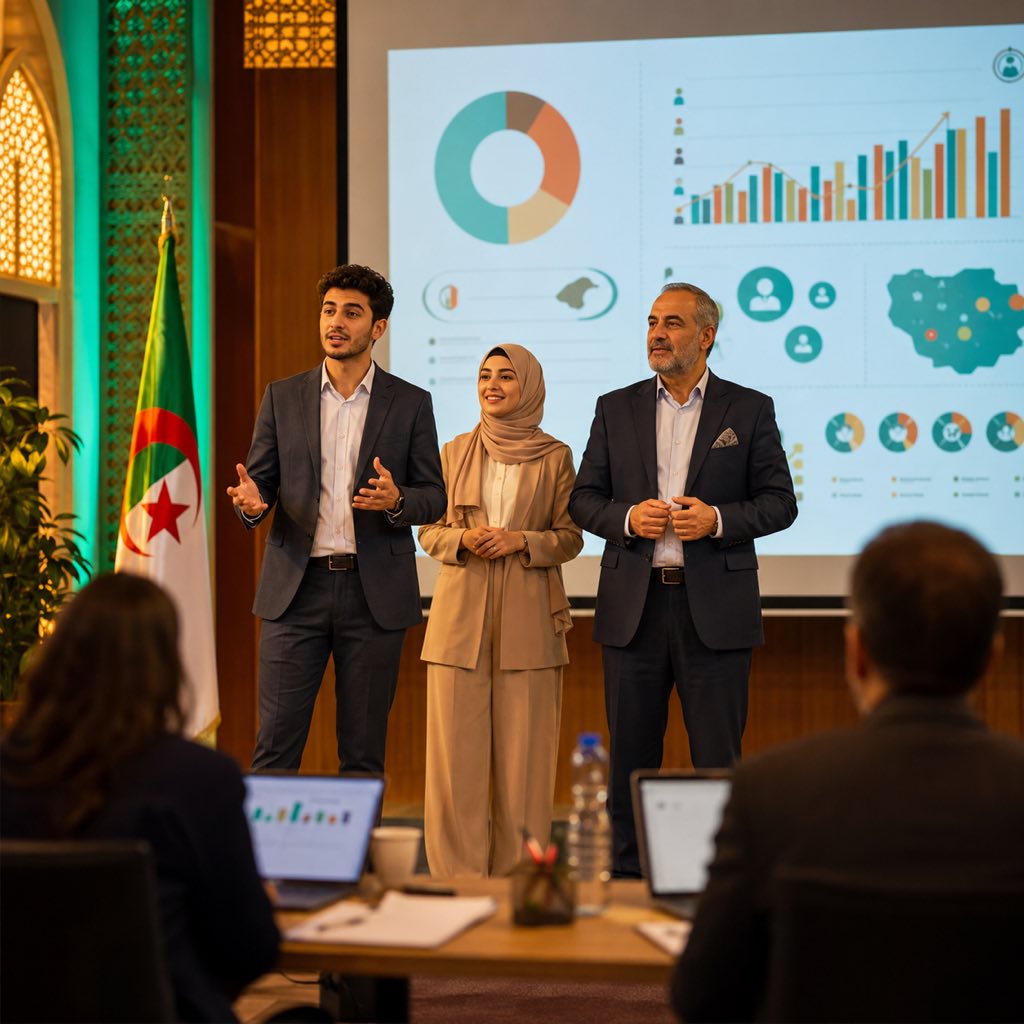
A Direct Line from Algiers to San Francisco
For years, Algerian founders who wanted exposure to Silicon Valley-grade investors and a credentialed global pitch stage had to route through Cairo, Dubai, or Paris — picking up a regional accelerator label, then translating it again for the U.S. context. The Startup World Cup Algeria 2026, organized by the Algerian Startup Ecosystem Community (ASEC), removes one of those hops. A single national pitch day in Algiers on June 27, 2026, will pick the country’s representative for the Startup World Cup Grand Finale in San Francisco — a $1M investment prize sitting at the end of the funnel, hosted at the Hilton Union Square on November 6, 2026.
The structural shift is small in calendar terms but large in optics. ASEC, founded in 2019 and now coordinating more than 400 startups and 3,000 community members, has positioned the Algeria edition as the official national qualifier for the global Pegasus Tech Ventures-powered Startup World Cup network — a circuit of more than 100 regional events spanning six continents. That means an Algerian post-MVP startup can now claim a globally recognized pitch credential without needing to fly its pitch deck to a neighbouring capital first.
This article is a practical playbook for founders weighing whether to compete, what the rules actually require, and how to use a regional run — win or not — as a step in a 2026 funding strategy.
What ASEC Actually Built
The Algeria edition is structured as a full-day national pitch event, not a multi-month accelerator. The application window opened on May 13, 2026 and closed on June 3, with finalists notified on June 8. From the broader applicant pool, ten startups are shortlisted to pitch live to an expert jury on June 27. Each finalist gets a 4-minute pitch followed by a 2-minute Q&A — the exact same structure used at the global finals, so the format is reusable downstream.
Judging follows nine evaluation criteria scored 1-10 each, for a maximum of 90 points. The dimensions tracked are problem/opportunity, solution, market size, traction, competitive advantage, business model, go-to-market strategy, team, and presentation. There are no sector restrictions — the Startup World Cup FAQ confirms that the global event encourages applications “in any domain, at any stage,” and the Algerian edition mirrors that openness, with one practical filter: applicants must have a working product and measurable traction, not just an idea. ASEC’s stated eligibility line reads “post-MVP, with measurable traction” and “global ambition expected.” That phrasing matters because it disqualifies the entire pre-MVP cohort that typically dominates earlier-stage local competitions.
The day is more than the pitch. ASEC frames the event as “a full day of pitching, masterclasses, and high-level networking with investors, corporates, and media” — a structure designed to give the ten finalists a visibility multiplier even if they don’t win. Listed sponsors so far include BK Fire, Gifty, and Qias Technology, with attendee and apply links pointing to swc-algeria.com/register and swc-algeria.com/apply. Contact runs through [email protected] and +213 770 222 045.
Advertisement
Why the Format Itself Is the Real Asset
The most underrated benefit of competing in a Startup World Cup regional is not the prize. It is the forced standardisation of how you talk about your company. The 4-minute pitch and 2-minute Q&A format is the global VC default — it is what every Pegasus Tech Ventures partner, every Sand Hill Road associate, and every demo-day judge expects in 2026. Most Algerian founders have a 20-minute deep-dive deck and a 90-second elevator version, but very few have a clean 4-minute version that survives jury scrutiny. Forcing that asset into existence is a higher-value byproduct than the trophy.
The nine-criteria scoring rubric is the second asset. It is a structured, externally validated diagnostic of where your company is weakest. A founder who scores 9/10 on team and 4/10 on go-to-market walks out knowing exactly what to spend the next quarter on. Most local incubator feedback loops in Algeria are unstructured and qualitative; the SWC rubric is quantified and benchmarked against thousands of global submissions.
The third asset is access. The grand finale in San Francisco brings together more than 100 regional champions, 2,500+ investors, and 50,000+ attendees across past editions. Even if an Algerian founder does not win the $1M, the room is the room — and there is no easier visa-and-credential pretext for an Algerian founder to enter that room than “I am the national champion of the Startup World Cup Algeria edition.” Past Startup World Cup speakers and judges have included Steve Wozniak, Marc Randolph, Vinod Khosla, Reid Hoffman, and Guy Kawasaki, anchoring the event in a credentialed global VC network.
What Algerian Founders Should Do Next
The 2026 application window has already closed, so for this edition the immediate priorities split between the ten shortlisted finalists and the wider Algerian post-MVP cohort planning for 2027. Here is the action plan, broken into numbered tracks.
1. If You Are a Shortlisted Finalist: Rebuild the Pitch to the 4-Minute Standard, Not the 12-Minute One
Most Algerian founders carry a deep-dive deck built for an angel investor coffee or an incubator demo day — typically 12-15 slides averaging 45 seconds each. The Startup World Cup format is brutal: 4 minutes total, which forces a 6-slide ceiling with roughly 40 seconds per slide. Cut every slide that does not directly support one of the nine scoring criteria — problem, solution, market size, traction, moat, business model, go-to-market, team, ask. Rehearse the 2-minute Q&A separately: pre-draft answers to the four predictable questions — competitive moat, unit economics, why-now timing, and capital efficiency. Walking into the jury with these answers pre-built is the difference between a 70-point pitch and an 85-point pitch.
2. If You Did Not Apply for 2026: Build the Traction Story This Year, Not Next
The 2027 edition will almost certainly preserve the post-MVP filter. That gives founders 8-12 months to convert an idea-stage prototype into a working product with measurable traction. Concretely: ship the first paid customer by Q4 2026, instrument one core engagement metric (DAU, retention, repeat-purchase rate), and document month-over-month growth from a clean baseline. Three to six months of consistent growth is a defensible answer to “what is your traction” — a single screenshot of one customer is not. Founders who treat the 2027 SWC Algeria deadline as a forcing function for product-shipping discipline will end the year with a stronger company, regardless of whether they win.
3. If You Are a Sector Player Without a Pitch: Use the June 27 Event as an Intelligence Operation
The Algiers event will gather the country’s strongest post-MVP startups, the jury of investors evaluating them, and a press corps writing up the winners. For founders not competing, attending as a registered observer is a low-cost benchmarking exercise. Three concrete intelligence actions: (a) Watch the ten pitches and score each yourself against the nine criteria — calibrate where you actually rank; (b) Identify which two or three judges’ theses align with your sector and schedule follow-up coffees within two weeks while you are top of mind; (c) Track which finalists win the audience and press attention versus the jury vote — the gap between the two is where the unspoken sector preferences live.
4. If You Are an Investor or Corporate Open-Innovation Lead: Treat the Finalists List as a Pre-Cleared Deal Funnel
ASEC’s selection process — application review, shortlisting, and live pitch — does most of the early diligence work for free. The ten finalists are pre-cleared on product-market traction and team credibility. For an investor or a corporate venture team, the cost of evaluating a SWC Algeria finalist is roughly half the cost of evaluating a cold-inbound deck. Build a 30-day post-event diligence calendar that loops back into all ten finalists, not just the winner. Several past Pegasus Tech Ventures regional runners-up have raised institutional rounds within six months of pitching — the brand of being a national finalist carries weight far beyond the trophy.
Where This Fits in Algeria’s 2026 Startup Calendar
The Startup World Cup Algeria edition lands inside a year that already has a dense calendar of credentialing events — Algeria Venture’s sector showcases, the broader Algeria Startup Challenge program that has run since 2018 under Ministry of Knowledge Economy patronage, ANADE’s micro-enterprise pipeline, and a handful of corporate open-innovation calls from Sonatrach, Algerie Telecom, and Djezzy. What SWC Algeria adds to that calendar is uniquely global. None of the other 2026 milestones come with a direct flight path to a credentialed San Francisco pitch stage.
Three implications are worth holding onto. First, founders no longer need to choose between local credibility and global visibility — a single qualifier delivers both. Second, the post-MVP filter raises the bar on the kind of company the ecosystem celebrates, which is healthy: a founder cohort optimised for “traction by June” produces stronger companies than one optimised for “best deck by June.” Third, the existence of the qualifier is itself a signal to international VCs that Algeria’s post-MVP cohort is now legible and benchmarkable — which over time lowers the friction for inbound capital, sector by sector. The November 6 grand finale in San Francisco is the headline, but the structural value of having a national qualifier compounds over multiple editions, not just one.
Frequently Asked Questions
What is the Startup World Cup Algeria 2026?
The Startup World Cup Algeria is the official national qualifier of the global Startup World Cup, organized by the Algerian Startup Ecosystem Community (ASEC). The 2026 edition is a single-day pitch event on June 27 in Algiers where ten shortlisted post-MVP Algerian startups pitch live to a national jury. The winner represents Algeria at the global Grand Finale in San Francisco on November 6, 2026, competing for a $1M investment prize.
Who can apply, and what is the pitch format?
Applicants must be Algerian startups that are post-MVP — meaning they have a working product and measurable traction — with global ambition. There are no sector restrictions. The pitch format is 4 minutes of presentation followed by a 2-minute Q&A with the jury, scored on nine criteria (problem, solution, market, traction, competitive advantage, business model, go-to-market, team, presentation) for a maximum of 90 points. The 2026 application window opened May 13 and closed June 3.
What does the winner actually get?
The Algeria edition winner earns the right to represent the country at the Startup World Cup Grand Finale in San Francisco on November 6, 2026, at the Hilton Union Square, where they compete against more than 100 regional champions for a $1,000,000 investment prize. Beyond the prize, the credential of being a national champion opens access to Pegasus Tech Ventures’ investor network and unlocks visa-and-credential entry to one of the largest global founder gatherings of the year.
Sources & Further Reading
🔗 Related Intelligence

10 Algerian Startups to Watch in 2026: Founders Redefining Local Tech

Algeria Startup Challenge 2026: What the Cohort Results Reveal About the Ecosystem

Algeria Startup Challenge 2026: Inside the 8th Edition and Its Open-Innovation Playbook
Algerian Startups on the World Stage: Vivatech, GITEX and TechCrunch Disrupt 2026 — A Practical Guide