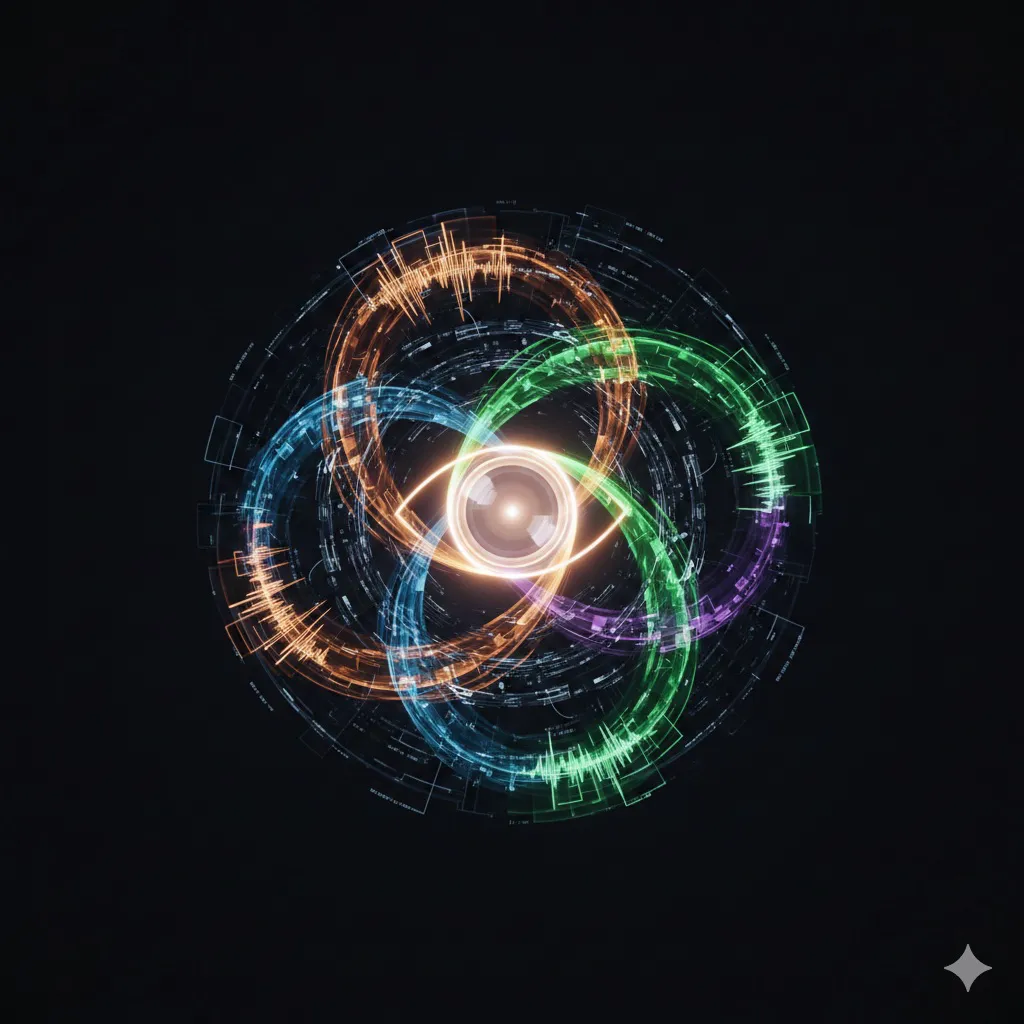
The dominant mental model of AI in 2023 was text in, text out. By 2026, that model is obsolete. Leading AI systems now see images, watch videos, listen to audio, read documents, analyze spreadsheets, interpret medical scans, and generate content across all these modalities simultaneously. Multimodal AI — systems that operate across text, vision, audio, and video — has moved from impressive demo to industrial infrastructure in less than three years.
The consequences cut across virtually every sector. A structural engineer uploads drone footage of a bridge and receives a structural analysis. A logistics manager photographs a shipping manifest and has it automatically entered into an ERP system. A student photographs a handwritten math problem and gets a step-by-step solution. The gap between what humans can perceive and what AI can process has narrowed dramatically, and the multimodal AI market is estimated at roughly $3.4-3.9 billion in 2026, growing at 28-35% annually.
How Multimodal Models Work
Modern multimodal AI systems combine several technical components.
Vision encoders process images and video frames, transforming pixel arrays into high-dimensional representations that capture objects, spatial relationships, text in images, and scene context. The foundational innovation was OpenAI’s CLIP model (Contrastive Language-Image Pretraining) in 2021, which learned to associate images with text descriptions by training on 400 million image-text pairs. Today’s vision encoders are dramatically more capable.
Audio encoders process speech, music, and environmental sounds. OpenAI’s Whisper model demonstrated that a single system could transcribe audio in 99 languages with near-human accuracy for well-resourced languages, trained on 680,000 hours of multilingual data.
Modality fusion is the challenging technical problem: combining representations from fundamentally different data types — pixel arrays, audio waveforms, token sequences — into a unified representation that a language model can reason across. Current approaches include cross-attention mechanisms and shared embedding spaces.
Unified generation allows models to produce outputs in any modality — generating text, images, audio, or video in response to inputs from any combination of sources. In 2025-2026, native audio generation emerged as a key advance, with multiple models generating speech directly rather than relying on separate text-to-speech systems.
The Leading Models in 2026
GPT-5 and GPT-4o: OpenAI’s GPT-5, released in August 2025, is natively multimodal from training and scores 84.2% on the MMMU benchmark. Its predecessor GPT-4o set the standard for real-time multimodal interaction, responding to spoken input with an average latency of 320 milliseconds — roughly 16 times faster than the previous GPT-4 Turbo voice pipeline. GPT-4o can interpret vocal tone and facial expressions from video, though AI emotion recognition from visual data remains contested among researchers.
Gemini 3 / 3.1 Pro: Google’s Gemini series was designed as natively multimodal from the architecture up. Gemini 3 Pro, released November 2025, scores 81% on MMMU-Pro and 87.6% on Video-MMMU, with real-time video understanding capabilities. Gemini 2.5 Pro introduced a one-million-token context window and native audio output, and Gemini 3.1 Pro has pushed performance further.
Claude 4 / Opus 4.6: Anthropic’s Claude models deliver strong vision, document analysis, and computer use capabilities — enabling agentic workflows where AI perceives screens and takes actions autonomously.
Open-source multimodal: The open-source ecosystem has produced capable alternatives. Alibaba’s Qwen3-VL, Meta’s LLaMA 3.2 vision models (11B and 90B parameters) and the newer LLaMA 4 (Scout and Maverick variants), and Microsoft’s Phi-4 for edge devices can all be deployed locally without commercial API dependencies.
Healthcare: Where Multimodal AI Hits Hardest
The clearest evidence of multimodal AI’s real-world impact comes from medical imaging.
Radiology has been transformed. AI systems read chest X-rays, CT scans, MRIs, and pathology slides with accuracy that meets or exceeds specialist radiologists on specific screening tasks. Google’s Med-PaLM 2 achieved 86.5% on USMLE-style questions, described as expert-level performance on text-based medical reasoning. For multimodal medical tasks, Google’s Med-Gemini models improved over GPT-4V by 44.5% across seven multimodal medical benchmarks, scoring 91.1% on MedQA. Meanwhile, a 2025 study in the journal Radiology found that AI mammography screening still missed 14% of cancers, underscoring that AI augments rather than replaces radiologist judgment.
Ophthalmology is another domain of rapid progress. A 2018 Google Research study published in Nature Biomedical Engineering demonstrated that AI analyzing retinal photographs could predict systemic health indicators — blood pressure, age, sex, smoking status, and cardiovascular risk — from 284,335 patients. This was information not previously known to be extractable from eye scans alone.
Dermatology AI is expanding access in low-resource settings. Systematic reviews of AI dermatology in low- and middle-income countries show promising diagnostic accuracy, though performance remains inconsistent across skin tones — a critical limitation for global deployment.
Advertisement
Manufacturing and Industrial Applications
In manufacturing, multimodal AI is enabling quality control systems that previously required skilled human inspection.
Traditional machine vision systems were brittle — they could detect specific defect types they were trained on but failed on novel defects or environmental variations. Modern multimodal AI systems can be retrained by showing examples and describing defects in natural language, rather than requiring weeks of annotated dataset construction.
NVIDIA’s GR00T N1, the world’s first open humanoid robot foundation model, combines multimodal perception with robotic control using a dual-system architecture — fast reactive thinking paired with deliberate vision-language reasoning. Robots powered by Project GR00T understand natural language instructions, visually inspect their work, and adapt to novel situations.
Major manufacturers are deploying these capabilities. BMW’s Regensburg plant became the first automotive factory to use AI-powered automated optical inspection in 2023, reporting defect reductions of up to 60% using models trained on roughly 100 real images per feature. TSMC uses deep learning for wafer defect detection with 95% accuracy in its intelligent packaging fab.
Creative Industries and the Copyright Battleground
Perhaps the most contested domain of multimodal AI is creative work. Image generation (DALL-E, Midjourney, Stable Diffusion), music generation (Udio, Suno), and video generation have put AI creative tools in the hands of anyone with a browser — and the capabilities accelerated sharply in 2025.
OpenAI’s Sora 2 (September 2025) introduced synchronized audio generation. Google’s Veo 3 (May 2025) generates video with synchronized dialogue, sound effects, and ambient audio in 4K resolution. Runway’s Gen-4.5 pushed the company past a $3 billion valuation.
The copyright controversy is equally sharp. The RIAA filed landmark lawsuits against Suno and Udio in June 2024 on behalf of Sony, UMG, and Warner. Udio has since settled with UMG and Warner on confidential terms; Suno’s case remains ongoing. The legal landscape for copyright in AI-generated content remains unresolved across jurisdictions.
The Deepfake Problem
Multimodal AI’s most dangerous current application is convincing synthetic media at scale and low cost.
In early 2024, an employee at Arup’s Hong Kong office was tricked into transferring approximately $25.6 million (HK$200 million) after a video call where every participant — not just the purported CFO — was a deepfake generated from publicly available video. Political deepfakes have been deployed in elections across multiple countries. Celebrity deepfakes are weaponized for non-consensual intimate imagery and investment scams.
Detection and provenance efforts are advancing. The Content Authenticity Initiative, founded by Adobe in 2019, now includes Nikon, Canon, Sony, Microsoft, the BBC, and Reuters, working to embed cryptographic provenance signatures in media through the C2PA standard under the Linux Foundation. But deployment remains slow.
Regulation is catching up. Article 50 of the EU AI Act requires providers to mark AI-generated content in machine-readable format and deployers to label deepfakes — though these transparency provisions take effect in August 2026. Several US states have passed deepfake laws. China requires deepfake labeling. Enforcement across the global internet remains the hard problem.
Conclusion
Multimodal AI has crossed from impressive capability to practical infrastructure. The applications transforming healthcare, manufacturing, and creative industries are current deployments with measurable outcomes. The challenges — deepfakes, copyright, liability, regulatory frameworks — are equally current and urgent.
The organizations that develop strategies for integrating multimodal AI into their operations — and the governance frameworks to do so responsibly — will hold structural advantages in cost, speed, and quality that compound over time. The question is no longer whether to engage with multimodal AI. It is how, and how wisely.
Frequently Asked Questions
What is beyond text?
Beyond Text: The Multimodal AI Revolution in 2026 covers the essential aspects of this topic, examining current trends, key players, and practical implications for professionals and organizations in 2026.
Why does beyond text matter?
This topic matters because it directly impacts how organizations plan their technology strategy, allocate resources, and position themselves in a rapidly evolving landscape. The article provides actionable analysis to help decision-makers navigate these changes.
How does how multimodal models work work?
The article examines this through the lens of how multimodal models work, providing detailed analysis of the mechanisms, trade-offs, and practical implications for stakeholders.
Sources & Further Reading
- OpenAI GPT-4o announcement
- IBM: GPT-4o overview
- OpenAI CLIP
- OpenAI Whisper
- Google Gemini models
- Gemini 3 announcement
- Gemini 2.0 Flash (Dec 2024)
- Med-Gemini research
- Med-PaLM 2 (Google Cloud)
- AI mammography false-negative rates (Radiology, 2025)
- Google Research retinal scan study (Nature, 2018)
- AI dermatology in LMICs (PMC systematic review)
- NVIDIA GR00T N1
- NVIDIA GR00T platform
- BMW AI quality control
- TSMC AI agents
- Qwen3-VL (GitHub)
- Meta LLaMA 3.2 vision
- OpenAI Sora 2
- Google Veo
- Runway Gen-4.5
- RIAA lawsuits against Suno and Udio
- Arup deepfake fraud (Fortune)
- Arup deepfake fraud (CNN)
- Content Authenticity Initiative
- EU AI Act Article 50
- AI emotion recognition debate
- Multimodal AI market size (Mordor Intelligence)