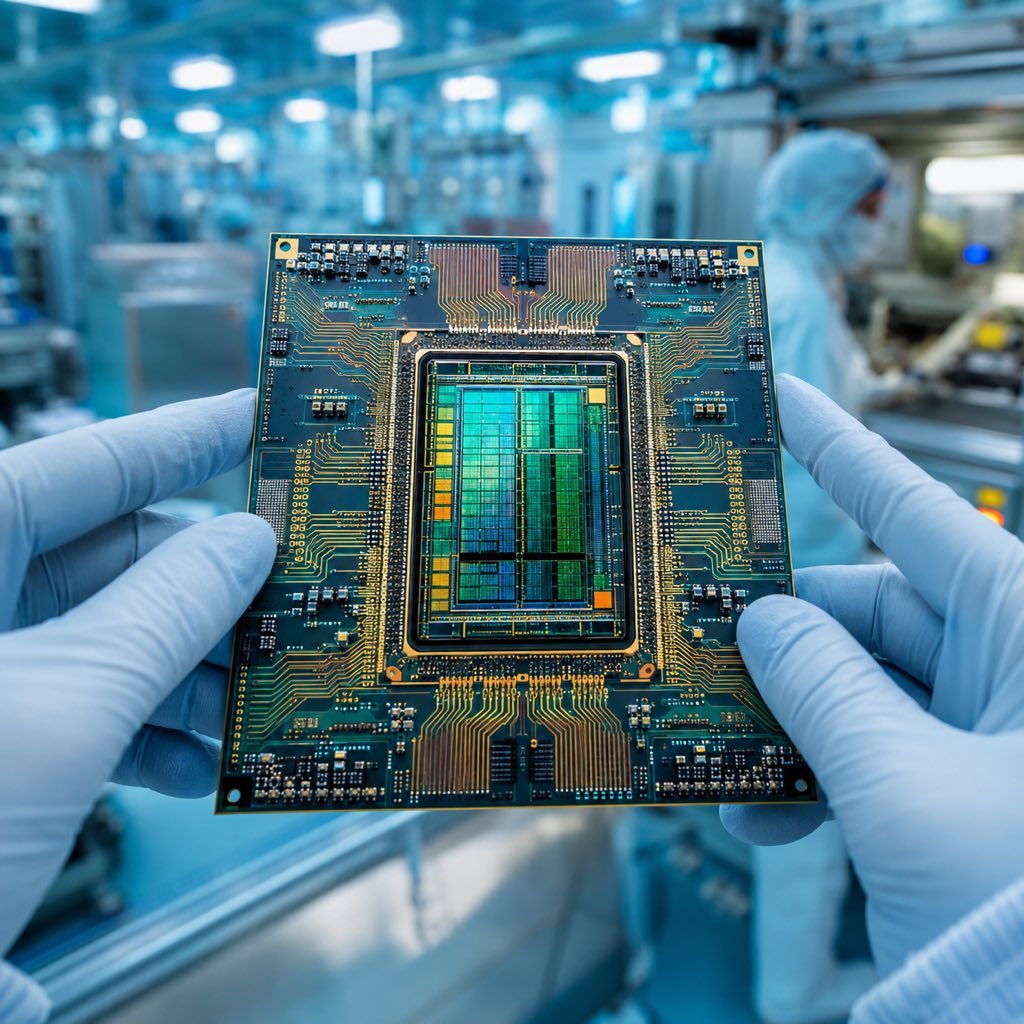
A Custom Chip Built to Undercut Nvidia’s Pricing
Microsoft is reportedly preparing to unveil its next-generation Maia AI accelerator, Maia 300, as early as September 2026, while holding talks with TSMC for manufacturing capacity exceeding 300,000 chips for delivery in 2027, according to TrendForce. TechDogs reports that Microsoft’s longer-term target extends beyond 1 million units, manufactured on TSMC’s 3-nanometer process — the same node used for the current Maia 200 generation.
The economic argument for the shift is already public. Per TrendForce, “Microsoft told investors in July that Maia 200 was 30% to 40% cheaper to operate than NVIDIA’s latest-generation chips when running OpenAI and Microsoft models.” That cost advantage — not a raw performance claim — is the core rationale Microsoft is using to justify scaling its own silicon rather than continuing to buy Nvidia GPUs at the volumes its Azure AI business requires.
What Maia 200 Tells Us About Maia 300
Microsoft has not disclosed full Maia 300 specifications, but the current-generation Maia 200 offers a useful baseline: 140+ billion transistors, 216GB of HBM3e memory, 272MB of on-chip SRAM, and 10+ petaFLOPS of FP4 performance, delivering roughly 30% better performance-per-dollar than the prior generation, according to TechDogs. Maia 200 launched in January 2026, following the original Maia accelerator’s debut in November 2023, per the same reporting — meaning Maia 300 would arrive roughly eight months after its predecessor, an aggressive iteration cadence for custom AI silicon.
Andrew Wall, Microsoft’s General Manager for Azure Maia, pushed back on the specific volume figures circulating in reporting, telling TechDogs that “the figures reported don’t reflect the scale of our program” — without disclosing Microsoft’s actual production targets. That non-denial denial is itself informative: Microsoft is not disputing that it’s scaling aggressively, only the precision of the leaked numbers.
Microsoft Is Playing Catch-Up, Not Leading
The competitive context matters for interpreting the scale of Microsoft’s ambition. TrendForce reports that Google already ships 3-5 million TPU 8 units annually using TSMC’s N3P process and CoWoS-S advanced packaging, while AWS deploys roughly 1 million Trainium2 chips, with Trainium2 powering Anthropic’s Claude training workloads and a 3nm Trainium3 already in the pipeline, followed by a planned 2nm Trainium4 by the end of 2027. Against that backdrop, Microsoft’s 300,000-unit near-term target for Maia 300 is a fraction of Google’s current annual TPU volume — TechDogs confirms Microsoft “currently lags Google (Tensor Processing Units) and Amazon (Trainium processors) in custom chip scaling.”
This reframes the Maia 300 story: it is not evidence that Microsoft has closed the custom-silicon gap with its hyperscaler rivals, but evidence that Microsoft recognizes the gap and is accelerating to close it, using the one lever it can move quickly — TSMC manufacturing capacity — rather than a fundamentally new architecture.
Advertisement
Why TSMC Capacity Is the Real Constraint
The entire story is really about a manufacturing bottleneck. Microsoft, Google, and AWS are all competing for the same limited pool of TSMC’s advanced-node capacity and CoWoS packaging slots, which means Microsoft’s ability to hit even its 300,000-unit 2027 target depends on TSMC allocation decisions Microsoft does not fully control. Winning enough fabrication and packaging capacity to scale Maia 300 to a level that meaningfully dents Microsoft’s Nvidia GPU spend is as much a supply-chain negotiation as it is an engineering achievement — and it puts Microsoft in direct capacity competition with two of its most direct cloud-infrastructure rivals for the same TSMC production lines.
This dynamic also explains why Microsoft’s own spokesperson declined to confirm specific volume numbers rather than simply denying them. Andrew Wall’s comment that “the figures reported don’t reflect the scale of our program” reads less like a correction of an inflated number and more like a hedge against publicly committing to a target that ultimately depends on how much TSMC capacity Microsoft can actually secure against Google’s and Amazon’s competing demand. In a market where the fabrication partner is shared across all three hyperscalers, publicly promising a specific unit count creates a commitment Microsoft cannot fully control fulfilling — which is a structurally different risk than the one Google or Amazon face if they have already locked in longer-standing TSMC allocation agreements from earlier custom-silicon generations.
What This Means for Cloud and Enterprise AI Buyers
1. Expect Azure AI pricing pressure once Maia 300 reaches meaningful scale
If Maia 300 preserves or improves on Maia 200’s 30-40% cost advantage over Nvidia chips, and Microsoft can secure enough TSMC capacity to run a meaningful share of Azure AI inference on its own silicon, expect that cost advantage to eventually show up in Azure AI pricing — though the 300,000-unit 2027 target suggests this remains a multi-year transition, not an imminent shift.
2. Don’t assume custom silicon means workload portability disappears
Enterprises building on Azure AI services should clarify with Microsoft which workloads will run on Maia versus Nvidia hardware, and whether performance or compatibility differs meaningfully between the two — a chip transition at this scale is rarely fully transparent to the API layer, but subtle differences can matter for latency-sensitive applications.
3. Treat the “300,000 vs. millions” gap as a multi-year timeline, not a near-term catch-up
Google’s 3-5 million annual TPU volume dwarfs Microsoft’s near-term Maia 300 target by roughly an order of magnitude. Enterprise buyers evaluating cloud AI infrastructure diversity should not expect Microsoft to reach TPU-scale custom silicon deployment within the 2026-2027 window — plan vendor diversification timelines accordingly.
4. Watch TSMC capacity allocation as the leading indicator, not chip announcements
Because Microsoft, Google, and AWS are all TSMC customers competing for the same advanced-node and CoWoS packaging capacity, TSMC’s own capacity-allocation disclosures (in its quarterly earnings calls) are likely to be a more reliable leading indicator of which hyperscaler is actually scaling custom silicon fastest than any single company’s chip-launch announcement.
The Structural Lesson
Maia 300 is less a chip story than a supply-chain story: Microsoft’s own cost data shows the economic case for custom silicon is real (30-40% cheaper than Nvidia on its own workloads), but converting that economic case into meaningful scale runs through the same finite TSMC advanced-packaging capacity that Google and AWS are also racing to secure. The company that leaves this competition with the most TSMC capacity — not necessarily the most impressive chip specifications — will be the one that actually reduces its Nvidia dependence at a scale that shows up in cloud AI pricing.
Frequently Asked Questions
What is Microsoft’s Maia 300 AI chip?
Maia 300 is Microsoft’s next-generation custom AI accelerator, expected to be unveiled as early as September 2026, built on TSMC’s 3-nanometer process, according to TrendForce. It follows the Maia 200, which launched in January 2026 and already runs 30-40% cheaper than Nvidia’s latest chips on OpenAI and Microsoft workloads.
How does Microsoft’s chip volume compare to Google and Amazon?
Microsoft is seeking 300,000+ Maia 300 units from TSMC for 2027 delivery, while Google already ships 3-5 million TPU 8 units annually and AWS deploys roughly 1 million Trainium2 chips, according to TrendForce — meaning Microsoft remains well behind both rivals in custom-silicon scale.
Will Maia 300 lower Azure AI prices for customers?
Not immediately. Microsoft’s own data shows Maia 200 is 30-40% cheaper to operate than Nvidia’s latest chips, per TrendForce, but converting that into customer-facing Azure AI price reductions depends on Microsoft securing enough TSMC manufacturing capacity to run a meaningful share of its AI workloads on Maia rather than Nvidia hardware — a process TSMC capacity constraints make a multi-year transition.
Sources & Further Reading
🔗 Related Intelligence

The AI Chip Wars: Nvidia’s Dominance, AMD’s Challenge, and the Rise of Custom Silicon

Cerebras IPO: The Wafer-Scale Chip Challenging Nvidia’s AI Reign

The AI Chip Insurgency: $1.2 Billion in One Week to Dethrone Nvidia
NVIDIA GB300 NVL72: The 72-GPU Rack Redefining AI Infrastructure