From Experiment to Primary Revenue Channel
Livestream commerce began as a Chinese phenomenon. Taobao Live, launched in 2016, generated $550 billion in GMV in recent years — with 900 million monthly users turning product demonstrations into entertainment and then into purchases in real time. Douyin (TikTok’s Chinese counterpart) followed with $375 billion GMV and 750 million monthly users, with an average of 2.09 million daily live viewers per stream. The Chinese model proved the thesis beyond any reasonable doubt: when the purchase button is inside the entertainment experience rather than three clicks away, conversion follows.
The West absorbed this lesson slowly. The United States live commerce market stands at roughly $50 billion in 2025, with projections of 36% growth by end-2026, driven primarily by TikTok Shop’s expansion and Amazon Live’s brand-pairing programs. Europe saw 35% of consumers make purchases via livestream formats, with Whatnot sellers growing 600% year-over-year and streaming 20,000+ hours weekly by 2025.
The global market as a whole is projected to exceed $1 trillion in livestream sales in 2026, up from $682.5 billion in 2023. The trajectory is steep, the infrastructure is live, and the early-adopter window — where first-movers can claim audience attention before the format becomes crowded — is closing in most major markets.
What makes the MENA region particularly interesting is that the adoption curve in parts of the Middle East and North Africa is compressing: the UAE reached 72% consumer adoption of livestream shopping, Thailand at 73% and Indonesia at similar levels are being joined by Gulf markets with high mobile penetration, young demographics, and platform-native consumer behavior — the precise conditions that drove China’s adoption in 2016-2019.
The MENA Opportunity — And Its Structural Differences
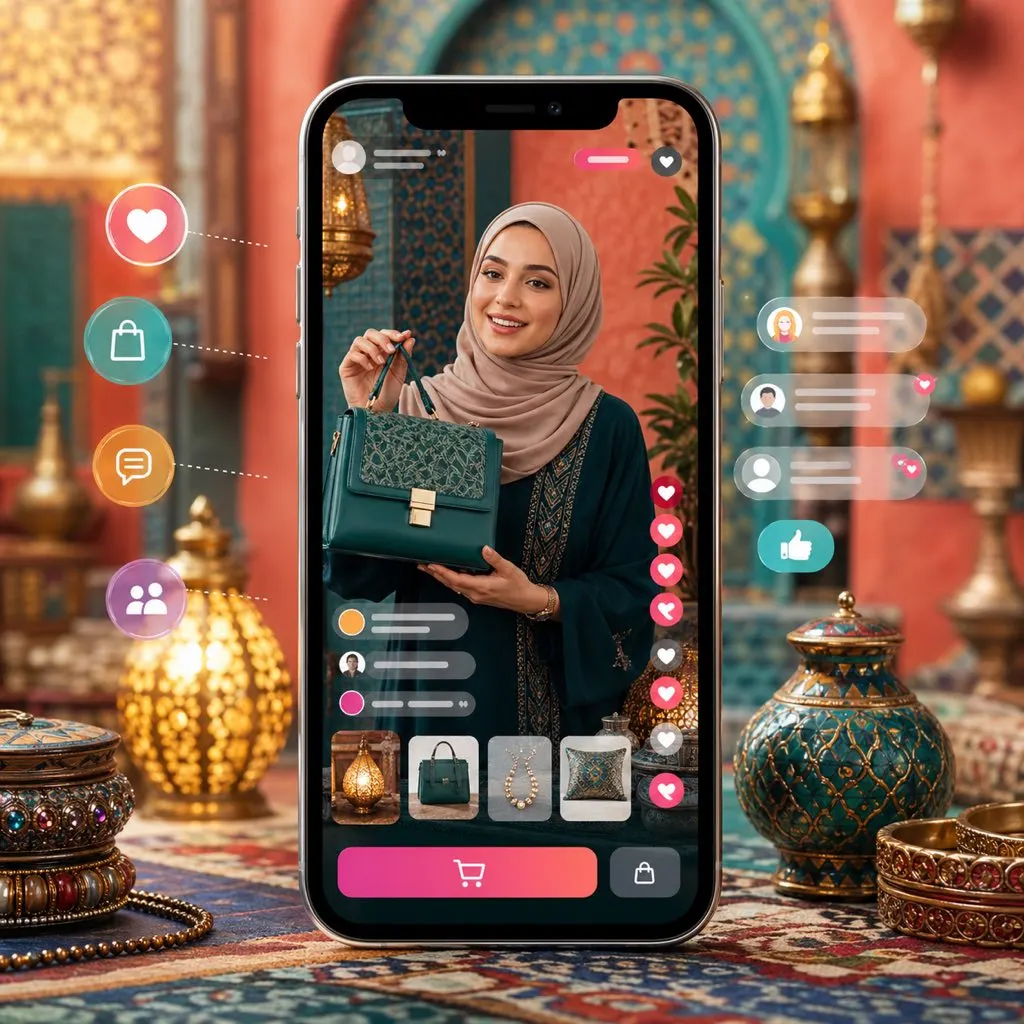
The MENA live commerce opportunity sits at the intersection of three structural advantages that most Western markets have already traded away.
Young, mobile-first demographics. The Middle East and North Africa has one of the world’s youngest median populations, with smartphone penetration rates in Gulf Cooperation Council countries exceeding 90%. In the UAE, Saudi Arabia, and Egypt, social media usage is among the highest globally in terms of daily time-on-platform — meaning the audience that live commerce requires (attentive, on-device, socially active) is already present at scale.
High average order values in Gulf markets. The UAE’s 72% livestream adoption rate is not driven by low-ticket impulse purchases. Gulf consumers demonstrate purchasing behavior consistent with premium fashion, beauty, and electronics — categories where livestream demonstration has the highest conversion advantage over static product pages. A beauty brand demonstrating a product with before/after effects in real time outperforms a product page image at every price point.
Platform access without the legacy e-commerce infrastructure competition. In North America, Amazon dominates the product discovery layer to such a degree that brands building on TikTok Shop are implicitly fighting for shelf space in a market where Amazon Prime loyalty creates structural inertia. In MENA, this lock-in is less established — consumers are more platform-fluid, discovery happens across Instagram, Snapchat, TikTok, and local marketplaces without a single dominant channel. This gives brands the space to establish a live commerce presence that becomes THE discovery channel for their category, rather than a secondary channel competing against an entrenched marketplace.
Advertisement
What Brands Should Do About It
1. Anchor on One Platform Before Multichannel Expansion
The most common live commerce failure mode — particularly among brands entering the format from a traditional e-commerce or content-marketing background — is launching across three platforms simultaneously with thin production investment on each. A Korean beauty brand achieved $500,000 GMV in 72 hours by focusing production quality and creator relationships on a single platform and schedule cadence. The implication is direct: choose the single platform where your target audience has the highest existing engagement (TikTok for under-35 fashion and beauty in MENA, Instagram for luxury and aspirational lifestyle, YouTube for high-consideration electronics) and build depth there first. Platform switching costs are low; audience trust in a live host is not.
2. Partner with Mid-Tier Creators Over Macro Influencers for MENA Launch
TikTok’s own analysis of its live commerce ecosystem consistently shows that mid-tier creators — typically those with 50,000 to 500,000 followers — outperform macro influencers (1M+) on conversion rates in live shopping contexts. The reason is engagement quality: mid-tier creators maintain active comment relationships with their audience, respond to product questions in real time, and have category authority that macro influencers who cover 20 different brand categories cannot replicate. In MENA specifically, where consumer trust is strongly influenced by authentic community recommendation rather than celebrity endorsement, the mid-tier creator model aligns with cultural purchase dynamics. Influencer commissions in live commerce run at 40-50% of live sales revenue — budget accordingly.
3. Design for Urgency at the Inventory Level, Not Just the Discount Level
The most cited consumer motivation for live shopping purchases is urgency — specifically, the fear of missing a limited-availability item at a live-exclusive price. Brands that deploy time-limited discounts in a live session generate higher average order values than brands relying on the entertainment value of the stream alone. But discount-only urgency is a diminishing tactic: audiences habituate to the format and wait for the discount rather than engaging with the product story. The more sustainable urgency architecture combines limited SKU availability (genuinely limited-run products, not artificial scarcity) with live-exclusive bundles that don’t exist in the standard catalogue. A home gadget brand generated $1 million GMV in a single live session using this architecture — the bundle was the product, not just the price.
4. Integrate Retargeting Immediately — Live Audiences Are Your Highest-Intent Cohort
Consumers who attend a live commerce session but do not purchase in-session are not lost — they are the highest-intent cohort available for retargeting, because they have already demonstrated product interest, brand engagement, and format comfort. TikTok Pixel, Meta’s Advantage+ audience tools, and Snapchat’s retargeting APIs all allow brands to create custom audiences from live session viewers and serve them post-session product ads within 24-48 hours. The conversion rate on retargeted live session viewers typically exceeds standard e-commerce retargeting by a significant margin because the warm-up work — product awareness, trust building, price anchoring — has already been done during the live session. Brands that do not install these pixels before their first live session lose this data permanently.
5. Optimize for Vertical Mobile First — Not Desktop Adaptation
Live commerce across all major platforms in 2026 is consumed on vertical mobile — 9:16 aspect ratio, full-screen, one-thumb navigation. Brands whose live production is designed for horizontal desktop streaming (wider shot, smaller product detail, presenter-at-a-distance framing) systematically underperform on mobile engagement metrics. The production investment required to optimize for vertical mobile is not significant — it is primarily a framing and camera positioning discipline rather than a technology investment. Place the product at eye level in the upper-center of frame, use close-up demonstration shots with deliberate cuts, and size text overlays for 4-inch mobile screens, not 24-inch monitors.
What Comes Next for Live Commerce in 2026
The format’s next phase of development is shaping up around two structural shifts. First, the creator-to-merchant ratio is inverting. In 2023, most live commerce content was creator-led: influencers endorsed brands in a live format. By 2025, 70% of Douyin live streams were merchant-led — brands operating their own live studios, with trained in-house hosts who have category expertise rather than follower counts. This is the professionalization signal: live commerce is becoming a sales channel with dedicated infrastructure, not just a marketing format.
Second, AI-generated live hosts are beginning to pilot in East Asian markets, with brands testing always-on virtual presenters that can stream 24 hours a day in multiple languages without the scheduling and talent cost of human hosts. These are early experiments, but their arrival signals that the competitive floor for live commerce production quality is moving upward rapidly — the “authentic iPhone stream” format that was sufficient for early adopters will be insufficient when professional AI-hosted competition appears in the same feed.
For brands entering MENA live commerce in 2026, the window for establishing authentic human-hosted presence — before AI hosts normalize and before the format becomes as crowded as display advertising — is measured in months, not years.
Frequently Asked Questions
What is the projected size of global livestream commerce in 2026?
Global livestream commerce is projected to exceed $1 trillion in 2026, up from $682.5 billion in 2023. China dominates the market with a projected $1.1 trillion in livestream GMV, representing approximately 78% of global live shopping activity. The United States market is expected to reach approximately $50 billion in 2026, with a 36% growth rate.
Which MENA countries have the highest live commerce adoption?
The UAE leads MENA with 72% consumer adoption of livestream shopping — the third-highest rate globally, behind Thailand (73%) and India (75% of shoppers). Gulf Cooperation Council countries generally show higher adoption rates than North African markets, driven by high smartphone penetration, young demographics, and premium purchasing behavior in fashion, beauty, and electronics categories.
What conversion rate advantage does live commerce have over traditional e-commerce?
Live commerce conversion rates consistently outperform static e-commerce product pages, primarily because product demonstration, real-time Q&A, and purchase urgency compress the decision cycle from days to minutes. Influencer commissions in live sessions run at 40-50% of live sales revenue, reflecting the platform’s premium on creator-driven conversion. Companies adopting livestream commerce early report top-line revenue growth of up to 25% in the categories where they deploy it.