The Jumia Gap and Why Physical Retail Became the Answer
Jumia’s official exit from Algeria — confirmed less than a month before Yassir announced the Uno acquisition in March 2026 — left a structural void in Algeria’s e-commerce market: a large-scale, branded fulfilment network with physical touchpoints that could bridge digital intent with physical delivery. Jumia’s failure in Algeria was not primarily a demand problem. Algerian consumers demonstrated willingness to order online, particularly for electronics and apparel. The failure was a logistics and trust problem: delivery reliability was inconsistent, return handling was complex, and consumer confidence in paying before receiving goods remained low.
Yassir, operating primarily as a ride-hailing and on-demand delivery super-app with a growing digital wallet component, identified the same gap. But rather than replicate the Jumia marketplace model — third-party sellers, third-party warehouses, third-party delivery contracted at scale — Yassir made a fundamentally different bet: own the physical infrastructure. The Uno hypermarket acquisition from Cevital (founded in 2007, with directly-owned locations in Bouira and Aïn Defla and leased spaces in Algiers and Sétif) gave Yassir something a purely digital company cannot buy with ad spend: existing store locations, established supplier relationships, and a physical footprint that customers can see, visit, and trust.
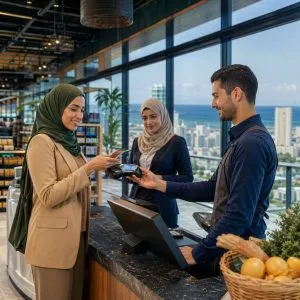
The Bab Ezzouar location, reopened during Ramadan 2026, is the first flagship expression of this strategy — and the first genuine test of whether a fintech wallet can scale through physical retail in Algeria.
What the O2O Stack Actually Includes
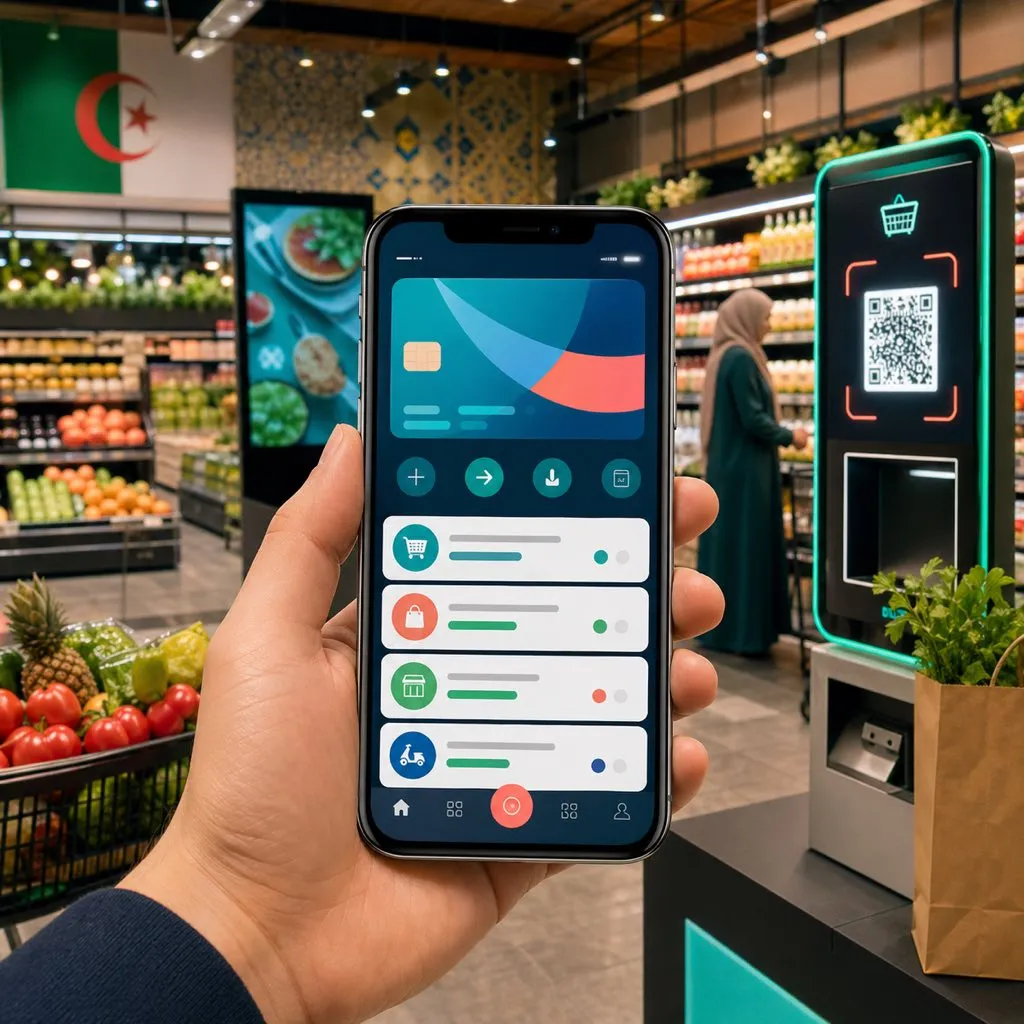
The Yassir Market model is architecturally different from a traditional hypermarket with an app. It is a purpose-built online-to-offline system with four integrated layers:
Layer 1 — Yassir Cash Digital Wallet: Yassir Cash is Yassir’s digital payment wallet, backed by an agent network that had grown to over 5,000 cash-in / cash-out points across Algeria by early 2026. At Yassir Market, Yassir Cash functions as the native payment method — enabling customers who do not have a bank card to conduct fully digital transactions by loading cash at an agent point and spending within the Yassir ecosystem. This is a critical inclusion bridge: it extends digital payments to the unbanked segment that COD-dependent competitors cannot serve without cash handling infrastructure.
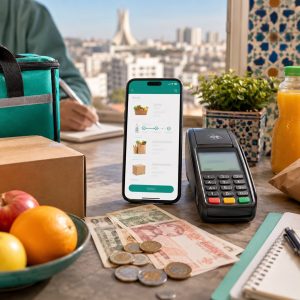
Layer 2 — Click-and-Collect Logistics: Click-and-collect allows customers to browse and order through the Yassir app, then collect their order at the Bab Ezzouar store at a scheduled time. This model eliminates the last-mile delivery uncertainty that drove Jumia’s return rates — the customer comes to the goods rather than waiting for goods to come to the customer. For groceries, which require refrigerated handling and have strict freshness windows, click-and-collect is operationally more reliable than home delivery in Algeria’s current logistics environment.
Layer 3 — In-Store Digital Kiosks: Physical kiosks within the Yassir Market store allow customers without smartphones to browse the digital catalogue, check prices, and initiate orders or payments. This is an important design choice: it serves the significant share of Algerian shoppers who are not yet smartphone-native but who visit physical stores regularly. Kiosk-initiated transactions count as digital transactions in Yassir’s data infrastructure, building purchasing profiles that improve personalization and inventory management.
Layer 4 — Kawarizmi Retail Media Stack: Yassir’s acquisition of Kawarizmi — a retail media technology company — added a data monetization layer to the physical retail operation. In-store screens, promotional slots, and supplier-facing analytics tools allow Yassir Market to sell advertising inventory to brands and suppliers, creating a revenue stream that pure e-commerce platforms cannot replicate. This retail media model mirrors what Amazon has built in North America and what Carrefour is building in Europe — and it positions Yassir Market as a platform business, not merely a grocery retailer.
Advertisement
What Algerian Retailers Should Take Away
1. Physical Presence Is Now a Fintech Moat, Not a Legacy Cost
The conventional wisdom in digital commerce held that physical retail was a cost burden — a legacy format being disrupted by apps and logistics networks. Yassir’s investment inverts this logic: physical stores are now a moat for digital wallets. A customer who visits Yassir Market, loads Yassir Cash at an agent point, and uses the Yassir app for click-and-collect is deeply embedded in the Yassir ecosystem. Competitors cannot easily replicate this because they would need to simultaneously acquire physical real estate, build an agent cash-in network, and develop the logistics integration — not just one of those three. Algerian retailers who still view their physical stores as separate from their digital presence should urgently reconsider: the O2O model makes physical stores the activation point for digital customer relationships, not an alternative to them.
2. Wallet Integration Beats Payment Gateway Integration for Loyalty Economics
Traditional e-commerce merchant strategy focuses on gateway integration — accepting CIB cards, adding BaridiMob QR, enabling Edahabia. These are necessary but not sufficient for loyalty economics. Yassir Cash operates differently: it is a closed-loop wallet that keeps purchasing power within the Yassir ecosystem. When a customer loads 5,000 DZD into Yassir Cash, that value is only spendable at Yassir-ecosystem merchants. The retention economics are structurally superior to card payments where the same card can be spent anywhere. Algerian retailers building digital payment strategy should evaluate whether a branded wallet or points system — even a simple one built on top of an existing gateway — can capture more purchasing power than raw transaction acceptance alone.
3. The Click-and-Collect Model Fixes the Last-Mile Problem for High-Value Categories
Algeria’s last-mile logistics environment makes home delivery expensive for low-margin, high-weight, or time-sensitive categories — particularly groceries and household goods. Click-and-collect eliminates the last-mile variable by treating the store as the endpoint. For retailers operating in those categories, click-and-collect is not a convenience feature — it is a margin protection strategy. The investment required is modest: a designated pickup zone, a QR-code-based order notification system, and staff trained to process collections. The logistics infrastructure (ordering, payment, inventory management) can be implemented via third-party platforms. Retailers who deploy click-and-collect before 2027 will be positioned to capture the wave of Algerian shoppers who discover app-based ordering through Yassir Market and expect the same option from other retailers.
4. Retail Media Is the Revenue Layer That Makes Omnichannel Sustainable
The grocery and hypermarket business is a thin-margin business in any market. What makes omnichannel investment financially sustainable is layering higher-margin revenue streams on top of the core product sales — specifically advertising revenue from suppliers and brands who pay to reach shoppers at the moment of purchase. Yassir’s Kawarizmi acquisition signals that this is the intended financial model for Yassir Market, not just a technical upgrade. Algerian retailers who build a customer data platform — even a basic one that tracks purchase patterns and channel preferences — create the foundation for selling advertising to the suppliers they already buy from. This transforms the retailer from a channel to a media company, with the corresponding margin expansion.
The Structural Lesson
Yassir Market is not primarily a story about a startup buying supermarkets. It is a story about the preconditions for digital wallet scale in a market where cash dominates. Backed by $193 million in cumulative funding, Yassir built the region’s largest ride-hailing and delivery super-app — but Yassir Cash’s agent network, at over 5,000 points, could not reach the volume scale required to compete with BaridiMob (with Algérie Poste’s 4,000+ post offices as natural agent locations) or the banking card networks, on app-to-app engagement alone.
Physical retail gave Yassir Cash a high-frequency activation use case: grocery shopping, which happens multiple times per week for most households. Yassir’s super-app platform had grown to over 30 million registered users across North and West Africa before the Uno acquisition, yet digital wallet penetration within that base remained well below its ride-hailing engagement — precisely because no daily spending anchor existed. A wallet used for groceries becomes a wallet used for ride-hailing, food delivery, and eventually financial services — building the engagement data, transaction volume, and user trust that a payments business requires to expand product offerings.
The Yassir Market experiment will either validate or challenge the O2O playbook for Algeria. If the Bab Ezzouar location achieves the customer density and transaction frequency that justifies the hypermarket operating costs, further Uno locations will follow. If not, Yassir will have learned whether the physical anchor thesis holds in Algeria’s specific market conditions — a lesson that no amount of app analytics can substitute for.
Frequently Asked Questions
What did Yassir acquire from Cevital and why does it matter?
Yassir acquired the Uno hypermarket chain from Cevital, an Algerian industrial conglomerate that founded Uno in 2007. The acquisition includes directly owned locations in Bouira and Aïn Defla, plus leased spaces in Algiers and Sétif. The first Yassir Market opened at Bab Ezzouar during Ramadan 2026. It matters because it gives Yassir a physical retail footprint to anchor its Yassir Cash wallet ecosystem and click-and-collect logistics in the high-frequency grocery category.
How does Yassir Cash function differently from a standard bank card payment?
Yassir Cash is a closed-loop digital wallet backed by an agent cash-in/cash-out network of over 5,000 points across Algeria. Unlike bank cards, which route through the CIB-SATIM interbank network and can be used at any merchant, Yassir Cash spending is retained within the Yassir ecosystem. This creates superior loyalty retention economics: once value is loaded into the wallet, it is preferentially spent at Yassir-ecosystem touchpoints — the app, Yassir Market stores, and Yassir delivery services.
What is the click-and-collect model and how does it solve Algeria’s last-mile problem?
Click-and-collect allows customers to order via the Yassir app and pick up their order at a Yassir Market store at a scheduled time. It eliminates last-mile delivery — the highest-cost, highest-risk part of e-commerce logistics in Algeria, where variable delivery times and cash-on-delivery return rates erode margins. For groceries, which are weight-heavy and time-sensitive, click-and-collect is more reliable than home delivery and does not require refrigerated last-mile vehicle infrastructure.
Sources & Further Reading
- Yassir Acquires Uno Hypermarkets, Algeria — Weetracker
- Algerian Super App Yassir Buys Uno Hypermarkets to Fill the Jumia-Shaped Hole — Launch Base Africa
- North African Superapp Yassir Acquires Uno Hypermarket Chain — Innovation Village
- Yassir Acquires Uno Stores to Support the E-Commerce Sector in Algeria and Africa — Entarabi