Combined capital expenditure from the four biggest hyperscalers is set to cross $600 billion in 2026, a 36 percent jump over 2025 and one of the largest corporate buildouts in modern industrial history. Amazon leads at roughly $200 billion, Google at $180 billion, Microsoft at $145 billion, and Meta at $115-135 billion. Around three-quarters of that — about $450 billion — is tied directly to AI infrastructure: GPUs, networking, power, and the data-center shells to house them. For every CIO, platform engineer, and founder building on cloud in 2026, the shape of this spending determines what is available, at what price, and when.
Where the money is actually going
Breaking down the AI-linked portion, four buckets dominate:
GPUs and accelerators. NVIDIA H200s, B200s, and next-generation Blackwell Ultra parts, plus growing allocations to AMD MI300X/MI355 and custom silicon (Google TPUs, AWS Trainium/Inferentia, Microsoft Maia, Meta MTIA). Accelerators alone account for a large share of per-data-center cost.
Power and cooling. A modern AI training campus now pulls hundreds of megawatts. Power-purchase agreements, transmission upgrades, and liquid-cooling retrofits are capex-heavy. Several hyperscalers have signed nuclear PPAs to secure long-term, carbon-free baseload.
Networking fabric. Intra-data-center InfiniBand and RoCE networks, optical interconnects between campuses, and subsea cable investments. Training frontier models across tens of thousands of GPUs is as much a networking problem as a compute problem.
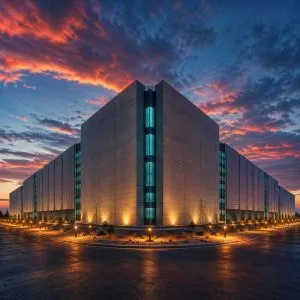
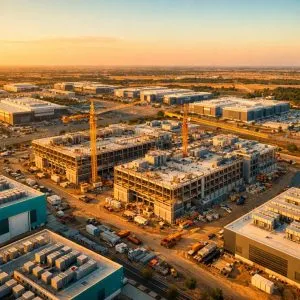
Data-center shells and land. The physical real estate is the least glamorous piece and among the hardest to accelerate. Lead times on new sites stretch 24-36 months.
Debt is replacing cash for the first time at scale
Through 2024 most hyperscaler capex was funded from operating cash flow. In 2026, debt financing is being used at scale for the first time. The Meta-Nebius $27 billion deal — where Meta effectively leases GPU capacity from a third-party provider, who in turn raises debt to build the data centers — is the template several others are copying. Project financing, asset-backed structures, and long-term data-center-as-a-service agreements are becoming standard.
Network World reporting on hyperscaler backlogs shows that demand continues to outpace supply: Microsoft and Google both cite multi-billion-dollar RPO (remaining performance obligations) tied to AI commitments that have not yet been delivered because the capacity does not exist yet.
What this means for GPU availability and pricing
Three dynamics will shape the 2026-2027 GPU market:
- Frontier-tier capacity remains constrained. Even with capex doubling, getting thousands of Blackwell Ultras on demand for a new project will still require long procurement cycles or co-development agreements.
- Mid-tier on-demand pricing stabilizes. As H100 and H200 capacity comes online from late-2025 builds, on-demand and spot pricing for one-to-hundreds-of-GPU workloads will moderate. This is the most relevant tier for most startups and enterprises.
- Regional differentiation grows. U.S., EU, and selected Asia-Pacific regions will have the widest instance catalogs first. Other regions — including Africa and parts of the Middle East — will see slower rollout, pushing teams toward sovereign-compute alternatives (see Singapore and Gulf national-AI programs as reference models for rapid regional buildout).
Advertisement
The concentration risk
Futurum Group projects 2026 AI capex approaching $690 billion when non-hyperscaler builders are included. A narrow set of buyers is placing orders that dwarf most national infrastructure budgets. The World Economic Forum has flagged the $7 trillion decade-long AI infrastructure forecast as a concentration-of-capital event comparable in scale to the early-2000s telecom buildout. The implication for everyone else: you are building on top of a stack being shaped by a very small number of procurement decisions.
What platform and cloud teams should plan for
Diversify frontier and production workloads. Even if most training and inference ends up on one provider, maintain live accounts and runbooks on a second. The 2026 capacity environment rewards optionality.
Write capacity commitments into contracts. Reserved-capacity and committed-use discounts are meaningful both for cost and for guaranteed access when on-demand runs short.
Model power as a scarce input. If you are operating private or colocated infrastructure, watch your power-purchase terms closely. Power price volatility is now a bigger risk than hardware depreciation for some workloads.
Plan for a mid-tier sweet spot. The biggest democratization effect of the $600B buildout is broader availability of H100/H200-class capacity at moderating prices. Architect to take advantage of this rather than chasing Blackwell Ultra unless you genuinely need frontier-tier training.
Expect regional lag. If you operate outside the U.S. and EU, assume a 6-18 month lag in instance availability for newest accelerators. This shapes localization strategy.
What Platform and Infrastructure Teams Should Decide Now
The $600 billion buildout changes the GPU market in ways that reward teams who plan ahead and penalise teams who assume yesterday’s procurement logic still applies. The five tactical positions below turn the macro analysis into executable decisions.
1. Lock in Committed-Use Discounts Before Mid-Tier Pricing Peaks
H100 and H200-class capacity coming online from late-2025 builds will moderate on-demand spot pricing through 2026, but committed-use and reserved-capacity contracts negotiated before that window closes capture the best terms. Network World reporting on hyperscaler backlogs confirms multi-billion-dollar remaining performance obligations that have not yet been delivered — providers will discount committed contracts to reduce that backlog. A team running 200 to 2,000 GPU-hours per month with predictable usage should run a comparative reserved-instance analysis across AWS, Google Cloud, and Azure for the specific instance type and region they use. The difference between on-demand and 1-year committed pricing for H100-class instances has been running at 30 to 40 percent. For a team spending $40,000 per month on on-demand GPU compute, that is a $14,000-$16,000 monthly saving available today.
2. Maintain Live Accounts on Two Providers Before Capacity Runs Short
Even with $450 billion in AI-linked capex, frontier Blackwell Ultra capacity will remain allocation-constrained through 2026. The Futurum Group’s projection of $690 billion total AI capex when non-hyperscaler builders are included does not change the supply bottleneck at the frontier tier, because hyperscalers and co-development partners absorb that capacity first. Teams that operate exclusively on a single provider have no negotiating leverage when that provider’s allocation is sold out. Maintaining a live account, runbooks, and a quarterly deployment on a second provider costs roughly 5 percent of the primary provider’s spend and provides immediate optionality when an availability zone goes down, a provider raises prices, or a new instance type becomes available first on a competitor’s platform. AWS, Google Cloud, and Azure all offer free-tier access and credits that cover the cost of maintaining a secondary environment at low usage levels.
3. Architect for Mid-Tier Efficiency, Not Frontier-Tier Assumption
The $600 billion buildout’s democratisation effect lands in the mid-tier first: H100 and H200-class instances at moderating prices for one-to-hundreds-of-GPU workloads. Teams that have architected their training and inference pipelines assuming Blackwell Ultra access will be blocked or priced out when those instances are unavailable outside committed co-development agreements. The correct architectural posture is to design against the H100/H200 performance envelope and treat Blackwell Ultra as an upgrade path, not a baseline requirement. The World Economic Forum’s $7 trillion decade-long AI infrastructure forecast notes that this buildout mirrors the early-2000s telecom expansion — and that early-2000s telecom buyers who over-specified for OC-192 when OC-48 was available and cheaper paid the price in overbuilt capacity that sat unused for years.
Bottom line
The $600 billion figure is less a headline and more a planning anchor. It signals that AI compute is graduating from scarce luxury to industrial commodity, but the transition runs through 2027 at best. Teams that map their workloads to the capacity tiers being built — and that negotiate commercial and technical optionality — will capture the value. Teams assuming yesterday’s pricing and availability will be surprised in both directions.
Frequently Asked Questions
Why is hyperscaler capex rising so fast in 2026?
Demand for AI training and inference capacity has outpaced existing data-center supply, and building new capacity requires land, power, accelerators, and networking — all of which have long lead times. Hyperscalers are spending to close the gap.
Does this mean GPU prices will drop sharply in 2026?
Mid-tier on-demand pricing (H100, H200-class) is expected to moderate as new capacity comes online. Frontier-tier Blackwell Ultra capacity will remain tight and expensive, with access often requiring committed contracts.
How should smaller teams without hyperscaler budgets respond?
Lock in reserved or committed-use discounts where usage is predictable, diversify across two providers for optionality, and architect to run efficiently on mid-tier accelerators rather than assuming frontier-tier access.
Sources & Further Reading
- Hyperscaler Capex $600B in 2026: A 36% Increase Over 2025 — ComSoc Technology Blog
- AI Capex 2026: The $690B Infrastructure Sprint — Futurum Group
- Hyperscaler Backlogs Show Growing Demand for AI Infrastructure — Network World
- Are AI Investments Sizing Up the $7 Trillion Buildout Right? — World Economic Forum