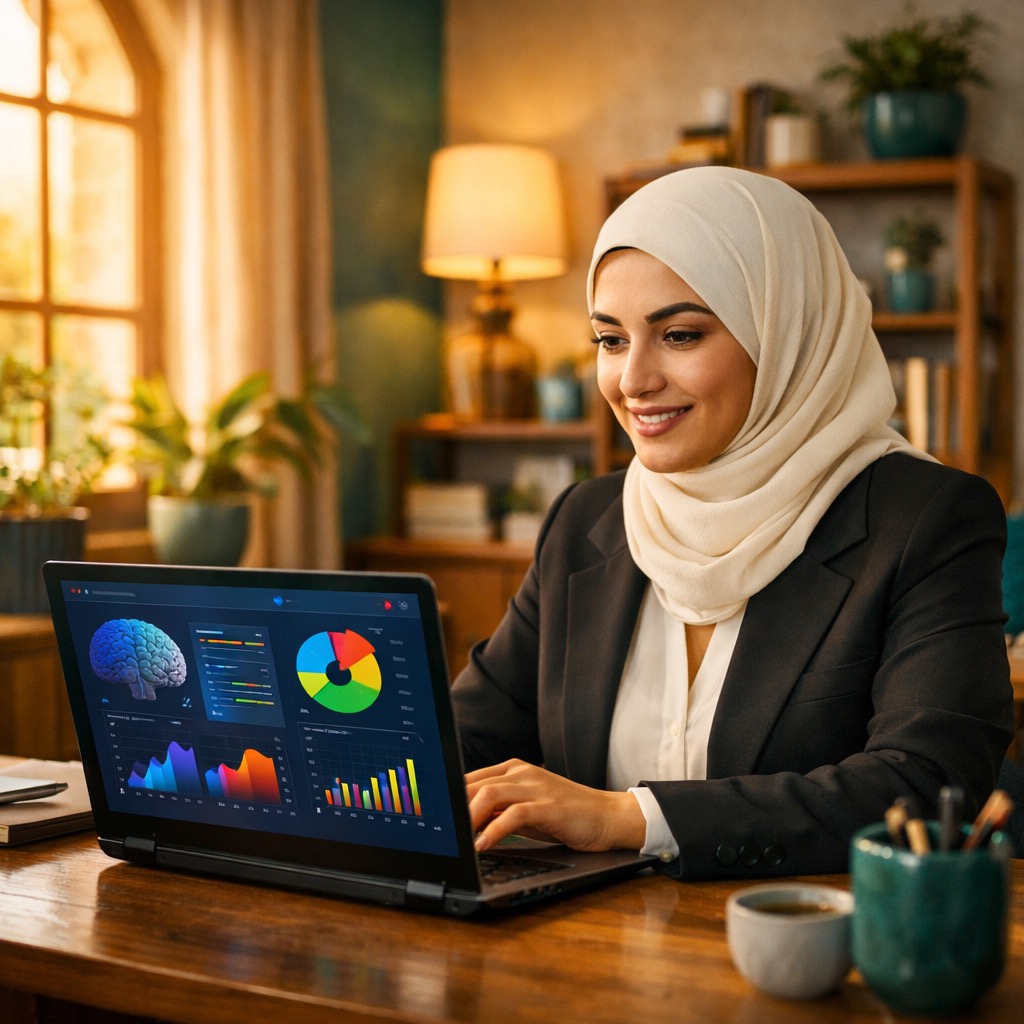
Walk into any commercial district in Algiers, Oran, or Constantine in 2026, and you will find something that would have been unimaginable five years ago: small business owners casually discussing ChatGPT prompts over coffee. The owner of a clothing boutique in Bab El Oued uses it to write Instagram captions in French and Algerian Arabic. A wedding photographer in Tlemcen generates SEO descriptions for his website. An import-export broker in Setif drafts bilingual correspondence with suppliers in Turkey and China.
Generative AI has arrived in Algeria’s small and medium enterprise (SME) sector — not through formal digital transformation programs, but through the back door of individual curiosity and WhatsApp-shared tips. According to Microsoft’s Global AI Adoption Report published in January 2026, roughly 12% of Algeria’s working-age population now uses generative AI tools, placing the country tenth in Africa for adoption. The uptake is real, messy, and far more widespread than any official statistics fully capture.
But beneath the surface enthusiasm lies a more complicated picture. Most adoption is superficial. Few SMEs have integrated AI into core business processes. The tools that work brilliantly in English often stumble in French and fail entirely in Algerian Darija. And the gap between what generative AI can theoretically do for a business and what an Algerian SME owner can practically extract from it remains vast.
This article maps the actual state of generative AI adoption among Algerian SMEs in 2026 — what is working, what is not, and what needs to happen for AI to move from a novelty to a genuine business advantage.
Algeria’s SME Landscape: The Context
Algeria’s economy is dominated by small and medium enterprises. Official data from the National Statistics Office (ONS) counted approximately 1.36 million registered SMEs at the end of 2022, though the actual number — including informal businesses — is significantly higher. These enterprises employ over 3.2 million people and represent the backbone of Algeria’s non-hydrocarbon economy.
The structure is striking: roughly 98% of Algeria’s SMEs are very small enterprises (VSEs) with fewer than 10 employees. Only about 3,170 firms qualify as medium-sized (50-249 employees), making up just 0.31% of the total. The majority operate in services (approximately 700,000 enterprises), followed by artisan activities (over 300,000) and construction (over 200,000).
The typical Algerian SME operates in services or trade, has limited digital infrastructure, and is managed by an owner who wears every hat. Formal IT budgets are virtually nonexistent. Digital tools are adopted through personal initiative, usually on mobile devices rather than desktops — unsurprising in a country with 54.8 million mobile connections, equivalent to 116% of the population.
This context matters enormously for understanding AI adoption. Algerian SMEs are not deploying enterprise AI platforms. They are using ChatGPT on their phones during lunch breaks. And that grassroots pattern shapes both the opportunities and the limitations.
How Algerian SMEs Actually Use Generative AI
Based on conversations with business owners, trade association representatives, and digital service providers across Algeria, several clear adoption patterns have emerged.
Marketing and Social Media Content
This is by far the most common use case. Algeria has 25.6 million social media users — 54.2% of the population — with Facebook alone reaching 25.6 million users and Instagram reaching 12 million. Algerian SMEs, particularly those in retail, food service, and personal services, rely heavily on these platforms for customer acquisition. Maintaining a consistent social media presence requires a steady stream of content, something that overwhelms solo operators and small teams.
Generative AI has become the de facto content assistant. Business owners use ChatGPT, Google Gemini, and Meta AI to draft social media posts, product descriptions, promotional announcements, and seasonal campaign copy. The workflow is typically: think of the general message, prompt the AI in French (sometimes English), review the output, and post.
The results are noticeable. Businesses that previously posted sporadically — maybe two or three times a week — now maintain daily posting schedules. The quality of copy has improved for businesses that previously relied on the owner’s limited marketing skills.
However, the language challenge is significant. Most Algerian social media operates in a blend of French and Darija (Algerian Arabic dialect). AI tools handle standard French well but struggle with Darija, producing output that sounds stilted and overly formal to Algerian audiences. Businesses targeting Arabic-speaking audiences outside Algeria fare slightly better, as MSA (Modern Standard Arabic) output is competent, but it lacks the local flavor that drives engagement.
Some savvy SME owners have developed workaround prompts: “Write this in casual French as if speaking to a young Algerian audience” or “Make this sound like a Facebook post from an Algerian business, not a corporate press release.” These yield better results, but require prompt engineering skills that most business owners do not have.
Customer Service and Response Templates
The second most common use case is customer service communication. Algerian SMEs — especially e-commerce sellers on Facebook Marketplace and Instagram — receive dozens or hundreds of direct messages daily. Responding to repetitive questions (pricing, availability, delivery zones, payment methods) consumes hours.
Business owners use AI to generate response templates that they then customize for individual customers. Some have gone further, using AI to draft FAQ pages for their websites or scripted responses for phone inquiries.
A furniture retailer in Hussein Dey described his process: “I gave ChatGPT my 20 most common customer questions and asked it to write professional responses in French. I saved them as text shortcuts on my phone. My response time went from hours to minutes.”
This is a practical, high-impact use case. But few Algerian SMEs have progressed to actual chatbot deployment — the technical barriers (integration with messaging platforms, hosting, ongoing maintenance) remain too high for most.
Translation and Multilingual Communication
Algeria’s multilingual reality (Arabic, French, Amazigh, with English increasingly important for international trade) creates constant translation needs. SMEs that trade internationally — importing goods from China, Turkey, or Europe, or selling to other African markets — regularly need translation services.
Generative AI has effectively replaced professional translators for routine business communication among many SMEs. Import-export operators use ChatGPT to translate supplier correspondence, draft purchase orders in multiple languages, and create multilingual product catalogs.
The quality is acceptable for business communication. It is not adequate for legal documents, regulatory filings, or marketing materials requiring cultural nuance — but for the volume of routine translation that SMEs need, it is a transformative improvement over the previous options (expensive human translators or unreliable free tools).
Invoice Processing and Administrative Tasks
A smaller but growing segment of SMEs uses generative AI for administrative tasks: drafting invoices, creating contracts from templates, writing business correspondence, and formatting reports. Some accountants and bookkeepers serving SME clients have integrated AI into their workflows for tax filing preparation and financial summary generation.
One accounting firm in Blida reported using AI to draft explanatory notes for clients’ financial statements: “What used to take 45 minutes per client now takes 10 minutes. The AI drafts the standard language, and I customize the specifics.”
Product Photography Enhancement
An emerging use case is AI-powered product photography. Small retailers — particularly clothing, jewelry, and home decor businesses — use AI tools to enhance product photos, remove backgrounds, generate lifestyle mockups, and create promotional graphics. Tools like Canva’s AI features, Remove.bg, and ChatGPT’s image generation have become part of the visual content toolkit.
This is particularly impactful for Instagram-based businesses where visual quality directly impacts sales. A handbag seller in Oran noted: “Before, I needed to pay a photographer 5,000 DA per product shoot. Now I take photos on my phone, clean them up with AI, and the result looks professional.”
Barriers to Deeper Adoption
Despite these real use cases, generative AI adoption in Algerian SMEs remains largely surface-level. Several barriers prevent deeper integration.
Internet Connectivity and Speed
Algeria’s internet infrastructure, while improving, remains a constraint. According to DataReportal’s Digital 2025 report, Algeria’s median fixed broadband download speed is 15.05 Mbps, while median mobile download speeds reach 23.42 Mbps. Algerie Telecom’s fiber connections perform better, averaging around 50 Mbps in major cities, but availability is uneven.
The good news is that 4G now represents nearly 90% of Algeria’s 54.87 million mobile subscriptions, with 5G licenses recently granted to Mobilis, Djezzy, and Ooredoo for nationwide rollout over the next six years. AI tools like ChatGPT and Gemini work reasonably well on Algeria’s current mobile internet, but more demanding applications — video generation, large document processing, API-based integrations — can be frustratingly slow, especially outside major urban centers.
Cost of Premium Tools
The free tiers of ChatGPT and Gemini are what most Algerian SMEs use. Premium subscriptions ($20/month for ChatGPT Plus or Google AI Pro) represent a significant expense for very small businesses where margins are tight.
More specialized AI tools — Jasper for marketing, Midjourney for images, Descript for video — are even further out of reach. The payment barrier compounds the cost issue: many Algerian SME owners lack international payment cards (Visa/Mastercard) needed for foreign subscription services. While CIB cards issued by Algerian banks support some domestic online transactions, international payment capabilities remain limited and inconsistent. Virtual card services like Buvei have emerged as a workaround, but awareness and adoption of these solutions is still low.
This creates a two-tier adoption pattern: SMEs with international payment access (often through personal connections or diaspora family members) can access premium AI tools, while the majority are limited to free tiers with their inherent restrictions on usage volume, model quality, and features. The emergence of free alternatives — notably DeepSeek, which Microsoft’s report found is used 2 to 4 times more heavily in Africa than in other regions — is partially closing this gap.
French and Arabic Language Limitations
Generative AI tools perform best in English. French performance is good but noticeably weaker, particularly for domain-specific content (legal, technical, medical). Arabic performance varies — MSA is acceptable, but dialectal Arabic (including Darija) is poor.
For Algerian SMEs that operate primarily in French and Arabic, this means AI output requires more editing and correction than English-language users experience. The productivity gain is still positive, but smaller than the global hype suggests.
The Darija gap is particularly frustrating for consumer-facing businesses. Social media audiences in Algeria respond best to content that sounds authentically local. AI-generated content in formal French or MSA often falls flat, reading like translated corporate copy rather than genuine business communication.
Digital Literacy and Prompt Engineering
Using generative AI effectively requires a skill — prompt engineering — that is not intuitive. Many Algerian SME owners discover AI tools through social media or word of mouth, try them a few times with basic prompts, get mediocre results, and either persist with low-quality usage or abandon the tool.
The difference between a vague prompt (“Write me a Facebook post about my restaurant”) and an effective one (“Write a casual, enthusiastic Facebook post in French for a family restaurant in Bab Ezzouar, Algiers, promoting our new couscous Friday special at 1,200 DA per person, targeting families, with a warm conversational tone”) is enormous. But teaching that skill at scale to SME owners who are already stretched thin requires deliberate effort.
A few Algerian digital agencies and freelancers have begun offering “AI coaching” sessions for SME owners — 2-3 hour workshops on effective prompting for business use cases. These are popular but reach only a tiny fraction of the market. The OECD’s 2025 survey on generative AI and SMEs found that firm-provided training and employer encouragement boost benefits by 10% to 40%, underscoring how much structured support matters.
Data Privacy and Trust Concerns
Many SME owners are hesitant to input sensitive business information into AI tools. Customer data, pricing strategies, supplier information, financial details — these are closely guarded in Algeria’s business culture. The idea of typing them into a foreign-owned AI system creates discomfort.
This concern is not unfounded. The OECD’s survey found that 54% of SMEs globally express concerns about copyright, legal, and regulatory issues around generative AI, and about what happens to the information fed into AI models. For Algerian SME owners without the sophistication to evaluate these risks, the default response is avoidance — using AI for generic content but keeping business-critical information offline.
Advertisement
MENA Context: How Algeria Compares
Across the MENA region, generative AI adoption follows similar patterns but at vastly different speeds. The UAE leads dramatically — Microsoft’s report found that 64% of the UAE’s working-age population used generative AI by end of 2025, making it the top country globally. This is driven by massive government AI investment (including a $100 billion+ AI infrastructure deal with the US), high digital literacy, and near-universal premium tool access. Saudi Arabia follows at 26%, supported by a $10 billion Google Cloud partnership and growing digital payment penetration.
Morocco, Algeria’s closest comparator, is investing in Arabic-language AI capacity. The country’s research community developed Atlas-Chat, the first large language model collection specifically designed for Moroccan Darija. Morocco has also partnered with France’s Mistral AI to build models that understand Arabic, Darija, and Amazigh — languages shared with Algeria. These initiatives create tools that could benefit Algerian SMEs as well.
Tunisia has a vibrant tech startup scene, with a generative AI adoption rate of 12.70% according to Microsoft’s data — slightly ahead of Algeria’s 12%. Both countries face similar SME adoption barriers: limited international payment access, language gaps in AI tools, and modest digital infrastructure.
Algeria’s position is roughly mid-pack for the Maghreb in raw adoption numbers but lags in depth — integration into business processes, premium tool usage, and API-based workflows remain rare. The bright spot is Algeria’s market size. With over 1.36 million registered SMEs, even modest deepening of adoption represents a massive aggregate market — one that should attract both international AI providers and local startups building Algeria-specific solutions.
What Needs to Happen: Practical Recommendations
For SME Owners
Start with one high-impact use case. Do not try to AI-ify everything at once. Pick the task that consumes the most time for the least value — social media content, customer response templates, or product descriptions — and build competence there before expanding.
Invest in learning effective prompting. Spend 2-3 hours watching prompt engineering tutorials (available free on YouTube in French and Arabic). The investment pays for itself within days in better AI output quality.
Use free tools strategically. ChatGPT free tier, Google Gemini, DeepSeek, Meta AI, and Microsoft Copilot all offer capable generative AI at no cost. Combine them — use whichever performs best for each specific task. Claude offers strong performance for French-language content.
Protect sensitive data. Never input customer personal data, financial details, or trade secrets into AI tools. Use AI for generating generic templates, then customize with specifics offline.
For the Algerian Government and Support Ecosystem
Integrate AI literacy into the Digital Algeria 2030 plan. The government’s ambitious 500+ digital transformation projects for 2025-2026, led by High Commissioner for Digitalization Meriem Benmouloud, focus primarily on public service modernization. Extending this vision to include practical AI training for SMEs — delivered through Chambers of Commerce across all 69 wilayas — would have outsized economic impact.
Address the payment barrier. The inability to pay for foreign digital services remains one of the biggest practical barriers to technology adoption in Algeria. Expanding international payment capabilities for CIB cards — or enabling local resellers of international AI subscriptions priced in dinars — would have an outsized impact.
Support Arabic and Darija AI development. Morocco’s Atlas-Chat project and Mistral AI partnership demonstrate what is possible. Algeria’s universities and emerging AI community should contribute to open-source Arabic language AI efforts. Fine-tuning models on Algerian French and Darija text would unlock value for millions of SME users.
Create an AI tool directory in French and Arabic. Many SME owners do not know what tools exist or how to evaluate them. A curated, government-endorsed directory of AI tools — with use-case guides and cost comparisons — would reduce the discovery barrier.
For the Algerian Tech and Startup Ecosystem
Build Algeria-specific AI wrappers. There is an opportunity for Algerian startups to build user-friendly interfaces on top of foundation models (via API), pre-configured for Algerian SME use cases: social media content in Algerian French and Darija, customer service bots for Facebook Messenger and Instagram DMs, invoice generation compliant with Algerian tax requirements.
Offer AI-as-a-Service in local currency. Pricing in dinars, accepting CIB and Edahabia payments, and providing Arabic and French support would remove the three biggest adoption barriers simultaneously.
Partner with trade associations. The Federation of Algerian Entrepreneurs (FCE), CACI, and sector-specific trade associations provide access to concentrated SME audiences. AI tool providers should partner with these organizations for distribution and training.
The Productivity Promise
The McKinsey Global Institute estimates that generative AI could increase global labor productivity by 0.1 to 0.6 percentage points annually through 2040, depending on adoption speed and how worker time is redeployed. Combined with other automation technologies, the range rises to 0.5 to 3.4 percentage points. For a country like Algeria, where labor productivity growth has been sluggish and economic diversification beyond hydrocarbons is a national priority, even the lower end of that range would be meaningful.
But the productivity gains do not appear automatically. They require adoption, integration, and skill development. Globally, the OECD found that 31% of SMEs now use generative AI, but depth of use varies enormously. Algeria’s SME sector has taken the first step — awareness and initial experimentation. The next step — systematic integration of AI into business processes — is where the real economic value lies.
The risk is that Algeria’s SMEs get stuck in the “toy phase” — using AI for minor convenience but never progressing to genuine productivity transformation. That outcome would leave Algeria’s small businesses less competitive relative to peers in Morocco and Tunisia who are investing in Arabic-language AI capacity, or in the UAE where two-thirds of the working-age population already uses these tools daily.
Frequently Asked Questions
What percentage of Algerian workers use generative AI?
According to Microsoft’s Global AI Adoption Report (January 2026), approximately 12% of Algeria’s working-age population uses generative AI tools such as ChatGPT, Gemini, and DeepSeek. This places Algeria tenth in Africa for AI adoption, slightly behind Tunisia (12.70%) and well below South Africa (21.19%).
Which generative AI tools are most popular among Algerian SMEs?
The free tiers of ChatGPT and Google Gemini dominate, largely because they require no subscription payment. Meta AI (integrated into WhatsApp and Instagram) is also widely used. DeepSeek, a free open-source alternative, has gained significant traction across Africa, with usage rates 2 to 4 times higher than in other regions according to Microsoft’s research.
Can Algerian SMEs pay for premium AI subscriptions?
The main barrier is international payment access. CIB and Edahabia cards primarily support domestic transactions. SME owners who need premium AI tools ($20/month for ChatGPT Plus or Google AI Pro) often rely on diaspora connections, virtual card services like Buvei, or informal workarounds. Expanding CIB international payment capabilities or enabling local dinar-priced resellers would significantly increase access.
Sources & Further Reading
- Global AI Adoption in 2025 — Microsoft AI Economy Institute — Comprehensive data on generative AI adoption rates by country, including Algeria’s 12% adoption rate and Africa-wide trends.
- The Economic Potential of Generative AI — McKinsey Global Institute — Analysis estimating generative AI could increase labor productivity by 0.1 to 0.6 percentage points annually through 2040.
- Generative AI and the SME Workforce — OECD — Survey data showing 31% of SMEs use generative AI, with findings on skill gaps, training impact, and policy recommendations.
- Digital 2025: Algeria — DataReportal — Internet penetration (76.9%), mobile connections (54.8M), social media usage, and broadband speed data for Algeria.
- Algeria’s Digital Transformation Plan: Over 500 Projects for 2025-2026 — MEA Tech Watch — Details of Algeria’s Digital Algeria 2030 initiative and the five-pillar digital transformation strategy.
- Microsoft Study Maps Africa’s Generative AI Uptake — Ecofin Agency — Analysis of free platform-driven AI adoption across Africa, including DeepSeek’s outsized role.
- Morocco Wants to Build AI That Speaks for Africa — Rest of World — Morocco’s investments in Arabic and Darija-language AI, including Atlas-Chat and the Mistral AI partnership.
🔗 Related Intelligence

Algeria’s Emerging AI Regulation: Balancing Innovation with Accountability

Algeria Tech Ecosystem: How AI Is Reshaping the Startup Scene

Intent Engineering for Algerian Enterprises: Before You Deploy AI

Algeria’s 859 AI Papers: Strong Research, Weak Commercialization Pipeline