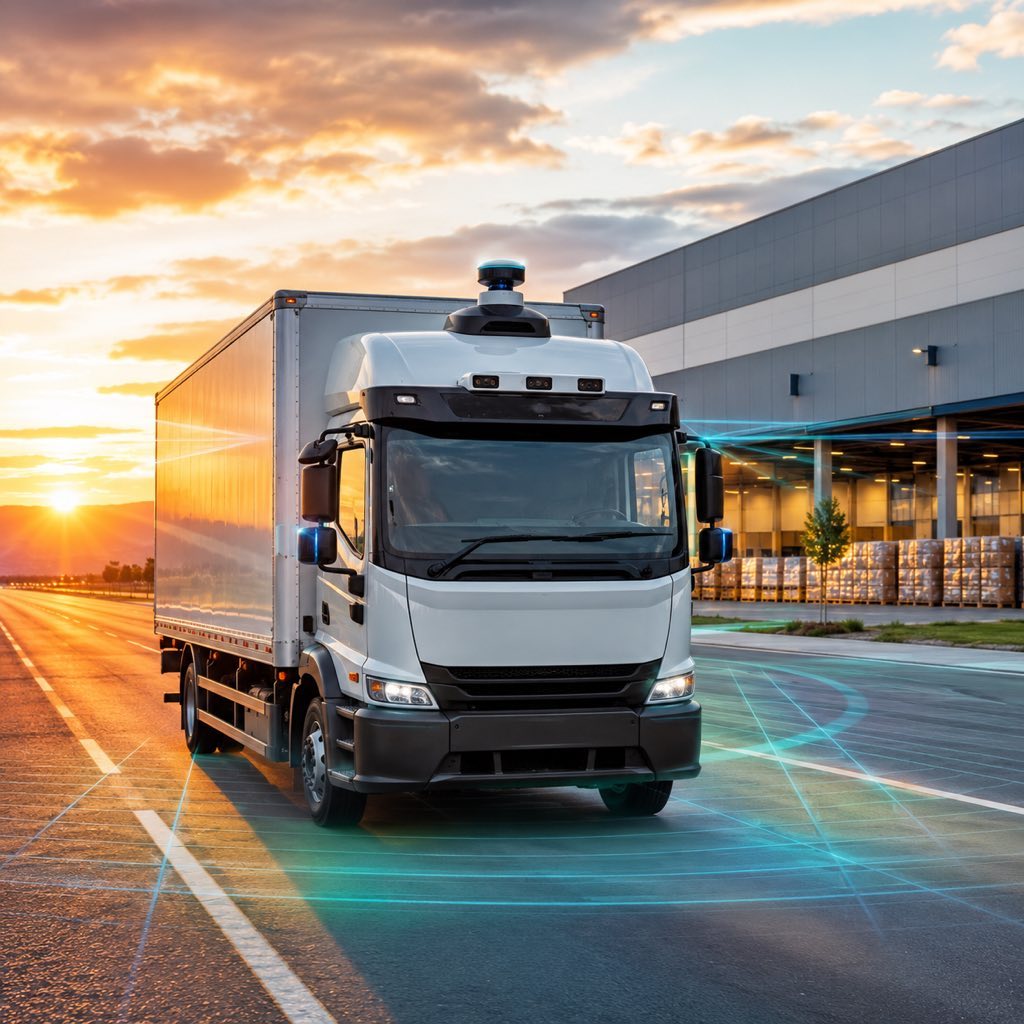
A Funding Round Anchored in Delivered Freight
The autonomous-vehicle industry spent a decade raising money on promises; Gatik’s latest round is notable because it raised on receipts. On August 25, 2026, Gatik announced a $200 million Series D led by the Qatar Investment Authority and Koch Disruptive Technologies, with participation from Millennium Management, ARK Invest and Intact Private Capital. The round brings the company’s total capital raised to approximately $500 million and is its largest to date.
What distinguishes this from the robotaxi era is the operating record underneath it. Gatik reports it has completed 85,000 fully driverless orders with 99% arriving on time, and that contracted revenue across its customer base runs past $600 million. The company pulled safety drivers from its commercial routes and now runs dozens of trucks that are fully driverless in day-to-day operation — not in a pilot, but moving real freight for real customers on fixed routes.
That customer list is the second signal. Gatik moves goods for Walmart — its first customer, disclosed years ago — along with Kroger, Tyson Foods and Loblaw in Canada. The most concrete recent proof point is a PepsiCo deal in which 41 driverless box trucks shuttle Frito-Lay products across Dallas, Phoenix and northwest Arkansas. These are not demonstrations arranged for investors; they are recurring commercial deliveries under contract, which is precisely why a sovereign wealth fund and an industrial-strategic investor were willing to lead the round.
Why the “Middle Mile” Is the Autonomy Niche That Actually Works
Gatik’s thesis is narrower — and more defensible — than the robotaxi dream that consumed most autonomous-vehicle capital. The company does not attempt full self-driving on open roads at highway speed with unpredictable passengers. It runs the “middle mile”: short, fixed, repeated business-to-business routes between distribution centers and retail locations, typically on the same roads day after day. That constraint is the whole point.
Fixed, repeated routes are radically easier to automate safely than open-ended passenger driving. The vehicle sees the same intersections, the same merges and the same conditions on every run, so the system can be validated exhaustively against a bounded problem rather than an infinite one. That is why Gatik could remove safety drivers on commercial routes while general-purpose self-driving remains stubbornly hard — it chose a problem it could actually finish. The economic pull is just as strong: freight moves on schedules and margins where removing the driver has clear, quantifiable value, and a 99% on-time rate on 85,000 driverless orders is the kind of operational metric a logistics buyer can underwrite.
What the Investor Syndicate Tells You
The composition of the round is as informative as its size. The Qatar Investment Authority is a sovereign wealth fund making a long-horizon infrastructure bet, and Koch Disruptive Technologies is the venture arm of an industrial conglomerate with deep operational exposure to logistics — Koch Disruptive Technologies had already led Gatik’s $85 million Series B in 2021 and returned as a lead investor here. A returning lead who has watched the company operate for years is a stronger endorsement than a new name chasing a hot sector.
The presence of ARK Invest and Millennium Management alongside a sovereign fund also signals that driverless freight is being priced as an operating business with real revenue, not a moonshot option. The money is earmarked for scaling: Gatik plans to grow its fleet from dozens of trucks today to more than 100 by the end of 2026, and to expand its workforce and geographic footprint to serve more of the large retailers and manufacturers already on its customer list. This is growth-stage capital funding the expansion of a working operation, which is a different risk profile from the early autonomous rounds that funded research toward an unproven capability.
Advertisement
What This Means for Founders and Investors Watching Autonomy
1. Narrow the problem until it is finishable, then dominate it
Gatik’s edge is not superior self-driving technology in the abstract — it is a deliberately bounded problem. Founders in hard-tech categories should study how narrowing the scope from “drive anywhere” to “drive these fixed routes” turned an unsolved problem into a shippable product. Pick the constrained version of your market that you can actually complete and defend, and win it fully before broadening.
2. Raise on operating metrics, not roadmap slides
The most persuasive line in Gatik’s raise is not a projection — it is 85,000 completed driverless orders at 99% on-time and $600 million in contracted revenue. Investors in 2026 are rewarding demonstrated operations over vision, especially in capital-intensive categories. If you are building something physical and expensive, prioritise reaching a real operating metric you can quote before you raise your growth round; it changes who is willing to lead.
3. Read the investor mix as a signal about your category’s maturity
When a sovereign wealth fund and a returning industrial-strategic investor co-lead a round, the category has moved from speculative to operational in investors’ eyes. Founders and later-stage investors should watch the composition of syndicates in adjacent hard-tech sectors — the arrival of infrastructure and strategic capital, replacing pure venture growth funds, is an early marker that a technology has crossed from promise into business.
The Correction Scenario
The optimistic read is that Gatik has found the durable niche in autonomy — bounded routes, real revenue, patient strategic capital — and that the $200 million simply accelerates a working machine. The counter-case is worth stating plainly. Scaling from dozens of trucks to a nationwide fleet introduces failure modes that fixed-route pilots do not surface: new geographies mean new roads to validate, weather and construction disrupt the “same route every day” assumption, and a single high-profile safety incident could reset public and regulatory tolerance for driverless freight overnight. The economics also depend on customers continuing to contract at scale, and contracted revenue is a promise, not yet fully realised cash.
Even so, Gatik’s raise marks a genuine shift in how autonomy is financed. The money is chasing an operation that already runs, not a capability that might one day exist — and that is the healthiest thing that can happen to a hype-scarred sector. Whether or not Gatik itself becomes the category winner, the template it demonstrated in August 2026 — bound the problem, prove the operation, then raise growth capital on the metrics — is the one the next wave of serious hard-tech founders will be measured against.
Frequently Asked Questions
How much did Gatik raise and who led the round?
Gatik raised a $200 million Series D announced on August 25, 2026, led by the Qatar Investment Authority and Koch Disruptive Technologies, with participation from Millennium Management, ARK Invest and Intact Private Capital. The round brings Gatik’s total capital raised to approximately $500 million and is the company’s largest funding round to date. The company did not disclose a valuation.
What makes Gatik different from robotaxi companies?
Gatik does not attempt full self-driving on open roads with passengers. It automates the “middle mile” — short, fixed, repeated business-to-business routes between distribution centers and retail locations. Because the routes are bounded and repetitive, the system can be validated against a finite problem, which is why Gatik has removed safety drivers on commercial routes and completed 85,000 fully driverless orders at 99% on-time while general-purpose self-driving remains difficult.
What is Gatik’s operating track record?
Gatik reports 85,000 fully driverless orders completed with 99% arriving on time, and more than $600 million in contracted revenue across customers including Walmart, PepsiCo, Kroger, Tyson Foods and Loblaw. A recent PepsiCo deal has 41 driverless box trucks moving Frito-Lay products across Dallas, Phoenix and northwest Arkansas. The new funding is earmarked to grow its fleet from dozens of trucks to more than 100 by the end of 2026.
Sources & Further Reading
- Self-driving truck startup Gatik raises $200M following PepsiCo deal — TechCrunch
- Gatik raises $200M to grow driverless fleet past 100 trucks this year — SiliconANGLE
- Gatik has raised $200m to put more driverless box trucks on US roads — The Next Web
- Gatik Scores New $200 Million Investment For Its Driverless Truck Tech — Forbes
🔗 Related Intelligence

The SELF DRIVE Act: America’s First Federal Law for Autonomous Vehicles

Hacking the Highway: Cybersecurity Risks in Connected and Autonomous Vehicles

When Wallets Become Government Rails: GCash, Fuel Subsidies, and the Public-Distribution Playbook

From Driver Loans to Robotaxi Depots: Moove Raised $250M at a $2.1B Valuation