
🧭 Decision Radar
Relevance for Algeria
Low
▾
Infrastructure Ready?
Partial
▾
Skills Available?
Partial
▾
Action Timeline
Monitor only
▾
Algerian university robotics labs, Ministry of Higher Education and Scientific Research, Ministry of Industry, logistics and fulfillment operators, Algeria Venture
Decision Type
Educational
▾
Quick Take: Eka Robotics raised $150 million at a $1.45 billion valuation by pairing simulation-trained reinforcement learning with a gripper costing less than $1,000. For Algerian researchers and industrial planners, the takeaway is to build simulation and control skills while treating company-reported figures like 1,500 picks per hour with healthy skepticism until year-long factory durability is proven.
A $1.45 Billion Valuation Built on Touch and Simulation
Eka Robotics has raised a $150 million Series A at a $1.45 billion post-money valuation, placing the young robotics company firmly in unicorn territory. According to Tech Funding News, the round was led by a16z and F-Prime, an affiliate of Fidelity parent FMR. Before this financing, Obvious Ventures and E14 Fund led an earlier seed round that PitchBook lists at $11 million in May 2025.
The company’s academic pedigree helped draw top-tier venture firms. TechCrunch notes that Eka was founded by MIT professor Pulkit Agrawal and former Google DeepMind researcher Tuomas Haarnoja, who met as graduate students at UC Berkeley. Rather than copying the prevailing industry template for robot control, Eka pitches a vision-force-action architecture rather than the vision-language-action approach, trained largely in simulation with reinforcement learning.
Company-Reported Speed Meets Hardware Skepticism
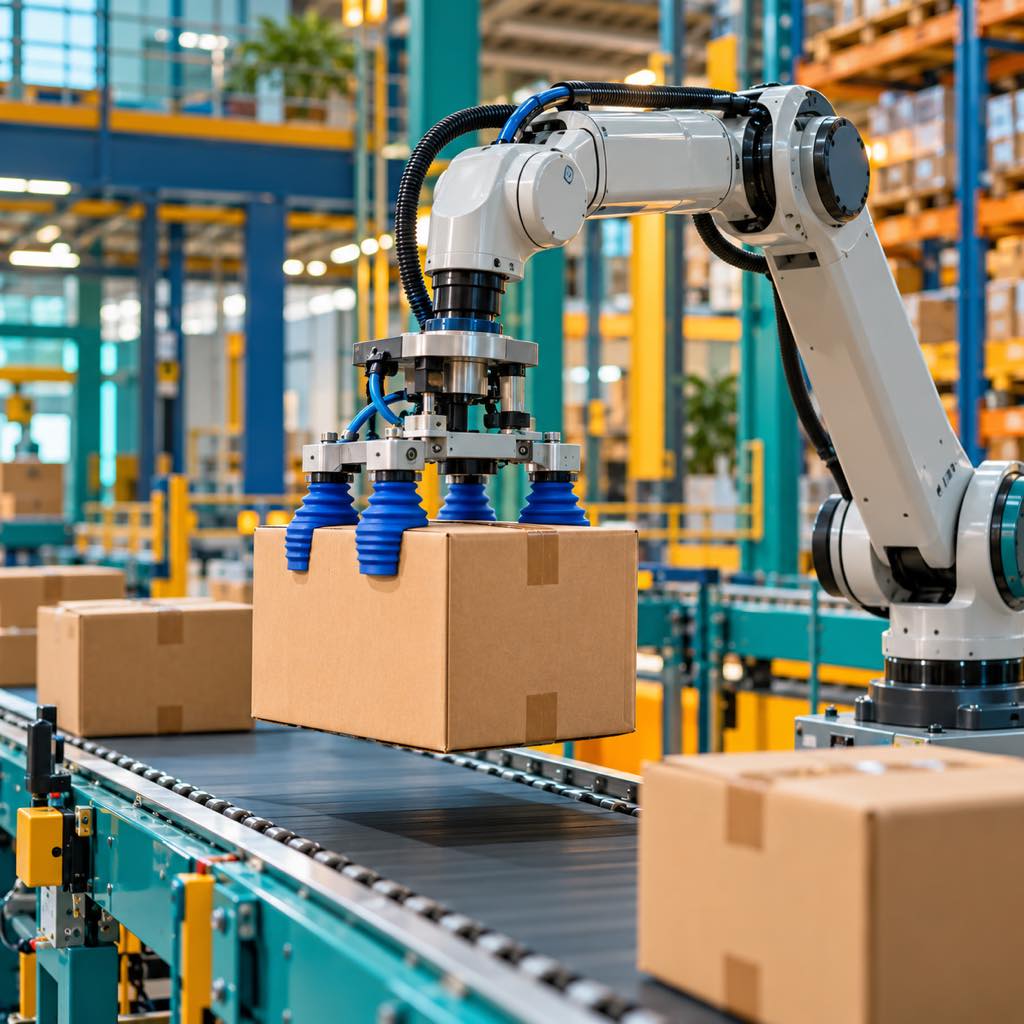
On the hardware and throughput side, the startup emphasizes low component cost and rapid manipulation, though its headline benchmarks are company-reported rather than independently audited. According to Tech Funding News, Eka says its robot handles about 1,500 objects per hour versus roughly 600 for a human, a company-reported figure. In addition, SiliconANGLE reports that the custom gripper costs less than $1,000 and is rated for 5 million duty cycles, with a goal of 20 million, and that Eka reports more than 95% pick success on objects up to 1 kilogram.
Outside robotics specialists urge caution when translating laboratory or pilot throughput into factory-floor reliability. As SiliconANGLE noted, a University of Illinois professor, Kris Hauser, questioned whether the system could run on an assembly line for a year without failure. The gap between 5 million rated duty cycles, a 20 million cycle target, and uninterrupted industrial operation is where physical AI startups face their hardest test.
Advertisement
What This Means for Algeria
The relevance to Algeria is indirect today—Eka Robotics has no announced local presence—but the underlying engineering shift matters for emerging industrial and logistics operators. Simulation-trained models paired with a gripper costing less than $1,000 point toward lower hardware barriers than traditional multi-sensor industrial arms, provided the durability questions raised by academic critics are answered.
1. Separate company-reported pilot metrics from factory-grade reliability
Algerian logistics and manufacturing engineers evaluating physical AI vendors should treat throughput claims—such as 1,500 objects per hour or more than 95% pick success on items up to 1 kilogram—as company-reported baseline figures. As Kris Hauser’s critique highlights, procurement teams must ask whether a system can sustain a full year on an assembly line without failure before committing capital.
2. Focus university robotics curricula on simulation and reinforcement learning
Because Eka trains its vision-force-action architecture largely in simulation with reinforcement learning, university laboratories do not need expensive fleets of high-end robotic arms to do relevant research. Algerian academic teams can train control policies in simulated environments first and test them on sub-$1,000 force-sensing hardware.
3. Watch gripper duty-cycle economics for light packaging and fulfillment
A custom gripper priced below $1,000 and rated for 5 million duty cycles—with a stated goal of 20 million—targets light-payload handling up to 1 kilogram. If Eka and its peers close the gap between 5 million and 20 million cycles, low-cost dexterous picking will become viable for regional warehousing and light assembly.
The Durability Test Ahead
Moving from an $11 million seed in May 2025 to a $150 million Series A at a $1.45 billion post-money valuation shows how aggressively venture capital is pricing physical AI. Yet the contrast between Eka’s company-reported picking numbers and Kris Hauser’s assembly-line durability question defines the real benchmark to watch: whether vision-force-action systems can survive continuous industrial duty without breaking down.
Frequently Asked Questions
How much did Eka Robotics raise in its Series A round?
Eka Robotics raised a $150 million Series A at a $1.45 billion post-money valuation, led by a16z and F-Prime, an affiliate of Fidelity parent FMR. It previously raised an earlier seed round led by Obvious Ventures and E14 Fund that PitchBook lists at $11 million in May 2025.
What is Eka Robotics’ technical approach and hardware cost?
Founded by MIT professor Pulkit Agrawal and former Google DeepMind researcher Tuomas Haarnoja, Eka uses a vision-force-action architecture trained largely in simulation with reinforcement learning rather than a vision-language-action approach. Its custom force-sensing gripper costs less than $1,000 and is rated for 5 million duty cycles, with a goal of 20 million.
Are Eka’s performance figures independently verified?
No, the throughput and accuracy numbers are company-reported: Eka says its robot handles about 1,500 objects per hour compared with roughly 600 for a human, and reports more than 95% pick success on objects up to 1 kilogram. University of Illinois professor Kris Hauser questioned whether the system could run on an assembly line for a year without failure.
Sources & Further Reading
- Eka is worth $1.45 billion thanks to a physical AI model — TechCrunch
- Eka Robotics raises $150M at $1.45B valuation led by a16z and F-Prime — Tech Funding News
- Eka Robotics custom gripper and reliability coverage — SiliconANGLE
- Eka Robotics raises $150M Series A at $1.45B for vision-force-action robot model — AI Weekly
🔗 Related Intelligence

NEURA Robotics Raises Up to $1.4B Series C: The Physical AI Bet Goes Mega-Round

Humanoid Raises $152M Series A at $1.35B, Becomes Europe’s First Pure-Play Robotics Unicorn

Humanoid Robotics Gold Rush: $14 Billion and the Race to Automate Warehouses
Avatar Robotics’ $6.5M Seed: Teleoperated Humanoids as a Path to Warehouse Autonomy