A Regulatory Foundation for Algeria’s Digital Economy
Algeria is building a comprehensive legal framework to protect consumers as the country accelerates toward a cashless economy. With digital financial transactions surging 71% in the first quarter of 2024 and the EDAHABIA card base more than doubling to 14.3 million by end of 2024, the stakes for consumer protection have never been higher. The convergence of new fintech regulation, upgraded e-commerce rules, and Algeria’s integration into continental payment networks marks a turning point for the 57% of Algerian adults who still lack basic transaction accounts.
The PSP Regulation: Algeria’s First Fintech Rulebook
The Bank of Algeria’s Instruction No. 06-2025, published on August 17, 2025, represents the country’s first dedicated regulatory framework for Payment Service Providers (PSPs). Spanning 36 articles, the instruction establishes binding rules for digital wallets, agent networks, and consumer fund protection — filling a gap that had left Algeria’s growing fintech sector operating without clear guardrails.
The regulation introduces a tiered digital wallet system designed to balance accessibility with consumer safety:
- Level 1 wallets allow balances up to approximately 100,000 DZD (~$740) with basic identification, lowering the barrier to entry for first-time digital payment users.
- Level 2 wallets permit up to 500,000 DZD (~$3,700) but require proof of income and official identification.
- Level 3 wallets support balances up to 1,000,000 DZD (~$7,400) and mandate enhanced verification, including a video interview.
Critically, the Bank of Algeria will monitor escrow accounts held by PSPs and can require providers to maintain multiple escrow accounts based on their risk profile. This ensures that consumer funds remain segregated and protected even if a payment provider encounters financial difficulties. Every PSP must be headquartered in Algeria, operate its payment platform on national territory, and maintain minimum capital of 160 million dinars — requirements that signal the central bank’s intent to build a regulated, domestically anchored fintech sector.
All digital payment services must be conducted exclusively in Algerian dinars, reinforcing monetary sovereignty while bringing informal cash transactions into the formal digital economy.
E-Commerce Consumer Rights Under Law 18-05
Algeria’s foundational e-commerce legislation, Law No. 18-05 of May 10, 2018, provides the legal backbone for consumer protection in digital transactions. The law defines clear rights for the “electronic consumer” — any person who acquires goods or services through electronic communications for end use — and imposes transparency requirements on e-suppliers.
Under Law 18-05, online merchants must disclose their tax identification, physical and electronic contact details, detailed product information, and full transaction terms before completing any sale. Electronic payments must go through dedicated, authorized payment channels, creating an auditable trail that protects consumers against fraud.
Registration with the National Center for the Commercial Register (CNRC) remains mandatory for all e-commerce operators, with a dedicated activity code (607.074) for online retail. Operating without registration exposes merchants to financial penalties and goods confiscation, a provision that helps shield consumers from unregulated sellers.
The Ministry of Internal Trade and National Market Regulation is now working on new legislation specifically tailored to the evolving e-commerce landscape, aiming to establish a clearer framework that prevents the emergence of unregulated virtual marketplaces while supporting entrepreneurial growth and consumer confidence.
Advertisement
Digital Wallet Expansion and Financial Inclusion
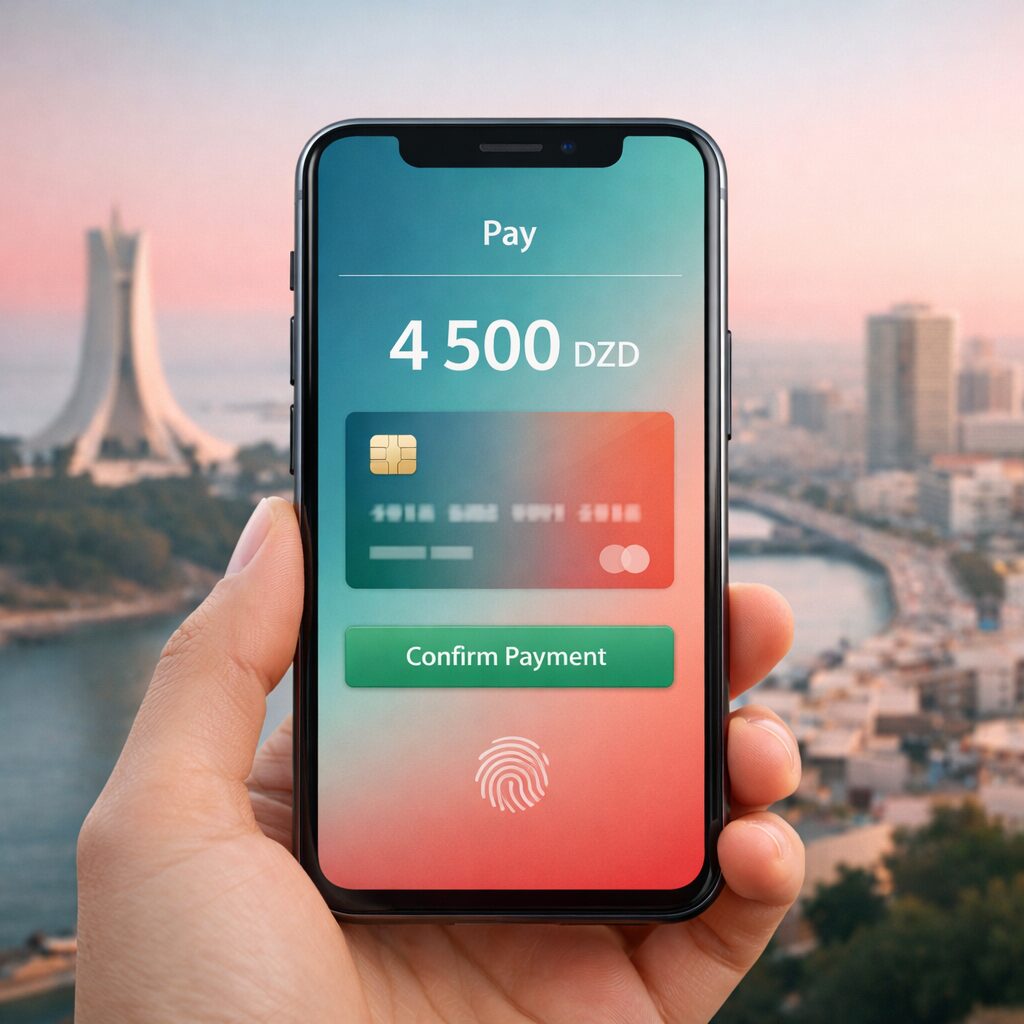
Algeria’s digital payment ecosystem has grown rapidly. Algérie Poste’s BaridiMob application has surpassed 5 million downloads on Android and become the most downloaded financial app in the country. In June 2025, Algérie Poste launched Baridi Pay, a QR code-based contactless payment service accessible through the BaridiMob app. Transactions are confirmed via SMS authentication, with funds transferred instantly from the customer’s account to the merchant’s.
The mobile payment interoperability project, known as “Switch mobile,” is now operational, enabling instant interbank transfers and account-to-account payments using QR codes across Algerian banks and Algérie Poste. WimPay BNA, the National Bank of Algeria’s digital wallet, has also expanded its feature set, offering payments, bill settlement, mobile top-ups, and peer-to-peer transfers.
These developments directly address Algeria’s financial inclusion challenge. The World Bank’s Global Findex data shows that 57% of Algerian adults — and 71% of women — still lack access to basic transaction accounts. The tiered wallet system in Instruction 06-2025 is specifically designed to serve these populations, with Level 1 wallets requiring only minimal identification to open.
The government established the National Payments Committee in 2024 to coordinate modernization efforts, strengthen transaction security across the banking sector, and promote inclusivity — a strategic move that has accompanied the measurable growth in digital transaction volumes.
Cross-Border Payments and Continental Integration
Algeria’s consumer protection framework extends beyond domestic transactions. In August 2025, the Bank of Algeria officially joined the Pan-African Payment and Settlement System (PAPSS), becoming the 18th country in the network. PAPSS, developed by the African Export-Import Bank, enables direct settlement of cross-border payments between African central banks in local currencies, eliminating the need for intermediary non-African currencies.
For Algerian consumers and businesses, PAPSS membership means lower transaction costs for intra-African trade — the system has delivered savings of up to 27% for end users in participating countries. The timing aligns with Algeria’s hosting of the Intra-African Trade Fair 2025 (IATF2025) in Algiers and the country’s broader engagement with the African Continental Free Trade Area.
With Tunisia, Egypt, and Morocco already connected, Algeria’s participation completes a North African corridor within the PAPSS network, connecting over 150 commercial banks across the continent.
The Road to 2030: Fintech Strategy and Tax Incentives
Algeria’s national Fintech Strategy 2024-2030 provides the overarching roadmap. The strategy targets 50% of all transactions to be cashless by 2030 and includes plans to establish a regulatory sandbox by 2026 to allow at least 20 fintech startups to test innovations annually. The Bank of Algeria’s governor has stated an even more ambitious goal: transitioning Algeria to a cashless society by 2028.
To accelerate adoption, the 2025 Finance Law introduced tax incentives for electronic payments. Stamp duty exemptions now apply to payments made via electronic means, and VAT and customs duties are waived on kits for assembling electronic payment terminals through December 2027. These fiscal measures complement the regulatory framework by reducing cost barriers for both merchants and consumers.
The 2023 Monetary and Banking Law laid additional groundwork by introducing provisions for payment service providers, digital banks, investment banks, and a potential central bank digital currency — signaling that the regulatory infrastructure for Algeria’s digital economy will continue expanding.
What This Means for Algerian Consumers
The convergence of PSP regulation, e-commerce enforcement, digital wallet expansion, and continental payment integration creates a multi-layered safety net for Algerian consumers entering the digital economy. Fund segregation requirements protect savings in digital wallets. Mandatory merchant registration deters fraudulent operators. Tiered identity verification makes digital finance accessible while scaling security with transaction size. And PAPSS integration ensures that cross-border protections extend to intra-African commerce.
For the 57% of unbanked adults, these protections are not abstract regulatory achievements — they are the preconditions for trust. And trust, more than technology, is what will determine whether Algeria meets its 2030 cashless ambitions.
Frequently Asked Questions
What are the three digital wallet tiers under Algeria’s new PSP regulation?
Instruction 06-2025 creates three tiers: Level 1 allows balances up to 100,000 DZD (approximately $740) with basic identification, designed for first-time users. Level 2 permits up to 500,000 DZD ($3,700) with proof of income and official ID. Level 3 supports up to 1,000,000 DZD ($7,400) and requires enhanced verification including a video interview. The tiered system balances financial inclusion with progressive security requirements.
How does PAPSS membership benefit Algerian consumers and businesses?
Algeria joined the Pan-African Payment and Settlement System in August 2025, becoming the 18th member country. PAPSS enables direct settlement of cross-border payments between African central banks in local currencies, eliminating costly intermediary conversions. Participating countries have seen savings of up to 27% on cross-border transaction costs. With Tunisia, Egypt, and Morocco already connected, Algeria completes a North African corridor linking over 150 commercial banks continent-wide.
What tax incentives exist for digital payment adoption in Algeria?
The 2025 Finance Law introduced several incentives: stamp duty exemptions for electronic payments, plus VAT and customs duty waivers on kits for assembling electronic payment terminals through December 2027. These fiscal measures reduce cost barriers for both merchants deploying terminals and consumers adopting cashless payments, complementing the regulatory framework to accelerate the transition toward the 50% cashless target by 2030.
Sources & Further Reading
- Algeria Launches First Fintech Regulation for PSPs — Startup Researcher
- Bank of Algeria Joins PAPSS Network — African Export-Import Bank
- Algeria’s Fintech Ecosystem in 2026 — The Fintech Times
- E-commerce in Algeria 2026: Laws, Taxes, and the Commercial Register — Ecommaps
- How Digital Financial Services Can Support Recovery in Algeria — World Bank
- Algeria Opens for Fintech: New PSP Rules — LaunchBase Africa
- Algérie Poste Launches Baridi Pay Mobile Payment Service — DzairTube
- Algeria Joins Pan-African Payment System — Fintech News Africa
🔗 Related Intelligence
From 95% COD to Digital Trust: How Algerian Platforms Are Shifting Payments

Financial Exclusion in Algeria: Why 65% Unbanked Blocks the Digital Economy

The COD Trap: How Cash on Delivery Is Strangling Algeria’s E-Commerce

Consumer Rights in Algeria’s Digital Markets: Returns, Refunds, and the Protection Gap