The First Structured AI Bridge Across the Maghreb
Regional science cooperation in North Africa has historically been organized bilaterally and informally — researcher exchanges, co-authored papers, occasional joint conferences. The April 2026 Algeria-Tunisia joint digital research platform represents a structural shift: for the first time, universities and research laboratories across both nations are connected through shared digital infrastructure with explicit mandates for data exchange, joint project development, and expert network coordination in AI-specific domains.
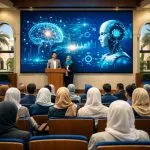
The announcement was made by Moez Chafra, president of the University of Tunis El Manar, during the second International Forum on Emerging and Intelligent Information Technologies — a venue that reflects the deliberate elevation of the initiative above routine bilateral diplomacy to the level of an academic and technology governance milestone. The platform targets three sectors: healthcare, where AI applications range from diagnostic imaging to epidemiological modeling; industry, where automation and predictive maintenance are high-priority; and education, where adaptive learning systems and student performance analytics are emerging research frontiers.
The institutional foundation predates the April announcement. At the seventh Forum of Algeria-Tunisia Border Universities held in December 2025 in Souk Ahras — a border city in northeastern Algeria — university delegations from both countries pledged to “establish a successful integration model” for collaborative research. The April 2026 platform launch converted that pledge into operational infrastructure. This sequencing matters: the platform is not a diplomatic communiqué or a memorandum of understanding left unimplemented. It is an operational digital system with stated functionality for data exchange, scientific publication dissemination, and networking of expert resources.
Why Fragmented Research Has a High Cost
The problem the platform addresses is not unique to Algeria and Tunisia — it is endemic to developing economies with strong educational infrastructure but weak research commercialization. Each country graduates thousands of engineers and researchers annually. According to the New Lines Institute’s 2026 analysis, Algeria alone enrolls 57,702 students across 74 AI master’s programs in 52 universities, and the country ranks among the top five African nations for recognized scientific publications. Tunisia has built a reputation for mathematical and engineering talent that far exceeds its domestic market’s capacity to absorb it.
The result is fragmentation: research conducted in Algerian universities rarely informs product development in Tunisian startups, and vice versa. A breakthrough in AI-assisted wheat disease detection at an Algerian agricultural research institute might never reach the Tunisian agri-tech companies that could productize it. A Tunisian NLP model trained on Maghrebi Arabic might not be accessible to Algerian developers building healthcare chatbots.
This fragmentation is not a data problem — both countries have published research. It is a coordination infrastructure problem. Without a shared platform for discovering, exchanging, and building on each other’s work, regional researchers default to the global scientific publication circuit, which is dominated by institutions in the United States, Europe, and increasingly Asia. Maghreb-specific AI research — calibrated to local languages, datasets, and problem contexts — loses its home-field advantage when there is no home field.
The joint platform’s stated objective of making AI research “more coordinated, practical and results-driven” addresses this directly. A shared discovery layer for datasets, methodologies, and expert profiles transforms what was a purely bilateral diplomatic gesture into an operational research commons.
Advertisement
What Algerian Universities and Researchers Should Do
The platform’s launch creates concrete action opportunities for Algerian institutions and individual researchers who can position themselves as nodes in the emerging Maghreb AI network.
1. Nominate Research Labs as Platform Anchor Points — Before the Architecture Is Fixed
Platform governance is easiest to shape at inception. Algerian universities with strong AI research programs should formally nominate specific laboratories as anchor nodes in the joint platform’s dataset and methodology sharing architecture. An anchor node designation means that the lab’s datasets, tools, and expert profiles are listed in the platform’s discovery layer with structured metadata — making them findable by Tunisian counterparts. Labs in natural language processing (working on Darija and Maghrebi Arabic), agricultural AI, and medical image analysis are the strongest candidates, as all three map to the platform’s stated sector priorities. The window to shape platform architecture is the six to twelve months following the April 2026 launch — before institutional inertia and technical debt make changes expensive.
2. Register Healthcare and Industrial AI Projects for Cross-Border Validation
Research conducted within a single national context has inherent validation limitations. An AI diagnostic tool trained on Algerian patient data needs validation against Tunisian patient data — and vice versa — to claim generalizability across the Maghreb. The joint platform’s data exchange functionality creates a mechanism for this cross-border validation that did not exist before April 2026. Algerian research teams with ongoing AI healthcare or industrial automation projects should register those projects on the platform explicitly to recruit Tunisian validation partners. A study co-authored by an Algerian and Tunisian institution has a higher probability of publication in international AI venues, increases citation counts, and strengthens the case for international grant funding — all of which reinforce the original research investment.
3. Anchor the Commercial Translation Layer at the Local Level
One structural risk of cross-border research platforms is that they remain purely academic — disconnected from the startup ecosystem that converts research into products. Algerian universities and technology parks should proactively build a bridge between the joint research platform and the Algerian Startup Fund’s portfolio companies. A university laboratory that identifies a commercially promising dataset or methodology through the Algeria-Tunisia platform should have a clear pathway to connect that asset with an ASF-backed startup. Building that connection now — before the platform’s commercial potential is absorbed by international technology companies that monitor academic publication feeds — is a competitive priority. Algeria’s national AI strategy explicitly includes a pillar for assisting startups to provide business solutions, making this bridge an on-strategy action.
The Bigger Picture
The Algeria-Tunisia joint AI research platform is significant not primarily for what it does today — the initial infrastructure will be modest — but for the precedent it sets. A functional, institutionalized research collaboration between two Maghreb universities is a first. If it succeeds operationally over the next two to three years, it creates a template that Morocco, Libya, and Mauritania can join — transforming a bilateral platform into a genuine Maghreb AI research commons.
That commons would have concrete economic value. Shared datasets calibrated to North African languages, agricultural conditions, and healthcare patterns are more valuable than any single national dataset. Shared compute infrastructure, once the platform scales, could reduce the cost of AI model training for researchers across the region. Shared publication and patent records make Maghrebi AI research more visible globally, attracting international collaboration and funding.
The December 2025 commitment in Souk Ahras and the April 2026 platform launch are the founding acts. What happens in the next eighteen months — which labs join, which datasets are shared, which joint projects are launched, and which startups benefit — will determine whether this is a genuine regional AI infrastructure moment or a well-intentioned announcement that fades for lack of follow-through.
Frequently Asked Questions
Is the Algeria-Tunisia joint AI research platform a government initiative or a university-led one?
It is institutionally university-led, announced by the president of the University of Tunis El Manar at an academic forum, and built on commitments made at a forum of border universities. However, it operates within a policy context shaped by both governments’ national AI strategies, and its success will require ministerial support for data sharing agreements, institutional participation mandates, and integration with national research funding frameworks. The distinction matters because universities can move faster than government agencies on platform adoption, but they need governmental backing for data governance and funding continuity.
Does this platform threaten to direct Algerian research talent to Tunisia rather than retaining it domestically?
The risk of talent outflow is real in any cross-border collaboration, but the platform’s design addresses it structurally. The joint digital infrastructure is shared rather than located in either country, expertise is networked rather than relocated, and both countries maintain their own research institutions as the primary employers of their nationals. Cross-border collaboration historically increases, not decreases, the international visibility of participating researchers — which improves local retention by providing international recognition without requiring physical relocation. Algeria’s strong track record among the top five African countries for scientific publications suggests a research community already oriented toward international engagement.
What AI research domains have the highest potential for Algeria-Tunisia joint projects?
The three platform sectors — healthcare, industry, and education — map to genuine Algerian and Tunisian strengths. In healthcare, both countries have research programs in medical imaging and disease epidemiology that would benefit from larger shared datasets. In industrial AI, Algeria’s petrochemical and manufacturing sectors and Tunisia’s automotive component and aerospace manufacturing provide complementary industrial AI testbeds. In education, both countries have Arabic-language pedagogical research that could advance adaptive learning systems calibrated to Maghrebi educational contexts. Agricultural AI — not explicitly listed but adjacent to the industrial sector — is arguably the highest-impact domain given both countries’ food security priorities.
Sources & Further Reading
- Tunisia and Algeria Launch Joint Digital Platform to Accelerate AI Research Collaboration — iAfrica
- Algerian Government Announces Adoption of National AI Strategy — Digital Policy Alert
- Algeria Unveils AI Strategy to Boost Digital Transformation — Ecofin Agency
- Why Algeria Is Positioned to Become North Africa’s AI Leader — New Lines Institute
- Algeria National AI Strategy: SAMENA Council Coverage
🔗 Related Intelligence

Tunisia-Algeria Joint AI Platform: A New Model for North African Research Collaboration

Algeria’s Sovereign AI Models: Universities and Startups Build Arabic and Tamazight Systems
Algeria’s AI Conferences: Two Universities Host International Research Events in One Week

Algeria’s AI Trainer Pipeline: From Train-the-Trainers to Startup Lab Outcomes