
Algeria is making its most ambitious bet on human capital in the digital era. The National Digital Transformation Strategy (SNTN), unveiled by the High Commissioner for Digitalization in May 2025, sets a target that would reshape the country’s technology landscape: training 500,000 ICT specialists by 2030 while simultaneously reducing the emigration of skilled tech workers by 40%.
The plan arrives at a critical moment. As Algeria pushes for full digital transformation across government services, financial systems, and industrial operations, the gap between technological ambition and available talent has become the single largest bottleneck to progress.
The SNTN Blueprint
The strategy is structured around several interconnected pillars, with human capital development at its core. Rather than treating workforce development as a secondary consideration, the SNTN positions it as the foundation upon which Algeria’s entire digital future depends.
The 500,000-specialist target encompasses a range of skill levels and disciplines, from software developers and data analysts to cybersecurity professionals and AI engineers. The plan integrates formal university education, vocational training, and industry certification programs into a coordinated pipeline.
Key institutional mechanisms include:
- Ministry integration: In May 2025, the Ministries of Labor and Vocational Training signed an agreement to interconnect their digital platforms, harmonizing training curricula with actual labor market demands
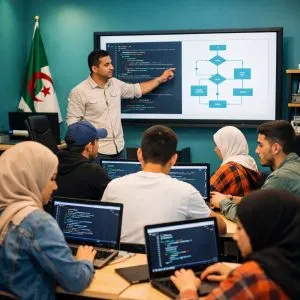
- Skills centers: Algerie Telecom opened the Setif Skills Center in September 2025, offering free AI lab access, ICT training, and expert workshops as a replicable model for other cities
- International cooperation: Algeria and Niger signed a digital skills cooperation agreement in early 2026, expanding bilateral knowledge exchange across the Sahel region
- Vocational expansion: 285,000 new vocational training places were announced for 2026, including certificate-oriented ICT qualification programs
Brain Drain: The 40% Reduction Target
Perhaps more challenging than training new specialists is keeping them in Algeria. The country has long suffered from technology talent emigration, with skilled professionals seeking higher salaries and better opportunities in Europe, the Gulf states, and North America.
The SNTN’s target of reducing tech emigration by 40% recognizes that training alone is insufficient without creating an environment where specialists choose to stay. The strategy addresses this through several approaches:
Salary competitiveness. While Algeria cannot match Silicon Valley compensation, the strategy envisions creating conditions where the cost-of-living-adjusted value proposition becomes more competitive, particularly through remote work opportunities with international companies.
Startup ecosystem development. By strengthening the startup ecosystem, including through initiatives like the Algerian Startup Fund (which scored its first exit with VOLZ’s 600 million dinar Series A in December 2025), the strategy aims to create local opportunities for ambitious technologists.
Quality of life investments. Digital infrastructure improvements, including the ongoing 5G rollout and expanded broadband access, are positioned not just as economic enablers but as quality-of-life improvements that make staying in Algeria more attractive for tech professionals.
Advertisement
The Skills Gap Reality
The ambition of training 500,000 specialists must be measured against the current reality. Algeria’s existing ICT workforce, while growing, faces several structural challenges:
Quality versus quantity. The emphasis on volume must not come at the expense of quality. Rapidly certifying large numbers of specialists risks producing graduates who lack the deep practical skills that employers need. The integration of labor market data with training curricula is designed to address this, but execution will determine outcomes.
Infrastructure readiness. Training AI engineers and cloud architects requires modern computing infrastructure at educational institutions. While centers like Setif represent progress, scaling this across Algeria’s 58 wilayas demands significant investment.
Industry alignment. The disconnect between academic curricula and industry needs has been a persistent challenge. The ministry integration agreement is a step forward, but closing the gap requires ongoing collaboration with private sector employers.
Certification recognition. International certifications in cybersecurity (CISSP, CEH), cloud computing (AWS, Azure), and AI remain expensive for individual Algerians. Subsidized certification programs could accelerate workforce readiness significantly.
Regional Context and Competition
Algeria’s workforce scaling plan exists within a competitive regional landscape. Morocco has aggressively positioned itself as a nearshore technology hub for European companies, with established training pipelines in French-language technical education. Tunisia’s startup ecosystem, while smaller, has deeper connections to European venture capital and talent networks.
Egypt, with its larger population, is scaling IT workforce programs that directly compete for the same international outsourcing contracts. The UAE and Saudi Arabia continue to attract North African tech talent with premium compensation packages.
Algeria’s competitive advantages in this landscape include its large young population (median age around 29), relatively lower cost of living compared to Gulf states, strategic time zone positioning between Europe and Africa, and natural resources revenue that can subsidize training programs.
Measuring Success
The SNTN’s effectiveness will ultimately be measured by several key indicators:
- Training throughput: Can institutions deliver quality education to 500,000 specialists within the timeline?
- Employment outcomes: What percentage of trained specialists find relevant employment within six months of certification?
- Retention rates: Does tech emigration actually decrease, and by how much?
- Economic impact: Do new ICT specialists contribute measurably to GDP diversification away from hydrocarbons?
- Gender inclusion: What percentage of the 500,000 target are women, and are programs actively addressing gender gaps in tech?
The May 2025 launch represents the starting gun, not the finish line. Algeria’s digital transformation depends not just on setting ambitious targets but on building the institutional capacity to achieve them.
Frequently Asked Questions
What types of ICT specialists does Algeria’s SNTN aim to train?
The 500,000-specialist target covers a broad range of disciplines including software developers, data analysts, cybersecurity professionals, AI engineers, cloud architects, and digital project managers. Training programs span formal university degrees, vocational certificates, and industry-recognized certifications like CISSP and AWS.
How does Algeria plan to reduce tech brain drain by 40%?
The strategy combines multiple approaches: improving salary competitiveness through cost-of-living advantages and remote work opportunities, strengthening the local startup ecosystem to create domestic career paths, investing in digital infrastructure like 5G, and creating quality-of-life improvements that make Algeria more attractive for tech professionals.
What is the Setif Skills Center and can it be replicated?
The Setif Skills Center, opened by Algerie Telecom in September 2025, offers free AI lab access, ICT training programs, and expert workshops. It serves as a pilot model that the government aims to replicate across other Algerian cities as part of the nationwide digital skills development infrastructure.
Sources & Further Reading
- Algeria Aims for Full Digital Transformation by 2030 with New Strategy — We Are Tech Africa
- Algeria Integrates Labor and Training Data to Align Skills with Jobs — We Are Tech Africa
- Algeria Launches Setif Skills Center to Boost Youth Innovation — We Are Tech Africa
- Niger, Algeria Explore Cooperation on Digital Skills Development — Ecofin Agency
- Towards 20 Million ICT Specialists by 2030 — EU Digital Skills & Jobs Platform