Algeria’s Entry Into Africa’s Payment Network
On August 15, 2025, the Bank of Algeria formally joined PAPSS — the Pan-African Payment and Settlement System — becoming the 18th country in the network. The timing was deliberate: the accession coincided with Algeria’s hosting of the Intra-African Trade Fair 2025 (IATF2025) in Algiers in September, cementing the country’s positioning as a hub for continental commerce. This was not a passive regulatory exercise — Algeria committed banking infrastructure, agreed to settlement rules, and signaled a decisive pivot toward intra-African trade finance at the institutional level.
PAPSS was established by Afreximbank and the African Union to solve one of intra-African trade’s oldest problems: the absence of a direct cross-border payment corridor between African countries. Before PAPSS, a payment between Algiers and Dakar would typically route through New York or London, incurring correspondent banking fees, multi-day settlement times, and foreign exchange losses. PAPSS collapses this to a direct, near-real-time settlement between participating banks in their local currencies — a structural shift comparable to what SWIFT did for European interbank payments in the 1970s, except designed from the ground up for African monetary realities.
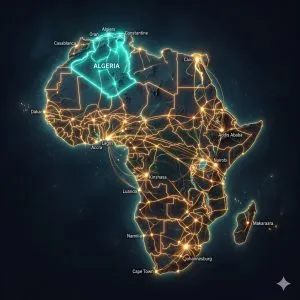
The network’s performance metrics validate the architecture. According to Afreximbank, PAPSS has reduced intra-Africa cross-border transaction costs by up to 27% for end users and enabled banks to record transaction volume surges of over 1,000% through digital channels integration. The system is forecast to save the continent more than $5 billion annually in payment transaction costs once fully scaled. With 150-plus commercial banks and 14 payment switches now connected, Algeria’s entry completes a North African corridor linking Algiers to Cairo, Rabat, Tunis, and Lagos on a single settlement rail.
It is worth contextualizing what that corridor means commercially. African Business Magazine’s analysis of the PAPSS expansion notes that before PAPSS, intra-African trade was fundamentally handicapped by the payment plumbing: businesses that wanted to trade across borders either maintained expensive multi-currency correspondent banking relationships or routed through dollar or euro intermediaries, absorbing the exchange rate exposure. PAPSS removes that intermediary layer. For Algeria, whose Fintech Strategy 2024-2030 targets 50% of all transactions being cashless by 2030, the PAPSS membership creates a direct line between that domestic cashless target and intra-African commerce ambitions.
Why This Matters More for Startups Than for Banks
The headline story of PAPSS is the banking infrastructure layer. But the real opportunity sits one level above: the Algerian startups and fintechs that can build products and services on top of this infrastructure. According to PAPSS’s own documentation, the system is accessible not just to commercial banks but to “licensed payment service providers (switches, fintechs, aggregators, etc.)” — which means the settlement layer is, in principle, reachable by regulated fintech startups through their partner banks.
This opens several concrete business models for Algerian founders:
B2B cross-border invoicing. An Algerian software exporter billing a client in Senegal currently faces a labyrinthine process: dollar invoicing, manual wire transfers, and multi-day settlement uncertainty. With PAPSS, a Dinar-denominated invoice can settle against CFA francs directly, with currency conversion happening at the system level. For Algerian tech service exporters — a fast-growing segment under the Digital 2030 agenda — this removes a critical operational friction.
Cross-border e-commerce. Algerian marketplace startups seeking to expand to PAPSS member markets gain a payment rail that doesn’t require establishing a legal entity or banking relationship in each target country. A managed marketplace aggregating Algerian artisans or agri-food exporters could offer buyers in West Africa a seamless checkout in local currency, with settlement flowing back to Algeria in DZD.
Logistics and supply-chain platforms. B2B logistics operators — a sector where Algerian startups like Temtem have already demonstrated traction — need reliable cross-border payment settlement to offer end-to-end services. PAPSS provides the financial rail; Algerian logistics tech firms can build the freight and customs layer above it. Fintech News Africa’s coverage of Algeria’s PAPSS accession specifically highlights that payment aggregators and fintechs — not just banks — are eligible participants in the PAPSS ecosystem, confirming that the opportunity is not bank-only.
Advertisement
What Algerian Startup Founders Should Do Now
1. Pursue Regulated Fintech Status to Access PAPSS Directly
PAPSS is bank-mediated — direct access requires either being a commercial bank or a licensed payment aggregator. Algerian fintech startups with genuine cross-border payment ambitions should prioritize obtaining payment institution status through Bank of Algeria’s regulatory framework, including participation in the planned regulatory sandbox (expected 2026) targeting at least 20 fintech startups. This regulatory foothold positions the startup to negotiate direct integration with PAPSS-connected banks, rather than relying on intermediaries who will take margin from every transaction.
2. Map the 18 PAPSS Member Countries for Market Prioritization
Not all 18 PAPSS member countries represent the same commercial opportunity for an Algerian startup. Côte d’Ivoire (which accounts for 40% of WAEMU’s GDP and has sustained near-6% annual growth for over a decade), Senegal (now an oil producer with projected revenues crossing $1 billion annually), and Morocco (a mature startup ecosystem with a $269 million fund-of-funds) are the high-priority markets. Founders should identify which of these markets have the strongest demand overlap with their product, then build the country-specific compliance and localization required for those 2-3 markets before attempting continent-wide scale.
3. Build Algeria-to-Africa Export Flows, Not Just Import Channels
Algeria’s most defensible PAPSS use case is not replacing existing import payment flows (which banks already handle) but enabling new export flows that currently do not exist at scale: digital services, software subscriptions, agricultural exports, and manufactured goods. Startups that build export-enabling infrastructure — payment aggregation, invoicing in multiple PAPSS currencies, trade finance for Algerian exporters — are building alongside government trade priorities and can access Algeria’s export promotion mechanisms (Tasdir+, CACI support) as distribution partners.
The Structural Lesson: Infrastructure Precedes Commerce
Every major cross-border commerce wave in Africa has been preceded by a payment infrastructure unlock. Mobile money enabled Kenya’s M-Pesa ecosystem. Interbank API standardization enabled Nigeria’s open banking fintech wave. PAPSS is Algeria’s version of that unlock — the moment when the payment plumbing connects well enough that new commercial applications become possible.
The window to build first is now. When PAPSS was announced as a concept, there were no Algerian startups positioned to build on it — because there was no confirmed timeline for Algeria’s accession. That timeline is now confirmed and past: Algeria has been in the network since August 2025. Founders who spend the next 12 months building PAPSS-native products will have an 18-24 month head start on competitors who wait for the opportunity to become obvious.
Frequently Asked Questions
What is PAPSS and how does it reduce cross-border payment costs in Africa?
PAPSS (Pan-African Payment and Settlement System) is an Afreximbank-backed infrastructure that enables near-real-time settlement between African commercial banks in local currencies, eliminating the need to route transactions through Western correspondent banks. This reduces transaction costs by up to 27% for end users, according to Afreximbank data. With 150+ banks and 14 payment switches across 18 countries now connected, PAPSS removes the foreign exchange conversion and correspondent banking fee layers that historically made intra-African payments expensive and slow.
Can Algerian startups access PAPSS directly or only through banks?
PAPSS is primarily bank-mediated: commercial banks and licensed payment service providers (fintechs, aggregators, switches) are the direct participants. An Algerian startup that is not itself a licensed payment institution must access PAPSS through a partner bank that has PAPSS connectivity. Startups with genuine cross-border payment ambitions should pursue regulated payment institution status through the Bank of Algeria — the planned 2026 regulatory sandbox is designed for exactly this purpose.
Which African markets should Algerian startups target first under PAPSS?
Among the 18 PAPSS member countries, the highest-opportunity markets for Algerian startups are Côte d’Ivoire (40% of WAEMU GDP, near-6% sustained growth), Senegal (oil revenue expected to cross $1 billion annually, active Startup Act since November 2025), and Morocco (a mature startup ecosystem with deep French-language cultural alignment). These three markets combine economic size, institutional readiness, and the highest demand overlap with Algerian digital services and agri-food exports.
—
Sources & Further Reading
- Bank of Algeria Joins PAPSS Network — Afreximbank
- PAPSS About Us — Pan-African Payment and Settlement System
- Bank of Algeria joins PAPSS — The Paypers
- Algeria Joins PAPSS Network — Fintech News Africa
- Africa’s Payment Revolution: PAPSS Network Expands — African Business
- What PAPSS Means for Developers — DEV Community
🔗 Related Intelligence

PAPSS and Algeria’s Fintech Startups: Building on the Pan-African Payments Rail

Algeria Joins PAPSS: What Pan-African Payments Mean for Cross-Border Trade
Algeria and PAPSS: How the Bank of Algeria’s Accession Unlocks Intra-Africa Trade Payments
Algeria Joins PAPSS: How Pan-African Instant Payments Could Unlock the Dinar’s Continental Potential