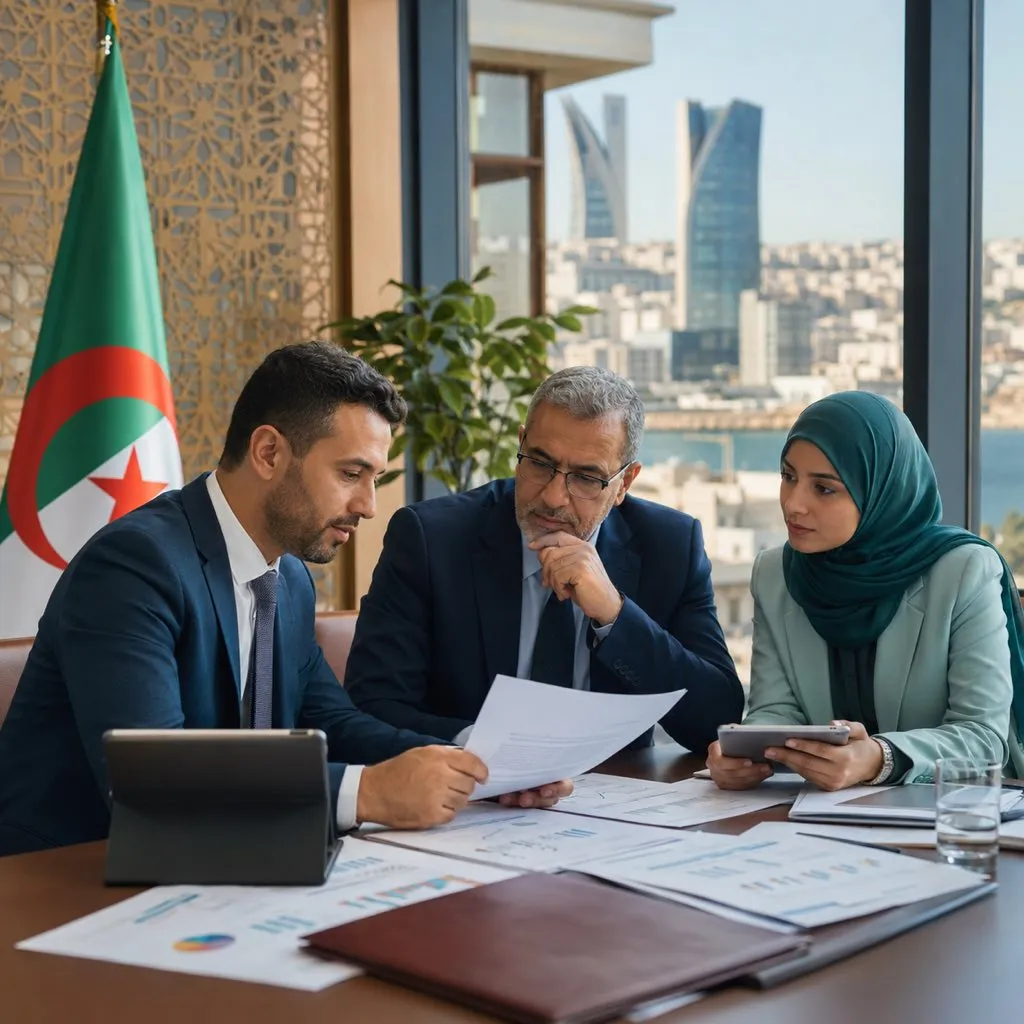
What the Three-Body Decision Actually Changes
For most of Algeria’s startup history, the Bourse des Valeurs d’Alger was irrelevant to early-stage founders. Public market listing implied legal maturity, audited financials, disclosure obligations, and — most dauntingly — a layer of fees charged at every step: registration with COSOB, the regulatory visa on disclosure documents, admission to the official list, and ongoing custody and settlement charges through Algérie Clearing. These costs, collectively, placed public market financing firmly in the territory of mature SMEs and corporate bond issuers, not the founders building software, logistics, or edtech companies.
The joint decision adopted in early 2026 and applicable from February 1, 2026 breaks this pattern. Three regulatory bodies — COSOB (Commission d’Organisation et de Surveillance des Opérations de Bourse), Algérie Clearing, and the Bourse des Valeurs d’Alger — have aligned to waive every fee a startup would normally pay during a Growth-segment fundraise:
- COSOB regulatory visa fees on the prospectus or information document
- Admission fees to the official pricing list
- Stock exchange listing fees payable to the BVA
- Custody, settlement, and securities management fees payable to Algérie Clearing
The waiver applies through December 31, 2028, giving a 34-month window during which the cost barrier is structurally removed. The capital ceiling per round is set at DZD 500 million — approximately USD 3.8 million at current rates — which covers the pre-Series A range most commonly needed by labeled Algerian startups.
This decision complements two existing vehicles without replacing either: the Algerian Startup Fund (ASF), which provides non-dilutive grant and loan instruments, and the COSOB equity crowdfunding framework introduced under Regulation 24-02, which opens retail participation via licensed portals at smaller ticket sizes.
Who Qualifies and What the Growth Segment Requires
The fee waiver is exclusive to companies holding Algeria’s official “Startup” label issued by the Startup Algeria committee under the Ministry of Knowledge Economy and Startups. The label is not automatic — it requires demonstrating an innovative product or service, a registered Algerian legal entity, and at least 51% Algerian ownership. As of early 2026, over 4,000 companies hold the label (the government’s 2029 target is 20,000 labeled startups), forming the eligible pool for the BVA Growth segment.
The Growth segment has lower admission requirements than the main regulated market: no minimum market capitalization, a simplified disclosure document rather than a full prospectus, and lighter ongoing disclosure obligations. However, companies must still meet baseline governance requirements:
- At least two years of audited financial statements
- A registered independent auditor
- A clear description of business model, risk factors, and use of proceeds
- A designated market-making intermediary (a licensed broker-dealer registered with COSOB)
The disclosure document, once waived of its visa fee, is prepared with a licensed intermediary and submitted electronically to COSOB’s portal. COSOB reviews and approves it before the fundraising window opens. The process from submission to launch typically runs four to eight weeks, depending on the complexity of the offering and the speed of the intermediary review cycle.
Advertisement
What This Means for Algerian Startup Founders
1. Run the Cost-Benefit Analysis Before the ASF or FCPR Route
The fee waiver removes the primary deterrent — cost — that made the Bourse irrelevant to startups. But the BVA Growth segment still requires audited financials and a licensed intermediary. Founders should compare total cost of capital across three channels: the ASF (non-dilutive but capped and process-heavy), the COSOB equity crowdfunding portals (retail retail participation but DZD 50 million ceiling per campaign), and the BVA Growth segment (up to DZD 500 million, institutional visibility, but higher disclosure burden). For startups past their first product-market-fit stage with two years of accounts, the Growth route now has a genuine cost advantage during the 2026-2028 window.
2. Secure the Startup Label Before the Window Closes
The waiver is conditional on holding a valid label at the time of application. The label must be renewed every three years. Founders who allow their label to lapse — particularly those who received it in 2022 or 2023 and have not yet renewed — will not qualify for the waived terms. The Startup Algeria committee handles renewals through the same online portal used for initial applications. Renewal documentation requires an updated business activity report, proof of continued Algerian ownership, and a statement from a licensed auditor. Allow at least 30 days for the committee to process a renewal ahead of any planned Bourse approach.
3. Prepare Financial Statements Now, Not at the Point of Fundraising
The two-year audited financials requirement is the most common bottleneck for startup founders approaching the Growth segment. Many labeled startups — especially those incorporated in 2023-2024 under the simplified SAS legal form — have not appointed an independent statutory auditor because it was not previously required by their governance structure. The cost of auditing two years of accounts retroactively is significantly higher than ongoing annual audits. Founders planning a 2027 or 2028 Bourse raise should appoint a registered commissaire aux comptes now and ensure fiscal year 2025 and 2026 accounts are formally audited before the waiver window closes.
4. Engage a Licensed Intermediary Early in the Process
The Growth segment requires a designated market-making intermediary — one of the broker-dealers registered with COSOB. As of 2026, there are a small number of licensed intermediaries in Algeria equipped to advise on Growth-segment offerings. Demand will increase as the waiver window becomes more widely known. Founders who engage an intermediary twelve months before their planned launch date will have better access to capacity, better pricing on intermediary fees (not covered by the waiver), and a more organized disclosure document than those who approach at the last moment.
The Bigger Picture: Capital Market Deepening as Policy Instrument
The fee waiver is not an isolated measure. It sits within a broader sequence of regulatory decisions designed to deepen Algeria’s capital markets as a financing channel for the productive economy. The FCPR vehicle (COSOB Regulation 24-02) created the institutional VC wrapper. The equity crowdfunding framework opened retail participation at smaller ticket sizes. The BVA Growth segment fee waiver now provides a bridge to the public market for companies large enough to benefit from broader capital access but not yet ready for a full main-market IPO.
Taken together, these three instruments create a genuine financing escalator for the startup ecosystem: retail crowdfunding for earliest-stage rounds, ASF for non-dilutive bridge capital, FCPR for institutional venture rounds, and the BVA Growth segment for larger pre-IPO raises. The Algerian market has never had this range of structured options simultaneously available.
The three-year waiver window (2026-2028) is designed to build a track record. If labeled startups successfully complete Growth-segment raises, that demonstrated demand will provide the regulatory argument for making the reduced-fee regime permanent or expanding the capital ceiling above DZD 500 million. Founders who move early in this window do not just benefit from the fee waiver — they contribute to the policy precedent that determines whether the instrument survives beyond 2028.
Frequently Asked Questions
Q: Can a startup with the label but less than two years of audited accounts still apply?
The Growth segment requires at least two years of audited financial statements as a condition of admission. The COSOB fee waiver does not modify this requirement. Startups incorporated after 2024 will need to build their audit trail before qualifying for the Growth route, and should consider the equity crowdfunding channel (DZD 50 million ceiling) in the interim.
Q: Does the fee waiver cover the licensed intermediary’s advisory fees?
No. The waiver covers only regulatory and exchange fees charged by COSOB, BVA, and Algérie Clearing. The licensed intermediary (broker-dealer) charges separate advisory and market-making fees that remain the startup’s responsibility. These are market-negotiated and are not covered by the joint decision.
Q: Can a startup that has already listed on the Growth segment benefit from the waiver retroactively?
The decision specifies that the exemption applies to fundraising rounds completed from February 1, 2026 onward. Raises completed before that date are not covered. However, startups that conducted a prior round and plan a second Growth-segment raise after February 1, 2026 are eligible for the waiver on the new round.