From Announcement to Asphalt: What Guenzet Actually Delivered
For years, Algerian smart-city ambitions lived in PowerPoint slides and ministerial communiqués. The inauguration of the Guenzet Smart City on 5 February 2026 changed that calculus. Ooredoo Algeria and DEO Electronique jointly deployed the country’s first live urban IoT platform in the upper Sétif province — not as a controlled lab experiment, but as an operational system managing real municipal infrastructure.
The project sits at the convergence of two parallel government drives: Algeria’s $492 million 5G licence awards to Mobilis, Djezzy, and Ooredoo, and a broader push to modernise municipal services in secondary cities. Guenzet — a commune of roughly 30,000 residents in the Kabyle highlands — was selected as the pilot precisely because it is representative of Algeria’s mid-tier municipalities: large enough to generate meaningful data, small enough to deploy quickly without the complexity of a major metropolis like Algiers or Oran.
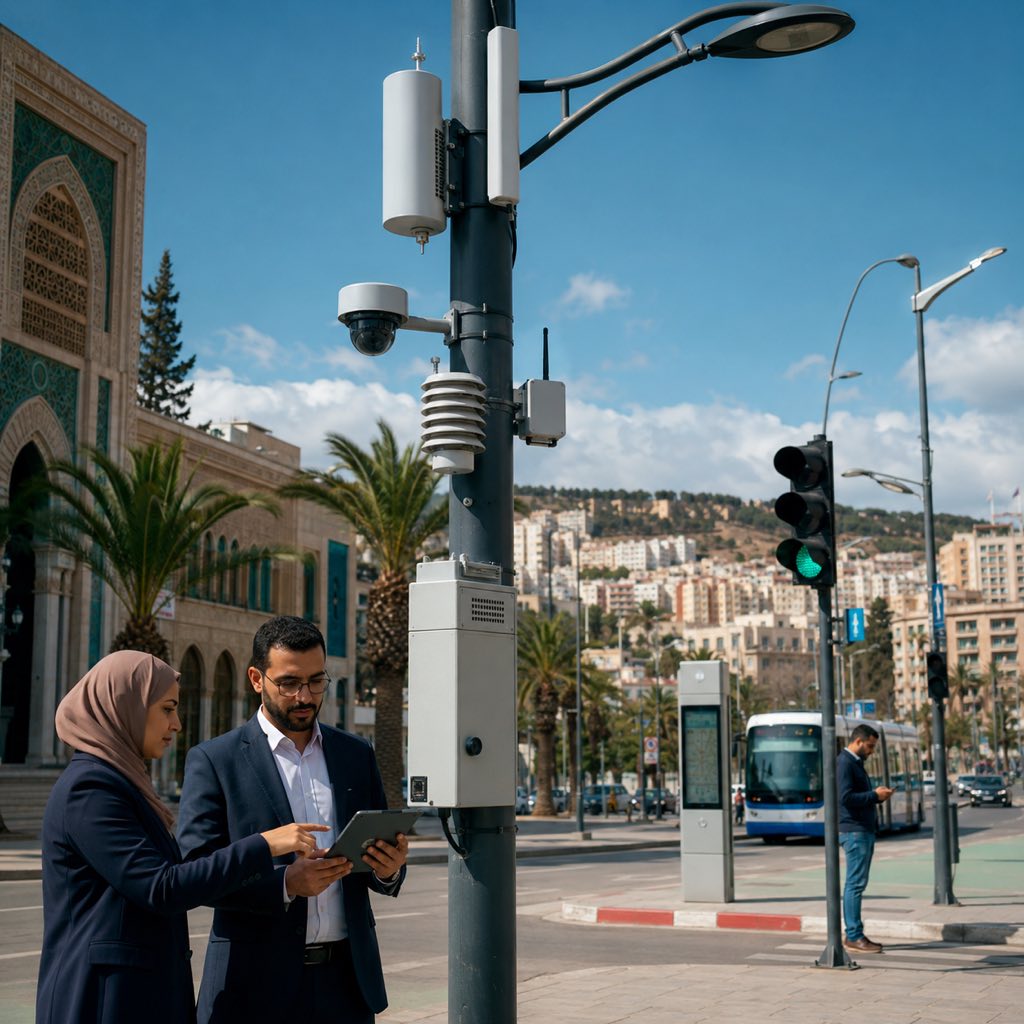
The IoT platform enables what Ooredoo Algeria’s official project coverage describes as “smart and centralised management of equipment and infrastructure.” In practice, this means connected sensors feeding real-time data to a municipal control room: street lighting that adjusts to ambient conditions, waste collection alerts based on bin fill levels, water network monitoring, and environmental quality metrics. The 5G backhaul — enabled by Ooredoo’s gradual national 5G launch — provides the low-latency connectivity that makes centralised real-time monitoring viable at scale.
DEO Electronique, the Algerian technology integrator behind the deployment, provides the hardware layer: sensors, edge devices, and the local data concentrators that aggregate readings before transmission. This is significant because the system is not simply imported turnkey infrastructure. DEO Electronique is an Algerian firm, meaning the integration expertise and some of the hardware assembly stays in-country — a deliberate choice consistent with Algeria’s import-substitution orientation in the technology sector.
Why Sétif, and Why Now
The selection of Sétif for Algeria’s first live smart-city pilot reflects deliberate strategic logic. The wilaya has positioned itself as a secondary economic hub, with an active industrial zone in Ain Azel and a university campus that supplies engineering graduates to regional enterprises. The city administration has been receptive to digital infrastructure experiments — Sétif hosted early fibre-optic deployments and was among the first wilayas to pilot e-government services under the Ministry of Digital Transformation’s 2023–2027 roadmap.
Timing also matters. The December 2025 commercial 5G launch by Algeria’s three licensed operators created the connectivity substrate that Guenzet needs. Without a reliable 5G or 4G-Advanced backhaul, IoT deployments at this scale tend to rely on dedicated private networks that are expensive and difficult to replicate across dozens of municipalities. Piggy-backing on Ooredoo’s 5G rollout solves the economics: once the base station is in place for consumer broadband, municipal IoT represents an incremental load, not a greenfield infrastructure investment.
Algeria’s national 5G plan targets eight pilot regions before full coverage by 2031, with Ericsson projecting total deployment costs of $3–8 billion including rural expansion. Guenzet’s proof-of-concept arrives exactly when national planners need evidence that IoT use cases can justify that investment beyond consumer broadband revenue.
Advertisement
What Algerian Municipal Decision-Makers Should Do
The Guenzet deployment is not just a tech showcase — it is a procurement and planning template. Here is what municipality managers, wilaya IT directors, and central government planners should take from it.
1. Map Your Infrastructure Before Issuing a Tender
Guenzet succeeded partly because DEO Electronique conducted a thorough asset audit before deploying sensors. Every smart-city pilot that has stalled in the MENA region — including several in Morocco and Tunisia — ran into the same problem: IoT sensors were ordered before anyone catalogued what physical infrastructure existed, where it was located, and who maintained it. In Algeria’s secondary cities, municipal asset registries are often incomplete or paper-based. Before engaging any vendor, local authorities should commission a digital asset inventory covering street lighting, water mains, waste collection points, and public buildings. This typically takes 8–12 weeks and can be done using low-cost GPS survey tools; it is non-negotiable for a deployment that needs to scale.
2. Negotiate a Data Sovereignty Clause With the Operator
Ooredoo Algeria is a subsidiary of the Qatari Ooredoo Group, and its 5G infrastructure contracts include data routing arrangements. Municipal IoT data — bin fill levels, water pressure readings, environmental sensors — may seem innocuous, but it creates an aggregate picture of urban activity that has strategic value. Algerian municipalities should insist that IoT data generated on their territory remains within the Algerian data jurisdiction (governed by Law 18-07 on personal data protection), that raw sensor feeds are stored on local edge infrastructure, and that the operator provides a contractual audit trail for any cross-border data transfers. This is not xenophobia toward a trusted partner; it is standard practice for any municipality in the EU or Gulf under their respective data laws.
3. Require an Open API Layer for Third-Party Integration
The Guenzet platform, as currently deployed, is a closed system: DEO Electronique hardware feeds into a Ooredoo-connected control room. For the next phase to be useful — enabling startups, university researchers, or other government agencies to build services on top of municipal data — the platform needs an open API layer. Singapore’s Smart Nation initiative learned this the hard way: early closed deployments in 2017–2018 required expensive retrofits to expose data to the developer ecosystem. Algerian municipalities should require, as a contract condition, that the system exposes a standardised REST or MQTT API for authorised third-party integrations from day one, rather than retrofitting openness after the fact.
4. Plan for Human Capital Before the Sensors Arrive
The most persistent failure mode in African smart-city projects is not the technology — it is the absence of trained operators. A municipal control room fed by 200 IoT sensors generates roughly 5–10 million data events per day. Without staff trained to interpret alerts, prioritise anomalies, and commission maintenance teams, the dashboard becomes noise. According to regional coverage of the Guenzet inauguration, Guenzet reportedly engaged Sétif University’s engineering faculty for operator training prior to go-live, an approach that should become standard. Municipalities planning similar deployments should budget for a 6-month training cycle and a minimum of 3–5 dedicated operators per control room, drawn from existing municipal technical staff wherever possible to preserve institutional memory.
What Comes Next for Algeria’s Smart City Ambitions
Guenzet is a proof of concept, not a finished product. The honest assessment is that the deployment covers a subset of municipal services in one commune — a controlled environment where Ooredoo and DEO Electronique could manage variables carefully. The leap from Guenzet to Algiers, Oran, or even a mid-size industrial city like Annaba involves orders-of-magnitude more complexity: denser infrastructure, competing operator interests, legacy systems with no API access, and municipal bureaucracies accustomed to paper-based workflows.
What the pilot does establish is that the technology stack works in an Algerian context. IoT sensors survive the Kabyle climate. Ooredoo’s 5G backhaul provides adequate bandwidth and latency. DEO Electronique can integrate hardware and software at municipal scale. These were genuinely uncertain before February 2026.
The next phase of ambition should be a formal replication protocol: the Ministry of Digital Transformation, working with the Ministry of Interior’s municipal affairs directorate, should package the Guenzet learnings — procurement template, data sovereignty clauses, training curriculum, API requirements — into a deployable toolkit that any wilaya can use. Algeria has 58 wilayas. If even 10 of them launch municipal IoT pilots by 2028, the country will have one of the most extensive smart-city networks in North Africa. LNR DZ’s analysis of smart city strategy highlights that the 5G era makes this timeline feasible in a way that earlier deployments were not. The Guenzet inauguration in February 2026 proves the first link in that chain is solid.
Frequently Asked Questions
What is the Guenzet Smart City and when did it launch?
The Guenzet Smart City is Algeria’s first operational 5G-IoT urban deployment, inaugurated on 5 February 2026 in the commune of Guenzet in the Sétif wilaya. Built by Ooredoo Algeria and DEO Electronique, it uses IoT sensors connected via 5G backhaul to enable centralised management of municipal infrastructure including lighting, water networks, waste collection, and environmental monitoring.
How does this differ from previous Algerian smart-city announcements?
Previous Algerian smart-city projects — including announcements tied to the Sidi Abdellah technology park and various ministerial roadmaps — remained at the planning or partial-construction phase. Guenzet is distinctive because it is fully operational: sensors are deployed, the control room is staffed, and real municipal data is flowing. It is described by Ooredoo as “among the first operational smart city and village initiatives linked to the gradual launch of 5G technology in Algeria.”
Can other Algerian municipalities replicate the Guenzet model?
Technically yes, and that is the intent. The key prerequisites are: a 5G or 4G-Advanced base station in the service area (being rolled out by Mobilis, Djezzy, and Ooredoo across eight pilot regions), a completed municipal asset inventory, and trained operators. The Ministry of Digital Transformation has signalled intent to develop a replication toolkit. Municipalities in the 5G pilot regions should begin the asset mapping phase now, as it takes 8–12 weeks and must precede hardware procurement.
Sources & Further Reading
🔗 Related Intelligence

Algeria 5G Enterprise: Industrial IoT and Smart Factory Use Cases Now Viable in 2026

Algeria’s 5G Enterprise Verticals: How Industry 4.0 and IoT Are Taking Shape

Algeria’s 5G Commercial Launch: Enterprise IoT Connectivity Roadmap for 2026
Edge Computing and IoT in Algeria: How 5G Is Rewriting the Rules of Industrial