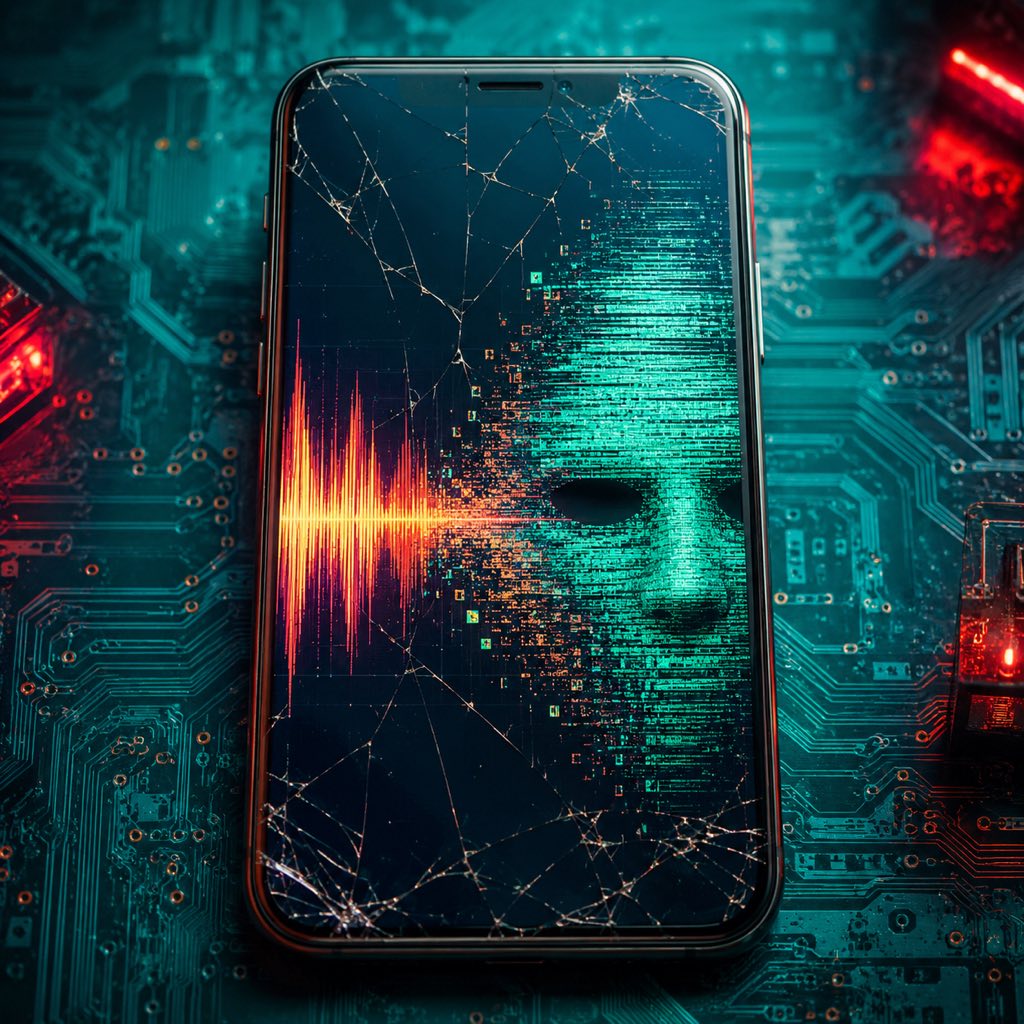
Voice Phishing Is No Longer a Human Problem
For most of enterprise security’s history, voice phishing was constrained by human limitations. A caller needed to speak convincingly, maintain a plausible cover story, and survive real-time skepticism without a script. Those constraints kept vishing a niche threat compared to email phishing, which could be automated at scale.
AI voice cloning eliminates every one of those constraints. According to data from Programs.com’s 2026 vishing analysis, modern AI tools require just 3 seconds of audio to clone a person’s voice convincingly enough that 27% of listeners cannot identify the deepfake, and 68% of victims perceived AI-generated interactions as realistic. Voice phishing attacks surged 442% in the second half of 2024 versus the first half, and deepfake-enabled vishing spiked 1,633% in Q1 2025 compared to Q4 2024.
The financial profile matches the threat trajectory. The projected cost of generative AI fraud is $40 billion by 2027, representing over 30% annual growth. The average annual cost to an organization targeted by voice phishing is $14 million. Financial institutions face an average loss of $600,000 per attack, with 10% reporting deepfake attacks exceeding $1 million per incident. Only 5% of stolen funds are recovered. The model that spent years as an expensive low-volume attack has become a cost-effective high-volume threat because AI has industrialized the voice production layer.
How the 2026 Vishing Attack Chain Works
Understanding the threat requires tracing the complete attack chain, because most enterprise defenses are designed for earlier, simpler versions of this attack.
Phase 1 — Audio collection. Attackers harvest voice samples from publicly available sources: earnings call recordings, YouTube interviews, podcast appearances, LinkedIn video posts, and company all-hands recordings. CEOs, CFOs, and heads of IT — the most commonly impersonated targets — are also the people most likely to have public voice recordings. Three seconds of continuous speech is sufficient for most current voice-cloning models, though longer samples produce more natural output across a wider range of intonations.
Phase 2 — Target and pretext selection. The most effective vishing attacks combine voice cloning with social engineering intelligence gathered from LinkedIn, company websites, and recent news. An attacker impersonating a CFO who knows the names of three direct reports, references a real project deadline, and uses the correct internal vocabulary for an organization’s procurement process is orders of magnitude more convincing than a generic executive impersonation. This intelligence-gathering phase is also being automated through AI tools that can scrape and synthesize organizational context from public sources.
Phase 3 — Real-time or recorded delivery. Vishing calls can now be delivered as real-time AI voice synthesis — the attacker speaks text that is instantly converted to the cloned voice — or as pre-recorded audio sent through messaging platforms. The real-time variant is more sophisticated but increasingly accessible; the pre-recorded variant is already commodity-level. Some attack chains use video deepfakes for initial contact (a Teams or Zoom call where the CEO appears on video) and switch to voice-only for follow-up calls that request wire transfers or credential resets.
Phase 4 — Action and exfiltration. The goal is almost always one of three outcomes: a wire transfer to an attacker-controlled account, a credential reset that grants access to internal systems, or the disclosure of sensitive information (employee data, customer records, deal details) that enables a follow-on attack. The social engineering payload is typically urgent and exploits organizational hierarchy — requests from senior executives for immediate action, outside normal approval channels, often citing a time-sensitive reason for bypassing standard procedure.
Advertisement
What Enterprises Must Do Now
1. Implement voice verification protocols for high-risk transactions
The single most effective defense against vishing is a secondary out-of-band verification requirement for any transaction above a defined threshold — wire transfers, credential changes, data access grants, or executive impersonation of any kind. This means that when a call comes in claiming to be the CFO requesting an emergency wire transfer, the recipient is required to call the CFO back through a separately verified number (not the callback number provided by the caller) or to confirm through a secure internal messaging system. Research from Helixstorm’s 2026 social engineering analysis shows that organizations using call verification protocols reduced vishing success rates by up to 46%. The protocol must be mandatory, not advisory — attackers specifically choose moments of urgency and authority to pressure recipients into bypassing optional verification.
2. Create a verified voice baseline for executives and key personnel
Organizations that have deployed voice-verification technology can create acoustic baselines for executives and key personnel, enabling real-time comparison during calls. For organizations without dedicated voice-verification platforms, the baseline process is simpler: document the communication patterns, vocabulary, and approval chains for senior executives, and establish a shared expectation among finance, IT, and operations teams that certain types of requests — wire transfers, credential changes, data access — will always follow documented procedures regardless of how urgent the caller claims the situation is. The attack succeeds when the urgency of the impersonated executive overwhelms the recipient’s adherence to procedure. Normalization of procedure adherence is the behavioral antidote.
3. Run regular AI-voice vishing simulations
PhishingBox’s 2026 enterprise security analysis documents that AI-powered simulation training reduces vishing risk by 80%, and trained employees show a 90% success rate in responding to AI voice attacks correctly. The critical detail is that simulation training must specifically include AI-generated voice — organizations that train only against human callers are not preparing employees for the actual threat they face. Simulations should include realistic scenarios: a caller impersonating an internal helpdesk requesting credentials for a system upgrade, a voice message from the “CEO” requesting an urgent wire transfer before end of business, a “vendor” calling to confirm payment details for an upcoming contract. Each scenario should be debriefed, and the debrief should specifically address the voice quality — helping employees understand that a convincing-sounding voice is no longer evidence of legitimacy.
The Structural Defense Shift Required
The deeper challenge that AI vishing creates is epistemic: voice is no longer a reliable identity signal. The implicit assumption baked into most organizational communication practices — that a call from someone who sounds like your CFO is probably your CFO — is no longer safe.
This requires a cultural shift as much as a technical one. Group-IB’s analysis of voice deepfake attack patterns documents that the most effective vishing attacks succeed not because the voice clone is perfect, but because the organizational culture rewards rapid compliance with executive requests and punishes the friction of verification. An employee who pauses to verify a request from the apparent CEO is often perceived as insubordinate or slow. Changing that perception — making verification a professional norm rather than an implicit insult — is the organizational change that technical defenses cannot substitute for.
The 2026 vishing landscape favors attackers for the same reason that any asymmetric threat favors the offense: the attacker needs to succeed once; the defender needs to succeed every time. But the asymmetry is not insurmountable. Out-of-band verification, mandatory approval chains, voice simulation training, and a culture that rewards procedural adherence over urgency compliance are the countermeasures that data shows work. The enterprises that build them before an incident will be significantly better positioned than those that build them after.
Frequently Asked Questions
How does AI voice cloning actually work and how convincing is it?
AI voice cloning uses machine learning models trained on audio samples to synthesize new speech in a person’s voice. Current models require as little as 3 seconds of audio to produce convincing output, and longer samples (10–30 seconds) produce natural intonation across a wider emotional range. In controlled tests, 27% of listeners cannot identify deepfake audio from real speech, and 68.33% of fraud victims perceived AI-generated voice interactions as realistic. The quality of commercially available tools has crossed the practical detection threshold for untrained listeners.
What is the typical financial impact of a successful vishing attack?
The average annual cost to an organization targeted by voice phishing is $14 million, including direct fraud losses, recovery costs, and reputational damage. Financial institutions face an average loss of $600,000 per attack, with 10% experiencing attacks exceeding $1 million. Only 5% of stolen funds are typically recovered. The generative AI fraud market is projected to reach $40 billion in losses by 2027, growing at over 30% annually, driven primarily by voice and video deepfake-enabled fraud.
What is the single most effective defense against enterprise vishing?
Out-of-band verification is consistently the most effective countermeasure: requiring that any high-risk request (wire transfer, credential reset, sensitive data access) be confirmed through a separately verified channel — calling back through a known number, confirming via a secure internal messaging system, or requiring a second approver. Organizations using call verification protocols reduced vishing success rates by up to 46%. Multi-factor authentication can block over 99% of credential-theft attempts via vishing, making MFA enforcement the critical technical control alongside procedural verification.
—
Sources & Further Reading
- Vishing Statistics 2026: 442% More Incidents, $40B In Losses — Programs.com
- Vishing Statistics 2025: AI Deepfakes & the $40B Voice Scam Surge — DeepStrike
- The Anatomy of a Deepfake Voice Phishing Attack — Group-IB Blog
- Vishing & AI Social Engineering Threats Target Enterprises in 2026 — PhishingBox
- Social Engineering in 2026: Beyond Phishing Emails — Helixstorm
🔗 Related Intelligence

AI Deepfake Voice Fraud: The Enterprise Defense Playbook for 2026

AI Voice Cloning Hits the Indistinguishable Threshold: The $680K Fraud Wave
AI-Powered Cyberattacks: Deepfakes, Social Engineering, and the New Threat Landscape

Deepfake Vishing: Why Voice Cloning Is the New CEO Fraud Weapon in 2026