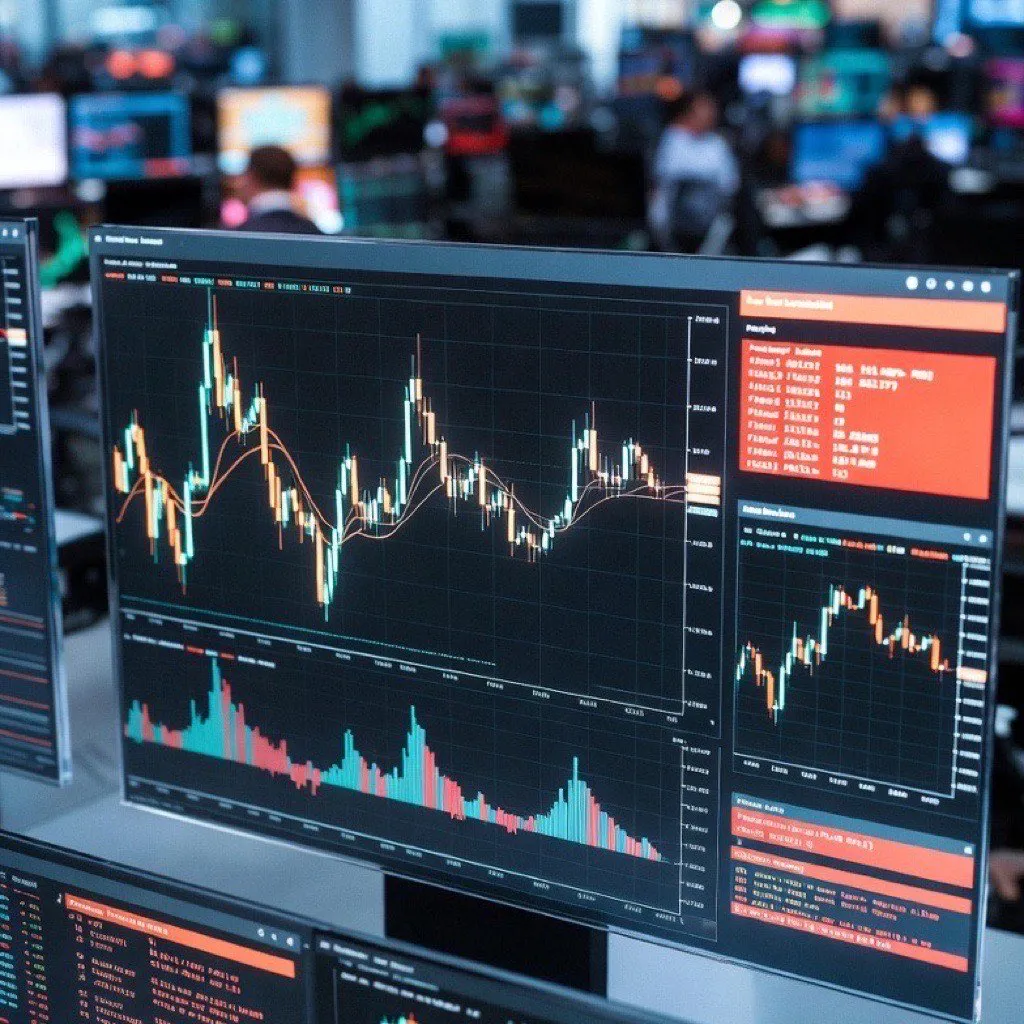
Wall Street’s Quiet Revolution
The financial industry does not talk about AI the way Silicon Valley does — no flashy demos, no open-source models, no Twitter threads about vibes. But finance may be the industry where AI has the deepest operational penetration and the highest financial impact per deployment.
In 2026, AI systems execute the majority of equity trades in US markets, process millions of fraud screening decisions daily, underwrite consumer and commercial loans, generate investment research, automate regulatory compliance reporting, and power the customer-facing interfaces of every major bank. JPMorgan Chase alone employs over 2,000 AI and machine learning specialists and has deployed AI across more than 400 production use cases. Goldman Sachs has placed AI at the center of its long-term strategic playbook, projecting it will boost firm-wide labor productivity by 15% by 2027.
The global AI-in-finance market was valued at USD 38.36 billion in 2024 and is projected to reach USD 190.33 billion by 2030, growing at a CAGR of 30.6%, according to MarketsandMarkets. But the scale of deployment has outpaced the regulatory frameworks meant to govern it — creating a growing tension between innovation speed and systemic risk management.
Algorithmic Trading: Machines Trading with Machines
Algorithmic trading — the use of computer programs to execute trades based on predefined rules and, increasingly, machine learning predictions — now accounts for approximately 70-80% of total equity trading volume on US exchanges and over 60% globally. This is not new; quantitative hedge funds have used algorithms for decades. What is new in 2026 is the integration of large language models and generative AI into trading strategies.
Sentiment-driven trading uses LLMs to parse earnings call transcripts, Federal Reserve statements, news articles, and social media in real time, extracting market-relevant sentiment signals faster than any human analyst. Morgan Stanley deployed an OpenAI-powered internal assistant used by 98% of its advisor teams for knowledge retrieval, and is building AI tools for investment analysis and client servicing — representing the kind of deep AI integration now standard across Wall Street’s largest firms.
Alternative data analysis applies machine learning to satellite imagery (counting cars in retail parking lots to predict quarterly revenue), credit card transaction data, shipping container movements, and even weather patterns to generate trading signals that traditional fundamental analysis would miss.
Reinforcement learning agents are being deployed by quantitative funds to execute trades that adapt their strategy in real time based on market microstructure — order flow, bid-ask spread dynamics, and liquidity conditions. These agents optimize execution quality (minimizing market impact and slippage) rather than predicting price direction.
The systemic risk concern is concentration and correlation. When hundreds of AI systems analyze the same data feeds, reach similar conclusions, and execute similar trades simultaneously, the result can be cascading moves that amplify volatility. The “flash crash” phenomenon — where markets drop precipitously in seconds due to algorithmic feedback loops — remains a serious risk. On August 5, 2024, correlated algorithmic selling amplified the yen carry trade unwind, contributing to a 12.4% single-day crash in the Nikkei 225 — the worst since 1987. While the trigger was macroeconomic (a Bank of Japan rate hike), automated stop-losses and algorithmic selling accelerated the decline dramatically, illustrating how AI-driven trading systems can transform an orderly correction into a market rout.
Fraud Detection: The AI Arms Race
Financial fraud is a $500+ billion annual problem globally, and AI is the primary technology deployed to fight it — and, increasingly, to perpetrate it.
Transaction monitoring systems at major banks process billions of transactions daily through ML models that score each transaction for fraud risk in real time. These models analyze hundreds of features: transaction amount, merchant category, geographic location, device fingerprint, time of day, behavioral biometrics (how you hold your phone, your typing rhythm), and deviation from the account holder’s historical patterns.
Mastercard’s Decision Intelligence system, deployed across its 3 billion+ card network, uses AI to analyze every transaction in under 50 milliseconds — approving legitimate purchases and flagging suspicious ones before the merchant even receives a response. The system reduced false positives by up to 200% and improved fraud detection rates by 20% on average — and up to 300% in some cases, according to Mastercard’s 2024 announcement.
Synthetic identity fraud — where criminals combine real and fabricated personal information to create entirely fictitious identities — has become the fastest-growing form of financial fraud. The Federal Reserve estimated $6 billion in annual losses as of 2016; more recent industry estimates suggest the figure has grown to $20 billion or more. Traditional rule-based detection systems are nearly useless against synthetic identities because the identity appears legitimate on the surface. AI systems that analyze cross-referential patterns (multiple identities sharing a phone number, address components, or application timing) are the only effective defense.
Deepfake fraud has emerged as a critical threat. Voice-cloning and video deepfake technology have enabled attackers to impersonate corporate executives and colleagues to authorize fraudulent wire transfers. In early 2024, a finance worker at multinational engineering firm Arup was tricked by deepfake video impersonations of colleagues in a video conference into transferring $25.6 million (HK$200 million) to scammers — a case that sent shockwaves through corporate treasury departments worldwide. Banks are now deploying AI-based voice authentication and liveness detection to counter this threat — AI defending against AI.
Advertisement
Lending and Credit: The Bias Question
AI-powered credit underwriting has expanded access to credit for millions of previously unbanked or underbanked consumers — but it has also raised the most acute fairness and bias concerns in any AI application domain.
Traditional credit scoring (FICO in the US, equivalent systems elsewhere) relies on a narrow set of factors: payment history, credit utilization, length of credit history, credit mix, and new inquiries. Millions of people with thin credit files — immigrants, young adults, gig economy workers — are effectively invisible to this system.
AI-based alternative credit scoring uses non-traditional data: rent payment history, utility bills, mobile phone usage patterns, employment stability, educational background, and even behavioral signals from the application process itself. Upstart, a leading AI lending platform, reported that its model approved 43% more borrowers with loss rates up to 75% lower compared to traditional credit models at the same approval rate.
The bias problem is structural. If training data reflects historical lending discrimination — which it does, in every country with a history of racial, ethnic, or gender-based economic inequality — AI models learn and perpetuate those patterns. An ML model trained on historical loan outcomes may learn that zip code is a strong predictor of default risk, but zip code in many countries is a proxy for race and ethnicity.
In September 2023, the Consumer Financial Protection Bureau (CFPB) issued guidance requiring AI-powered lenders to provide specific and accurate reasons for credit denials — not just “the model said no.” The EU’s AI Act classifies credit scoring as a “high-risk” AI application, requiring transparency, human oversight, and bias testing. These regulatory requirements are pushing lenders to adopt explainable AI techniques (SHAP values, LIME) that can decompose model decisions into interpretable factors.
Investment Research and the Bloomberg Terminal Evolution
Bloomberg’s AI integration has transformed how investment research is conducted. Bloomberg Terminal, the dominant platform for financial professionals (with approximately 350,000 subscribers at roughly $30,000 per year each), has progressively integrated AI capabilities:
Bloomberg GPT and its successors — domain-specific LLMs trained on Bloomberg’s proprietary dataset of financial news, filings, transcripts, and market data spanning decades — power natural language queries against financial data. An analyst can ask “What was Apple’s R&D spending trend relative to revenue over the last 5 years and how does it compare to Microsoft?” and receive an instant, data-grounded answer with charts.
Automated research notes generate first-draft equity research summaries from earnings releases, incorporating historical context, peer comparisons, and analyst consensus estimates. Human analysts then review, refine, and add proprietary insight. JPMorgan’s AI research assistant reportedly reduces the time to produce a post-earnings research note from 4 hours to 45 minutes.
Regulatory filing analysis uses NLP to flag material changes in SEC filings (10-K, 10-Q, 8-K) compared to prior periods — language changes that may indicate emerging risks, litigation exposure, or strategic shifts that investors need to know about. This analysis, which previously required hours of paralegal work, now happens in seconds.
The Regulator’s Dilemma: Speed vs. Oversight
Financial regulators face a fundamental asymmetry: the AI systems they must oversee evolve faster than the regulatory frameworks designed to govern them.
The SEC has proposed rules requiring asset managers to disclose their use of AI in investment decision-making and to address conflicts of interest arising from predictive analytics. The proposal, first floated in 2023, remains controversial — industry participants argue it is too broad and would impede innovation, while consumer advocates argue it does not go far enough.
The EU AI Act classifies credit scoring and insurance pricing as high-risk AI applications, requiring conformity assessments, transparency obligations, and human oversight. European banks face a compliance deadline that requires significant investment in AI governance infrastructure.
The Bank for International Settlements (BIS) published reports in 2024-2025 warning that AI-driven concentration in financial markets — where a small number of AI models from a small number of providers make decisions that move trillions of dollars — represents a new category of systemic risk not captured by existing financial stability frameworks.
The core dilemma: regulate too aggressively and financial AI innovation moves to less regulated jurisdictions; regulate too lightly and a systemic AI-driven financial crisis becomes a question of when, not if.
The Next Frontier: Agentic Finance
The emerging frontier in financial AI is agentic systems: AI agents that do not just analyze data and recommend actions but autonomously execute multi-step financial workflows.
Personal finance agents manage budgets, pay bills, optimize savings, negotiate rates, and rebalance investment portfolios — acting as automated financial advisors for consumers. Companies like Wealthfront and Betterment have operated algorithm-driven investment management for years, but the agentic generation adds natural language interaction, proactive financial planning, and cross-account optimization.
Corporate treasury agents manage cash positions across multiple banks, currencies, and time zones — executing foreign exchange hedges, optimizing working capital, and ensuring compliance with internal policies. This is a workflow that currently employs thousands of corporate treasury professionals globally and is highly amenable to AI automation.
Compliance agents monitor trading activity for regulatory violations, generate suspicious activity reports (SARs), and prepare regulatory submissions — compressing compliance workflows from days to hours.
The agentic shift raises the stakes on every existing concern — bias, transparency, systemic risk, accountability — because autonomous agents make decisions faster and at larger scale than human-supervised AI tools.
Quick Take: Algeria’s financial sector — with its push toward digital payments (Algeria Post’s Edahabia ecosystem serves over 14 million cardholders, with its BaridiMob mobile payments app surpassing 4.7 million active users), expanding fintech ecosystem, and ongoing banking modernization — is at an inflection point where AI can leapfrog legacy processes. The highest-impact immediate applications are fraud detection for digital payments and AI-assisted credit scoring for SME lending (where thin credit files are the norm). The Bank of Algeria should proactively develop AI governance guidelines for financial services before the technology outpaces regulation, as has happened in more mature markets.
Frequently Asked Questions
What is ai in finance?
AI in Finance: Algorithmic Trading, Fraud Detection, and the Regulator’s Dilemma covers the essential aspects of this topic, examining current trends, key players, and practical implications for professionals and organizations in 2026.
Why does ai in finance matter?
This topic matters because it directly impacts how organizations plan their technology strategy, allocate resources, and position themselves in a rapidly evolving landscape. The article provides actionable analysis to help decision-makers navigate these changes.
How does algorithmic trading: machines trading with machines work?
The article examines this through the lens of algorithmic trading: machines trading with machines, providing detailed analysis of the mechanisms, trade-offs, and practical implications for stakeholders.
Sources & Further Reading
- MarketsandMarkets — AI in Finance Market Report
- JPMorgan Chase — AI and Machine Learning Strategy
- Goldman Sachs — 10-Year Strategic Playbook (CNBC)
- OpenAI — Morgan Stanley AI Assistant
- Mastercard — Decision Intelligence Gen AI
- Federal Reserve — Synthetic Identity Fraud Mitigation
- SC World — Deepfake Video Conference $25M Scam
- Consumer Financial Protection Bureau — AI Lending Guidance (2023)
- EU AI Act — High-Risk Classification for Credit Scoring
- Bank for International Settlements — AI and Financial Stability (2025 Annual Report)
- Upstart — AI Lending Performance Data
- SEC — Proposed Rule on AI in Investment Advisory