The Week That Changed the Chip Wars
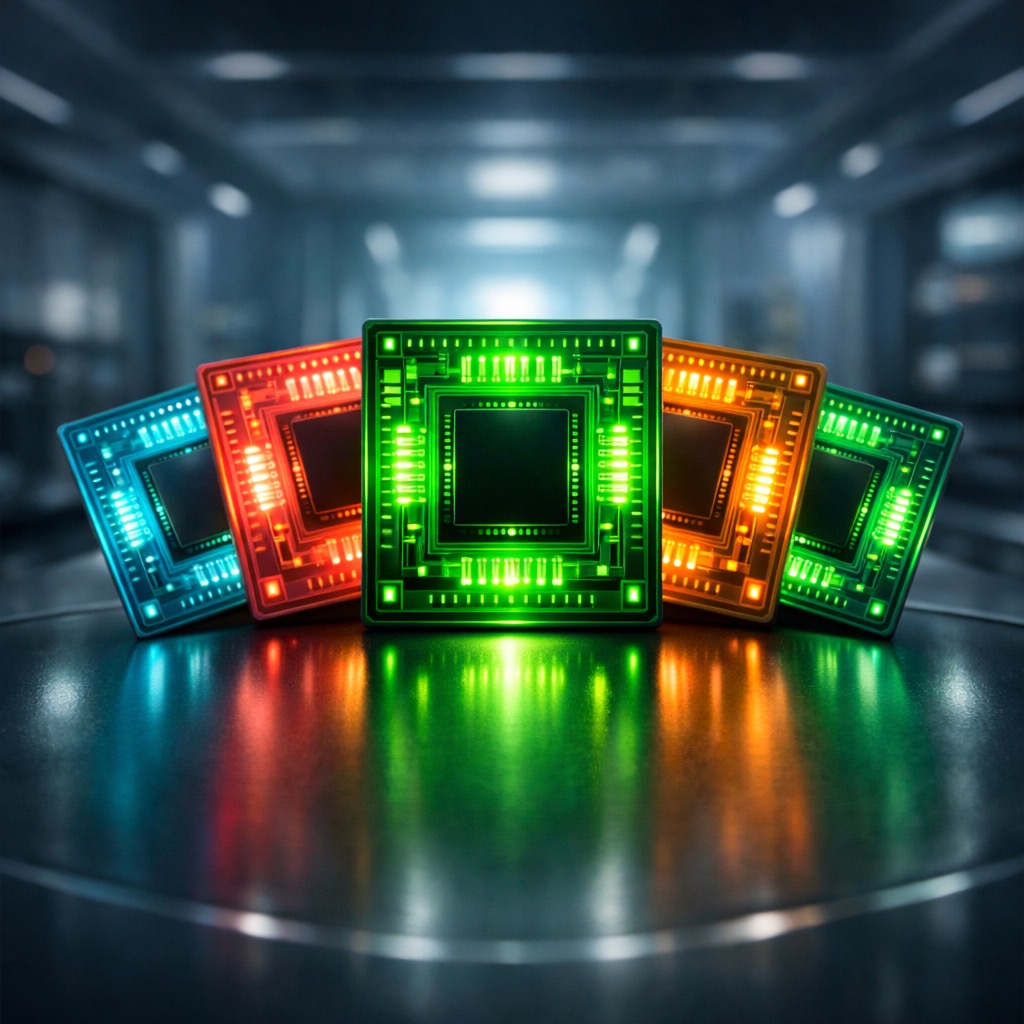
In the third week of February 2026, something unprecedented happened in the semiconductor startup world. Four companies collectively raised over $1.2 billion in a span of days, each pitching a fundamentally different approach to dethroning Nvidia in AI compute. MatX secured $500 million for its LLM-first accelerator architecture. Positron closed $230 million from Arm and Qatar’s sovereign wealth fund at a valuation exceeding $1 billion. Taalas pulled in $169 million for its radical transistor-embedded model weights technology. And SambaNova added $350 million with Intel as a strategic backer.
This was not a coordinated effort. These companies operate in different geographies, target different segments of the AI compute stack, and in some cases compete directly with each other. What unifies them is a shared conviction: Nvidia’s GPU-centric monopoly on AI compute is economically and architecturally unsustainable, and the market is ripe for disruption.
The timing is not accidental. Inference workloads are projected to consume two-thirds of all AI compute by the end of 2026, a dramatic shift from the training-dominated landscape of 2024. Training requires brute-force parallelism where Nvidia’s architecture excels. Inference demands efficiency, low latency, and cost optimization — a fundamentally different engineering challenge that opens the door for purpose-built alternatives.
MatX: The LLM-First Architecture
MatX emerged from stealth with the most audacious claim: its custom accelerator delivers 10x the performance of Nvidia’s flagship H100 for large language model inference at a fraction of the cost per token. Founded by former Google TPU engineers who helped design the Tensor Processing Units that power Google’s own AI infrastructure, MatX represents the most credible technical challenge to Nvidia’s dominance.
The company’s approach starts from first principles. Rather than building a general-purpose GPU that can be adapted for AI workloads, MatX designed its chip architecture around the specific computational patterns of transformer models. The attention mechanism, key-value caching, and token generation that dominate LLM inference each receive dedicated silicon optimized for those exact operations.
MatX’s $500 million round, reportedly led by a consortium of hyperscaler investors, signals that the largest consumers of AI compute see enough technical merit to place a significant bet. The company claims to have working silicon in customer hands, though independent benchmarks have not been published. If the performance claims hold, the economics are compelling: a 10x efficiency improvement would reduce the cost of running inference for a GPT-4-class model from roughly $0.03 per 1,000 tokens to $0.003, a price point that could make previously uneconomic AI applications viable.
The risk is equally significant. Custom chip startups have a long history of promising revolutionary performance and failing to deliver at scale. The gap between a working chip and a production-ready system with software tooling, compiler support, and ecosystem compatibility is measured in years and billions of dollars.
Positron and Taalas: Radical Departures
Positron’s $230 million raise attracted attention less for the amount than for the investors. Arm Holdings, the company whose instruction set architecture underlies virtually every mobile processor on Earth, led the round alongside Qatar’s sovereign wealth fund. The $1 billion-plus valuation for a company with limited public benchmarks suggests that Arm sees Positron’s approach as complementary to its own ambitions in data center AI.
Positron’s architecture focuses on what the company calls “native sparsity” — the observation that in most AI inference operations, the vast majority of computations produce near-zero results and can be skipped entirely. Nvidia’s GPUs perform these unnecessary calculations because their architecture processes all matrix elements uniformly. Positron’s chip identifies and eliminates zero-value computations at the hardware level, theoretically delivering massive efficiency gains for inference workloads where sparsity rates often exceed 90%.
Taalas takes an even more radical approach. Its $169 million raise funds a technology that embeds model weights directly into transistor configurations during chip fabrication. In conventional AI hardware, model weights are stored in memory and shuttled to compute units — a process that creates bottlenecks as models grow larger. Taalas eliminates this memory bandwidth constraint entirely by encoding the model into the chip’s physical structure. The tradeoff is obvious: each chip is purpose-built for a single model and cannot be reprogrammed. But for high-volume inference of popular models like GPT-4 or Claude, the economics could be transformative.
This approach echoes the historical pattern of ASICs (Application-Specific Integrated Circuits) that disrupted general-purpose computing in domains like Bitcoin mining and video encoding. The question is whether AI inference will consolidate around a small number of dominant models — making Taalas-style fixed-function chips viable — or continue to fragment across thousands of specialized models where general-purpose hardware retains its advantage.
Advertisement
SambaNova and the Intel Alliance
SambaNova’s $350 million round, with Intel as a strategic investor, represents a different competitive dynamic entirely. Unlike the pure-play startups, SambaNova has been shipping its DataScale systems to enterprise customers since 2023 and has a meaningful installed base in government and financial services.
The Intel partnership is strategically significant for both parties. Intel has struggled to compete with Nvidia in AI accelerators, watching its Gaudi product line fail to gain meaningful market share despite aggressive pricing. By investing in SambaNova, Intel gains access to a reconfigurable dataflow architecture that complements its own Xeon processors in heterogeneous data center deployments. SambaNova gains Intel’s manufacturing relationships, enterprise sales channels, and validation with CIOs who remain cautious about startup vendors for critical infrastructure.
SambaNova’s architecture is built around reconfigurable dataflow units that can be optimized for different model architectures without the fixed-function limitations of Taalas or the general-purpose overhead of Nvidia’s GPUs. The company positions itself in the enterprise market rather than competing directly with hyperscalers, targeting organizations that need to run AI inference on-premises for regulatory or security reasons.
The Inference Economics Driving the Insurgency
The fundamental force behind this funding wave is an economic inflection point in AI compute. During the training era of 2023-2024, Nvidia’s monopoly was nearly unassailable. Training a frontier model required thousands of GPUs running in tight synchronization for months, and Nvidia’s CUDA ecosystem, NVLink interconnects, and software tooling created switching costs that no startup could overcome.
Inference is structurally different. Each inference request is independent, latency-sensitive, and cost-constrained. A company running a chatbot serving millions of users cares primarily about cost per token and response latency — metrics where Nvidia’s training-optimized architecture is increasingly over-provisioned and inefficient.
The numbers tell the story. Nvidia’s H100 GPU costs approximately $30,000 and delivers roughly 1,000 tokens per second for a 70-billion parameter model. At data center operating costs, this translates to approximately $0.01-0.03 per 1,000 tokens depending on utilization. For a consumer-facing AI product serving millions of daily users, inference compute can represent 60-80% of total operating costs.
Any startup that can deliver equivalent inference performance at 50% lower cost per token immediately addresses a market worth tens of billions of dollars annually. At 90% lower cost — the range that MatX and Taalas are targeting — entirely new categories of AI applications become economically viable: real-time AI video processing, always-on AI assistants, and AI-powered services in emerging markets where current pricing is prohibitive.
Industry analysts project the AI inference chip market to reach $50-70 billion by 2028, growing at a compound annual rate exceeding 40%. Even capturing 10% of this market would make any one of these startups a major semiconductor company.
What This Means for Nvidia’s Monopoly
Nvidia is not standing still. The company’s Blackwell architecture, shipping in volume throughout 2026, delivers significant inference efficiency improvements over H100. Nvidia’s roadmap includes the Rubin architecture in 2027 with further inference optimizations. And the CUDA software ecosystem — with millions of developers, thousands of optimized libraries, and deep integration into every major AI framework — creates a moat that no hardware advantage alone can overcome.
But the competitive dynamics have shifted. In 2024, Nvidia faced competition primarily from well-funded incumbents — AMD, Intel, Google — that moved slowly and lacked AI-native chip design philosophy. The 2026 challengers are different: fast-moving startups with focused architectures, billions in funding, and founding teams drawn from the same talent pool that built Nvidia’s and Google’s AI hardware.
The most likely outcome is market fragmentation rather than displacement. Nvidia will likely retain dominance in training and in inference workloads requiring flexibility across many model architectures. But the standardized, high-volume inference market — running well-established models at massive scale — may see purpose-built alternatives capture significant share.
For the broader AI ecosystem, this competition is unambiguously positive. Lower inference costs accelerate adoption, enable new applications, and reduce the concentration of AI compute power in the hands of a few hyperscalers. The $1.2 billion raised in a single week is not just a bet on four startups — it is a bet that the AI compute market is large enough and growing fast enough to support multiple architectural approaches. Given current trajectories, that bet looks increasingly sound.
Frequently Asked Questions
What does “The AI Chip Insurgency” mean?
The AI Chip Insurgency: $1.2 Billion in One Week to Dethrone Nvidia covers the essential aspects of this topic, examining current trends, key players, and practical implications for professionals and organizations in 2026.
Why does the ai chip insurgency matter?
This topic matters because it directly impacts how organizations plan their technology strategy, allocate resources, and position themselves in a rapidly evolving landscape. The article provides actionable analysis to help decision-makers navigate these changes.
How does matx: the llm-first architecture work?
The article examines this through the lens of matx: the llm-first architecture, providing detailed analysis of the mechanisms, trade-offs, and practical implications for stakeholders.
Sources & Further Reading
- MatX Raises $500M for LLM-First AI Accelerator — TechCrunch
- Positron Secures $230M from Arm and Qatar at $1B+ Valuation — The Information
- Taalas Emerges with $169M for Transistor-Embedded AI Weights — Wired
- SambaNova Raises $350M with Intel as Strategic Backer — Bloomberg
- AI Inference to Hit Two-Thirds of Compute by 2026 — Gartner Research
🔗 Related Intelligence

Cerebras IPO: The Wafer-Scale Chip Challenging Nvidia’s AI Reign

The AI Chip Wars: Nvidia’s Dominance, AMD’s Challenge, and the Rise of Custom Silicon

TSMC’s $56 Billion AI Bet: Why One Company Controls All Chips