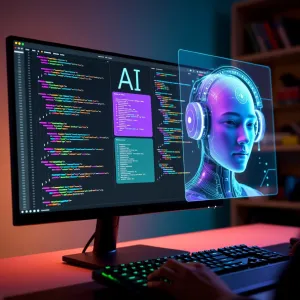
On February 2, 2025, AI researcher Andrej Karpathy posted on X about a new way he was writing code — describing what he wanted in natural language and letting AI generate it, barely reviewing the output, and “just seeing stuff, saying stuff, running stuff, and copy-pasting stuff.” He called it “vibe coding.” Within months, Collins Dictionary named it Word of the Year for 2025 — a remarkable trajectory for a term born from a casual social media observation about the changing nature of software development.
By early 2026, the concept had evolved significantly. Karpathy himself moved past the term, promoting “agentic engineering” as a more accurate description of where AI-assisted development was heading. The shift from one term to the other tells the story of an industry grappling with the most fundamental change to software development since the invention of high-level programming languages.
What Is Vibe Coding?
Vibe coding refers to a fundamentally different approach to writing software:
- Describing functionality in natural language rather than writing syntax
- Accepting AI-generated code with minimal manual review
- Iterating through prompts rather than manual editing and debugging
The concept resonated because it captured something many developers were already experiencing: the growing gap between traditional software engineering practices and the reality of working with increasingly capable AI coding assistants. The programmer’s role was shifting from code author to AI orchestrator — someone who directs what should be built rather than specifying exactly how it should work at the implementation level.
The Rise of Prompt-Driven Development
Throughout 2025 and into 2026, vibe coding evolved from a niche concept to a widely discussed paradigm. Tools like Cursor, GitHub Copilot, Claude Code, and Windsurf made it practical for developers to generate entire functions, modules, and even applications through conversational prompts. The adoption numbers are striking: surveys indicate that approximately 85% of developers now use AI coding tools in some capacity — a massive shift from just two years prior.
The workflow typically looks like:
- Describe the desired behavior in plain language
- Review the AI-generated output for correctness
- Iterate with follow-up prompts to refine the result
- Accept and integrate once the output meets requirements
For many routine coding tasks — CRUD operations, boilerplate generation, test writing, documentation — this approach proved dramatically faster than traditional development. Y Combinator’s Winter 2025 batch made headlines when it was reported that 25% of accepted startups had codebases that were approximately 95% AI-generated — a statistic that would have been unthinkable even a year earlier.
The Backlash: Speed vs. Quality
Not everyone embraced the term or the practice. According to Business Insider, Peter Steinberger, creator of OpenClaw, called vibe coding a “slur” against engineering skill. His argument: reducing software development to “vibes” understates the deep technical knowledge, architectural thinking, and debugging expertise that separates working code from production-quality software. Steinberger subsequently joined OpenAI in February 2026 — a move that underscored how even critics of the term were deeply engaged with AI-assisted development.
AI researcher Andrew Ng also pushed back, arguing that while AI coding tools were powerful, the “vibe coding” label encouraged a dangerous casualness about code quality and understanding.
Empirical evidence began supporting the skeptics. A study from METR (Model Evaluation and Threat Research) found that experienced open-source developers were actually 19% slower when using AI coding assistants on complex, real-world tasks — contradicting the assumption that AI universally accelerates development. A CodeRabbit analysis found that AI-assisted pull requests contained approximately 1.7 times more issues than traditionally written code. These findings suggest that while AI excels at generating boilerplate and straightforward code, it can introduce subtle problems in complex systems that require more debugging time than manual implementation would have taken.
Additional concerns emerged around:
- Technical debt accumulation from accepting code without deep understanding
- Security vulnerabilities introduced by generated code that looks correct but contains subtle flaws
- Skill atrophy among developers who rely too heavily on AI generation
- Overconfidence in generated outputs that pass basic tests but fail under edge conditions
Advertisement
From Vibe Coding to Agentic Engineering
In February 2026, on the one-year anniversary of his original post, Karpathy began promoting the term “agentic engineering” to better describe the emerging reality. The distinction matters:
Vibe coding implies casual, prompt-based generation — describe what you want and hope for the best.
Agentic engineering implies structured orchestration of AI coding agents — defining workflows, setting constraints, reviewing outputs systematically, and maintaining architectural coherence across a codebase.
The shift reflects increasing sophistication in how developers work with AI tools:
- Multi-agent workflows where different AI agents handle planning, implementation, testing, and review
- Constraint-based generation where developers specify not just what to build but how it should integrate with existing systems
- Automated quality gates where AI-generated code passes through automated testing, linting, and security scanning before acceptance
- Human-in-the-loop architecture where developers make high-level decisions while agents handle implementation details
The tooling ecosystem reflects this maturation. Windsurf was acquired by Cognition AI (makers of the Devin AI software engineer), consolidating AI coding capabilities into more integrated agent platforms. Claude Code introduced agentic capabilities that go beyond simple code completion to full project-level reasoning. These are not autocomplete tools — they are autonomous agents that can plan, execute, and iterate across entire codebases.
What This Means for Developers
The evolution from vibe coding to agentic engineering signals that AI-assisted development is maturing beyond the initial hype cycle. For the estimated 47 million developers worldwide (according to SlashData’s 2025 developer survey), the practical implications are significant:
- Junior developers need to learn both traditional fundamentals and AI orchestration skills — understanding what the code does remains essential even when AI writes it
- Senior developers become more valuable as architects who direct AI agents, design system boundaries, and ensure quality — the skills that AI cannot yet replicate
- Engineering teams need new workflows that integrate AI generation with systematic human review and automated quality gates
- Companies must develop policies around AI-generated code ownership, liability, and quality standards
Programming is indeed becoming “unrecognizable” compared to a few years ago, as Karpathy stated. But the core skills — logical thinking, system design, debugging, and understanding user needs — remain as important as ever. What changes is how those skills are applied: less time writing syntax, more time orchestrating agents, reviewing outputs, and making architectural decisions.
Why This Matters
The vibe coding to agentic engineering arc is more than a semantic shift. It represents the software industry’s transition from:
- AI as autocomplete (Copilot-era) to AI as collaborator (agent-era)
- Individual tool use to orchestrated workflows
- Casual adoption to systematic integration
The METR and CodeRabbit studies serve as important reality checks: AI coding tools are powerful but not infallible, and using them well requires more skill, not less. The developers who thrive will be those who combine AI fluency with deep engineering judgment — the essence of what agentic engineering demands.
Frequently Asked Questions
What is from vibe coding to agentic engineering?
From Vibe Coding to Agentic Engineering: How AI Is Reshaping Software Development covers the essential aspects of this topic, examining current trends, key players, and practical implications for professionals and organizations in 2026.
Why does from vibe coding to agentic engineering matter?
This topic matters because it directly impacts how organizations plan their technology strategy, allocate resources, and position themselves in a rapidly evolving landscape. The article provides actionable analysis to help decision-makers navigate these changes.
How does the rise of prompt-driven development work?
The article examines this through the lens of the rise of prompt-driven development, providing detailed analysis of the mechanisms, trade-offs, and practical implications for stakeholders.
Sources & Further Reading
- Wikipedia — Vibe Coding
- Business Insider — “Karpathy says programming is becoming unrecognizable with AI”
- Business Insider — “OpenClaw creator criticizes vibe coding term”
- METR — AI assistants slow experienced developers on real-world tasks
- CodeRabbit — AI Code Quality Analysis
- arXiv — Risks in AI-generated code (2512.11922)