What Meta Just Committed To
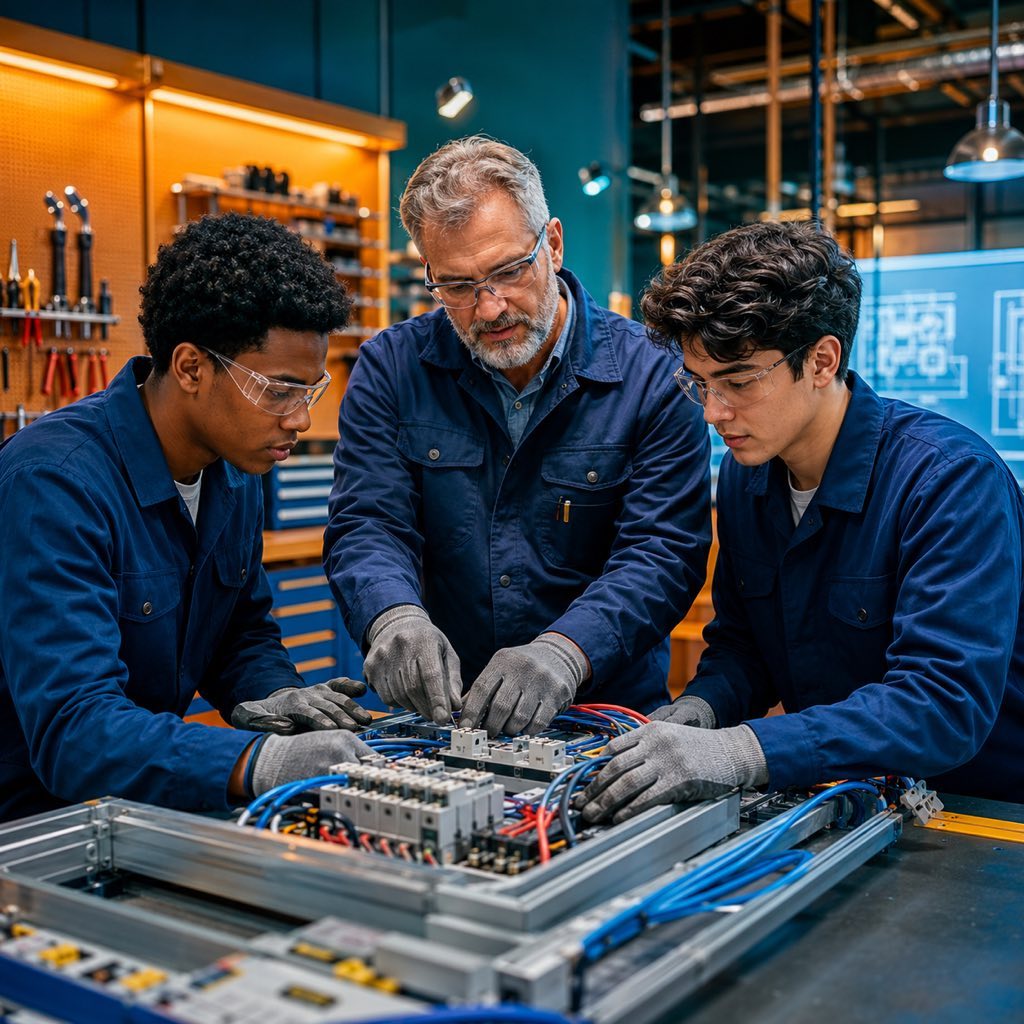
Meta has launched America’s Workforce Academy (AWA), a $115 million investment in its first year designed to train electricians, welders, plumbers, fiber technicians, mechanics, and construction technicians for jobs on its data-center buildout, according to Meta’s official announcement. The program is free to attend, runs five weeks, and covers tuition, housing, and a daily stipend for participants — no prior trades experience required, Fortune reports.
Graduates leave with two credentials: the industry-recognized National Center for Construction Education and Research (NCCER) certification and Meta’s own America’s Workforce Certificate. Crucially, completing the academy comes with a guaranteed job on a Meta data-center project through one of its contractor partners, contingent on passing a background check and drug screening and finishing the training requirements, according to Construction Dive. Meta describes the initiative as “the largest private-sector commitment to the skilled trades with a job guarantee in U.S. history.”
The pilot phase launches in 2026 across four states: Baton Rouge, Louisiana; Columbus, Ohio; Indianapolis, Indiana; and Houston, Texas — each chosen because Meta is actively building or expanding a data center nearby, per Fox Business. Delivery is handled through a coalition of partners rather than Meta alone: CBRE manages recruitment, training, and deployment logistics; Associated Builders and Contractors (ABC) contributes its network of roughly 800 training centers nationwide; and the National Urban League, the U.S. Hispanic Chamber of Commerce, and STRIVE handle outreach to veterans, career changers, and underrepresented job seekers, alongside local partners like the Boone County Economic Development Corporation in Indiana and the Richland Parish Chamber of Commerce in Louisiana.
Why the AI Buildout Needs Electricians as Much as Engineers
The AI infrastructure race is usually framed as a contest over GPUs and machine-learning talent. AWA is a reminder that it is just as much a construction problem. According to CBS News, the United States currently has roughly 3,000 data centers under construction or publicly announced, a buildout Meta projects will generate 4.7 million temporary construction jobs and around 700,000 permanent operational positions in the years ahead. That scale of demand is colliding with a construction workforce that, in Meta’s own words, is already short on “electricians, welders, fiber technicians, plumbers and other skilled craft professionals.”
Meta has direct evidence of how lopsided that supply-demand gap already is. Its prior fiber-technician training initiative, LevelUp, received 35,000 applications for just 1,000 openings within the first seven days, according to Fortune’s coverage of the program. The jobs on offer are not marginal either: Fortune cites an average national fiber-technician salary of $57,818 and an average data-center technician salary of $54,031, wages that compete favorably with entry-level white-collar work and require no four-year degree. That combination — overwhelming applicant demand for a narrow prior program, plus wages attractive enough to draw career changers — is the evidence base Meta is using to justify scaling from a single-track pilot into a multi-trade, multi-state academy with a hard job guarantee attached.
Advertisement
What Workforce Planners and Training Institutes Should Do
1. Treat the job guarantee as the product, not the curriculum
The single biggest lever AWA pulls is not its five-week syllabus — it’s the fact that a named employer has pre-committed to hiring every qualifying graduate. Most vocational programs sell training and hope employers show up at graduation; AWA inverts that by locking in demand first. Training institutes negotiating with any large infrastructure employer — telecom, renewable energy, logistics — should push for a written hiring commitment tied to specific headcount and timeline before designing the coursework around it. A credential with no attached employer is a credential competing in an oversupplied market; a credential with a guarantee is a credential competing for enrollment.
2. Build direct pipelines with contractors before finalizing coursework
AWA does not train people for Meta directly — it trains them for CBRE-coordinated placement with Meta’s contractor network, which is the actual hiring layer on any large construction project. Workforce planners should identify who the contractors will be before finalizing a curriculum, because contractor licensing requirements, safety certifications, and equipment standards vary by trade and by region. Skipping this step produces graduates who hold a generic certificate that no specific employer in the pipeline actually requires, which is the failure mode AWA is explicitly designed to avoid by having ABC’s roughly 800-center network embedded from day one.
3. Use stipends to remove opportunity cost, not just tuition cost
Free tuition alone rarely moves career changers and veterans into a five-week program, because the real barrier is lost income during training, not the sticker price. AWA pairs free tuition with covered housing and a daily stipend specifically to neutralize that opportunity cost — a design choice confirmed by Fortune’s reporting on the program’s full-cost coverage. Institutes recruiting from populations with immediate income needs should budget for a living stipend as a core line item, not an optional add-on, since a credential program that requires five weeks of unpaid time will systematically filter out the applicants most likely to need a guaranteed job the most.
4. Track regional buildout announcements as a leading enrollment signal
Meta picked Baton Rouge, Columbus, Indianapolis, and Houston because each already has an active or planned data-center project nearby — the training pipeline follows the infrastructure, not the other way around. Workforce planners in regions courting large capital projects (fabs, ports, renewable-energy plants, or data centers) should treat a company’s public construction announcement as the trigger to open training-pipeline negotiations, well before ground is broken. By the time a facility is operational, the skilled-trades hiring window has usually already closed to whoever moved first.
The Structural Lesson
AWA is a useful corrective to how the AI boom gets covered. The dominant narrative is chips, model weights, and compute contracts — but a hyperscale data center is, physically, tons of concrete, miles of fiber, and thousands of electrical connections that someone has to install by hand. Meta’s willingness to put $115 million behind a guaranteed-job trades program is a signal that the bottleneck constraining AI infrastructure delivery is shifting from capital availability to labor availability, at least in the skilled-trades segment.
The model is also a hedge against a familiar failure pattern in corporate workforce programs: training without hiring commitments, which produces credentialed but still-unemployed graduates and erodes trust in the next program a company tries to launch. By binding the credential to a guaranteed placement, Meta is betting that the reputational and recruiting upside — plus faster, cheaper access to labor than open-market bidding for scarce electricians — outweighs the fixed cost of the guarantee. If AI capital expenditure slows before the four pilot cohorts graduate, that guarantee becomes the first real test of how durable this kind of commitment is when the buildout that justified it stalls.
Frequently Asked Questions
How much is Meta investing in America’s Workforce Academy, and is the training free?
Meta is investing $115 million in the program’s first year. The training itself is free for participants, and Meta also covers housing and provides a daily stipend during the five-week course, according to Fortune.
What job guarantee does America’s Workforce Academy actually offer?
Graduates who pass a background check and drug screening and complete the training requirements are guaranteed a position on a Meta data-center project through one of Meta’s contractor partners, and they leave with an NCCER credential plus Meta’s America’s Workforce Certificate, per Construction Dive.
Where is the program launching, and who delivers the training?
The 2026 pilot covers four sites — Baton Rouge (Louisiana), Columbus (Ohio), Indianapolis (Indiana), and Houston (Texas) — each near an active Meta data-center project. CBRE manages recruitment and deployment, while Associated Builders and Contractors, the National Urban League, the U.S. Hispanic Chamber of Commerce, and STRIVE handle training delivery and outreach, per Meta’s announcement.
Sources & Further Reading
- America’s Workforce Academy: Free Skilled Trade Training — Meta Newsroom
- Meta’s $115M Bet on Free Trade Training and Guaranteed Jobs — Fortune
- Meta Launches Data-Center Workforce Academy Training — CBS News
- Meta Launches $115M Skilled Trades Academy With Guaranteed Jobs in 4 States — Fox Business
- Meta’s Workforce Academy Targets Data-Center Construction Labor Gap — Construction Dive
🔗 Related Intelligence

Meta Lets You Use AI in Coding Interviews: The 2026 Reset of Engineering Hiring

Meta’s $135B Gamble: Inside the 2026 Superintelligence Infrastructure Build

Meta Deepens AI Infrastructure With 1B CoreWeave Deal

Meta’s May 2026 Layoffs: The Skill Profiles That Were Cut — and Those That Were Not