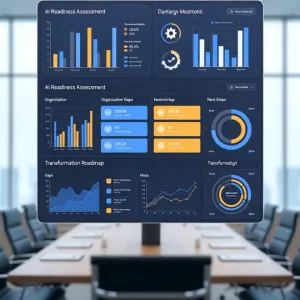
The Shift from Differentiator to Prerequisite
There is a moment in the adoption curve of any technology when knowing it stops being an advantage and starts being a baseline requirement. For internet skills, that moment arrived somewhere around 2003. For mobile development, approximately 2012. For cloud infrastructure, 2018. For AI fluency — the ability to use, evaluate, configure, and build with AI systems — that moment is 2026.
The data is unambiguous. According to CompTIA’s State of the Tech Workforce 2026 report, 275,000 active job postings in January 2026 referenced AI skills. This number covers two distinct categories: dedicated AI positions such as AI engineers, ML architects, and prompt engineers; and general tech positions — software development, data analysis, product management, IT operations — where AI tool fluency is listed as a standard requirement alongside version control and communication skills.
The Dice.com analysis of the US tech labor market shows that 50% of all US tech job postings now require AI skills as of September 2025, up from 47% in August — representing a 98% jump in AI skill requirements compared to September 2024. Gloat’s analysis of nearly one billion job ads puts the wage premium into sharp relief: workers with AI skills commanded a 56% wage premium in 2024, up from 25% the year before. Occupations explicitly requiring AI fluency grew from approximately 1 million workers in 2023 to around 7 million by 2025 — a sevenfold increase in two years.
This is not confined to technology companies. The top sectors requiring AI skills now include finance and insurance, professional and scientific services, and manufacturing — industries where AI fluency was considered optional as recently as 2024.
What “AI Fluency” Actually Means for Employers in 2026
The term is used loosely, which creates confusion about what candidates actually need to demonstrate. Employer requirements in 2026 cluster into three distinct levels, and knowing which level your target role demands is the first step in an efficient upskilling strategy.
Level 1 — AI literacy is the floor for virtually all knowledge worker roles. It means: understanding how large language models work and where they fail (hallucination, context limits, prompt sensitivity); ability to evaluate AI-generated output for accuracy and appropriateness; familiarity with the major AI tool categories (generative, classification, recommendation, prediction). This is now a baseline expectation for roles in marketing, HR, legal, operations, and all of product management.
Level 2 — AI tool proficiency is what most tech hiring managers mean when they list “AI skills” in a job description. It covers: daily use of AI coding assistants (GitHub Copilot, Cursor, Claude Code) as part of a development workflow; ability to design and test prompts for complex tasks; integration of AI APIs into existing systems; and use of AI-powered analytics and BI platforms. Gloat’s research shows that 75% of knowledge workers already use AI tools in some form, but only 9% of organisations have achieved true AI maturity — the gap is in structured, verifiable proficiency rather than casual use.
Level 3 — AI development competence is what specialist roles require. ML engineers, AI architects, and applied scientists need to build, fine-tune, evaluate, and deploy models in production environments. Natural Language Processing saw a 155% increase in job postings in 2024 with vacancy rates hitting 15% — double the national average — signalling that the specialist layer is significantly undersupplied relative to demand.
Understanding which level applies to your current or target role eliminates the most common upskilling mistake: over-preparing for Level 3 while ignoring the Level 2 proficiency that your employer can actually evaluate in an interview.
Advertisement
What Every Tech Professional Should Do About It
1. Audit Your Current Role for the AI Fluency Gap — Then Close It in 90 Days
Before committing to a learning programme, map your current role’s AI requirements. Look at job descriptions for your exact title at peer companies: what AI tools or competencies appear in the first five bullet points? If AI skills appear there and you cannot demonstrate them in an interview, you have an active gap. The 90-day closure path for Level 2 proficiency is well-defined: four weeks of structured AI tool usage in your current workflow (commit to using GitHub Copilot or similar on every coding task for one month — not occasionally); four weeks of prompt engineering practice on real work tasks (not toy examples); and four weeks of integration — building one small internal tool that uses an AI API to solve a real problem at your company. At the end of 90 days, you have a demonstrable portfolio item that supports both internal promotion conversations and external hiring discussions. According to the Dice.com report, the 98% jump in AI skill requirements happened in a single year — which means the window to close this gap before it affects your next performance review or job application is narrower than most professionals assume.
2. Get a Credential That Signals AI Fluency to a Recruiter in 6 Seconds
Recruiters reviewing 200+ applications spend an average of 6 to 8 seconds on initial resume screening. In a market where 50% of tech roles require AI skills, a clearly visible credential creates immediate shortlist signal. The most effective credentials for Level 2 fluency in 2026: Microsoft Azure AI Fundamentals (AI-900), Google Professional Machine Learning Engineer, AWS Certified Machine Learning — Specialty, and DeepLearning.AI’s Machine Learning Specialization (Coursera, 4 million+ completions). For Level 3, the HuggingFace certification, MLflow certification, and domain-specific credentials (Databricks Certified Associate, NVIDIA AI certification) carry the strongest employer recognition. Pluralsight’s 2026 skills analysis confirms that cloud and AI certifications are the top two credentials most likely to accelerate a candidate from application to interview shortlist. The credential is not a substitute for demonstrated skill — but it is the signal that gets you to the room where you can demonstrate it.
3. Reposition Your Resume Around AI-Adjacent Output, Not Just AI Knowledge
The most common upskilling mistake is completing a course and then adding “familiar with AI tools” to a resume. That phrase means nothing to a recruiter who has seen it on 150 applications this week. What works: specific, quantified AI output. “Reduced code review cycle time by 35% by integrating GitHub Copilot into the team’s PR workflow” is a hiring signal. “Automated 60% of data cleaning steps for the Q4 reporting pipeline using Python and a custom LLM prompt chain” is a hiring signal. “Completed Google AI Fundamentals course” is not. The second talent market analysis for 2026 shows that candidates who describe specific AI-enabled productivity outcomes — not just AI tool usage — convert from resume to interview at 2-3x the rate of those who list AI skills generically. This is the repositioning that actually moves hiring outcomes, and it requires going back to your current and previous roles and finding the specific cases where AI tools changed your output.
The Failure-Path Comparison
The careers most at risk in the 2026 AI skills shift are not those of non-technical workers — it is those of technical workers who are highly competent at non-AI-augmented tasks and have not updated their working methods. A senior developer who writes excellent code manually but has not integrated AI coding assistants is not at risk of immediate replacement — but is at risk of a growing productivity gap relative to peers who have. Over an 18 to 24 month horizon, this gap affects promotion velocity, project assignment, and, in a restructuring environment, layoff selection.
Meta’s May 2026 layoffs — 8,000 positions cut, 6,000 open roles cancelled — illustrate the structural direction: the company explicitly stated it intends AI to write four times the amount of code as its human engineers in 2026. The surviving and expanding roles are those involving AI oversight, AI system integration, and AI-focused product development. The eliminated roles skew toward teams not adjacent to AI. This is not a Meta-specific trend — it is a preview of where the broader market is heading over the next 24 months. Tech professionals who build verifiable AI fluency now are positioning for that market. Those who wait are positioning against it.
Frequently Asked Questions
Is AI fluency now required for non-technical roles, or just software engineering positions?
AI fluency is now a baseline expectation across all knowledge worker roles, not just technical ones. The CompTIA 2026 report shows AI skill requirements expanding beyond the tech sector into finance, insurance, professional services, and manufacturing. For non-technical roles, Level 1 literacy — understanding how AI tools work and being able to evaluate their output — is the minimum expected. For technical roles, Level 2 proficiency (daily use of AI coding or productivity tools) is increasingly standard, and Level 3 development competence is required for specialist AI positions.
How quickly can a tech professional become genuinely AI-fluent in 2026?
Level 1 AI literacy — sufficient for non-technical roles — can be achieved in 2 to 4 weeks of structured learning using free resources from Google, Microsoft, or DeepLearning.AI. Level 2 tool proficiency — sufficient for most tech roles — requires 60 to 90 days of consistent practice integrating AI tools into actual work tasks, not just completing courses. Level 3 development competence for specialist roles typically requires 6 to 12 months of dedicated study and project work, particularly for engineers transitioning from traditional software development to ML engineering.
What is the most reliable signal of AI fluency for a recruiter reviewing a resume in 6 seconds?
Internationally recognised credentials (Google Professional ML Engineer, AWS ML Specialty, Microsoft AI-900, DeepLearning.AI Specialization) are the most reliable resume-stage signals because they provide a standardised benchmark that any recruiter can recognise instantly. After the credential, the most effective resume signal is a specific, quantified outcome from AI tool usage — a percentage improvement, an automation achievement, or a deployed project with a measurable result — rather than a generic claim of “familiarity with AI tools.”
—
Sources & Further Reading
- State of the Tech Workforce 2026 — CompTIA
- 50% of Tech Jobs Now Require AI Skills — Dice.com
- AI Skills Demand in the U.S. Job Market (2026) — Gloat
- Top Tech Skills 2026 — Pluralsight
- AI Impact on the Job Market in 2026 — Second Talent
- Meta Cuts 8,000 Jobs and Cancels 6,000 Open Roles as $135B AI Spending Reshapes the Company — The Next Web
🔗 Related Intelligence

Job Postings Requiring AI Skills Grew 144% Year-Over-Year as Reskilling Outpaces “Learn to Code”

AI Engineer: The Role That Grew 153% and the Skills Employers Want Now

185,499 New Tech Jobs: Why AI Fluency Just Became a Hiring Baseline

AI Skills Now Hardest to Hire on Earth: The Turning Point Employers Missed in 2026