What the Bank of Algeria Actually Changed
For most of the e-commerce era, Algerian online merchants could sell to the world but could not get paid by the world. A customer in Paris, Dubai or Dakar who wanted to buy from an Algerian site had no clean way to pay with their own bank card, and the merchant had no authorized channel to receive that money online. That asymmetry just closed.
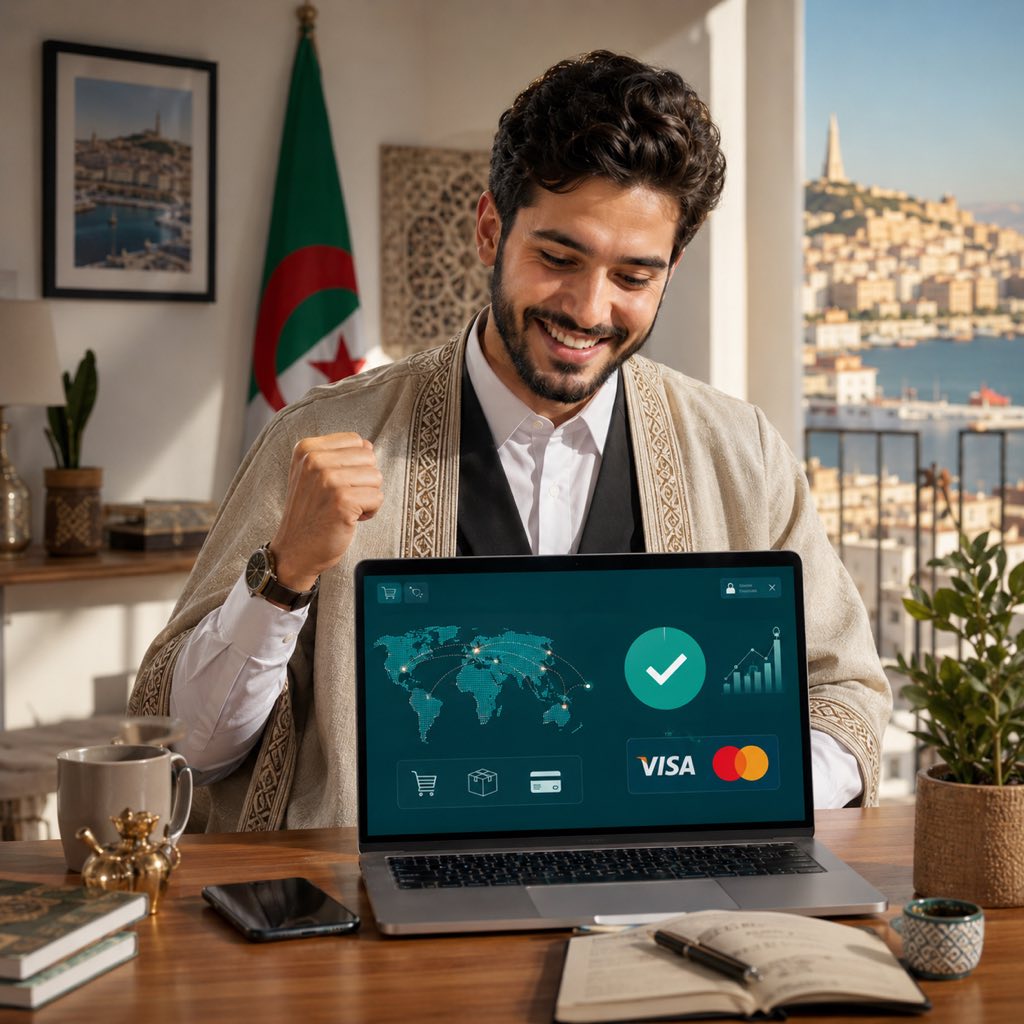
According to Algerie360’s breakdown of the reform package, the Bank of Algeria finalized an update to its compendium of authorized banking products and services on May 14, 2026, validating five major reforms at once. Four of them — a deferred-debit CIB card, the return of consumer credit, interbank QR-code payments, and a new range of international Visa, Mastercard and American Express cards for individuals and professionals — modernize how Algerians spend. The fifth is the one that changes the export equation: explicit authorization for Algerian web merchants to accept payments by foreign bank cards and sell directly to customers worldwide, receiving the funds online.
The mechanics are deliberately fast. As La Voie d’Algérie reported, financial institutions have a window of just fifteen days after a prior declaration to commercialize these new products. That means the gap between “the regulator allowed it” and “my bank can offer it to me” is measured in weeks, not the multi-year delays Algerian fintech has grown used to.
Why This Is the Missing Half of the Payment Story
The reform does not arrive in a vacuum — it lands on top of a payment market that was already growing fast in one direction and stuck in another. Domestically, electronic payments are booming. The GIE Monétique reported, via Horizons, that the total value of electronic payments via terminals, internet and mobile reached 939 billion dinars in 2025, up 46% from 643.8 billion dinars in 2024. Online payments alone hit 27 million transactions worth 145 billion dinars — a 179% jump year-on-year.
But all of that momentum was inward-facing. Those 27 million online payments were Algerians paying Algerian merchants with CIB and Edahabia cards. The infrastructure to accept a card issued outside Algeria — the half that turns a local shop into an exporter — was the missing piece. A pilot run by the Banque de Développement Local (BDL) proved both the demand and the model: BDL launched a cross-border inbound payment service on the Visa network in May 2025 and, as Le Courrier d’Algérie documented, extended it to Mastercard on December 11, 2025. Since the Visa launch, that single platform processed transactions exceeding one million euros, concentrated in tourism, telecommunications and travel — early adopters including the CNAS social-security fund and the telecom operator Djezzy.
The May 2026 reform takes what BDL piloted and makes it a system-wide right. Instead of one bank running a first-of-its-kind service, every authorized Algerian institution can now offer foreign-card acceptance to its merchant clients. The proof-of-concept is over; the build-out begins.
Advertisement
What Algerian Web Merchants Should Do Now
This is not a “monitor and wait” reform — it is a now-or-never window where the first movers will define the category. Here is how to act on it.
1. Confirm your bank’s foreign-card acquiring timeline before your competitors do
Do not assume your existing payment provider will turn this on automatically. Call your bank’s corporate or e-commerce desk and ask one precise question: when will it offer inbound Visa, Mastercard and American Express acquiring, and what onboarding documents does it need? Because institutions have only fifteen days after declaration to commercialize, the offers will appear in waves over the coming months. BDL has a proven head start with both networks live, but BDL is not your only option — ask your primary bank directly, and if it cannot give a date, treat that as a signal to open a relationship with an institution that can.
2. Price and invoice in foreign currency before you flip the switch
Accepting a euro or dollar card is only useful if your storefront can quote in that currency and your accounting can recognize the inflow correctly. Rework your product pages so international visitors see prices in EUR or USD, not only dinars, and decide your foreign-exchange policy up front — do you absorb the conversion spread or pass it on? The BDL pilot’s million-plus euros came overwhelmingly from tourism, telecom and travel because those sectors already think in foreign-currency terms. If you sell digital services, software, design, or tourism experiences, you are closest to revenue; build the multi-currency checkout now, not after your first foreign order is lost at the payment page.
3. Target the diaspora and digital-service buyers first, not generic global traffic
The fastest-converting foreign customer for an Algerian merchant is not a stranger in another continent — it is the Algerian diaspora and the buyer of a digital service that has no shipping problem. The BDL model already serves diaspora payments and tourism inflows, which tells you where demand is warm. Map your catalogue to what travels well across borders: downloadable products, subscriptions, consulting, online courses, tourism bookings, and remittance-adjacent services. Run your first international campaign at France, the Gulf, and West African markets where Algerian sellers have existing cultural and commercial ties, rather than spending ad budget on cold global reach.
4. Treat fraud and chargeback readiness as a launch requirement, not an afterthought
Inbound international cards bring a risk profile Algerian merchants have rarely had to manage: cross-border chargebacks and card-not-present fraud. Before you take your first foreign payment, confirm your acquiring setup includes 3-D Secure authentication and a clear chargeback-handling process, and keep delivery proof for every digital and physical order. The same secure-platform standards that let BDL operate on the Visa and Mastercard networks apply to you — meeting them is the price of staying connected. A single wave of disputes can get a young merchant account frozen, so build the discipline before the volume arrives.
Where This Fits in Algeria’s 2026 Digital Economy
Seen in isolation, foreign-card acceptance is a payment feature. Seen in context, it is the moment Algeria’s digital economy gains a second engine. For years the growth story was about getting Algerians to pay digitally at home — and that story is working, with a 46% jump in electronic payment value and a 179% surge in online transactions. But a domestic-only payment rail caps the ceiling: it lets the country digitize consumption without monetizing the talent, content and services Algeria could sell abroad.
This reform reframes the opportunity. A freelance developer in Oran, a design studio in Algiers, a tourism operator in the south, or a SaaS startup anywhere in the country can now build a business that earns foreign currency online — legally, through a regulated bank, on the same networks the rest of the world uses. Combined with the simultaneous rollout of international cards for Algerian consumers and interbank QR payments, the May 2026 package signals a financial system being rewired for two-way traffic. The merchants who build their multi-currency, export-ready storefronts in the next few months will not just be early — they will be the reference cases the next wave learns from.
Frequently Asked Questions
What exactly did the Bank of Algeria authorize in May 2026?
In an update to its compendium of authorized banking products finalized on May 14, 2026, the Bank of Algeria validated five reforms, including explicit authorization for Algerian web merchants to accept payments from foreign Visa, Mastercard and American Express cards and receive the funds online. This is the first time local online merchants can legally accept inbound international card payments from customers abroad.
Which Algerian bank already offers cross-border card acceptance?
The Banque de Développement Local (BDL) piloted the model, launching a cross-border inbound payment service on the Visa network in May 2025 and extending it to Mastercard on December 11, 2025. Since the Visa launch, that platform processed transactions exceeding one million euros, mostly in tourism, telecommunications and travel. The May 2026 reform now lets other authorized institutions offer the same capability.
Who benefits most from accepting international cards in Algeria?
Digital-service exporters benefit first because their products cross borders without shipping: freelance developers, design studios, SaaS startups, online educators and tourism operators. The diaspora and inbound tourists are the warmest early customers, mirroring where the BDL pilot saw its strongest demand. Merchants should price in foreign currency and build fraud-ready checkout before their first international sale.
Sources & Further Reading
- Further Reading
- Du crédit conso aux paiements internationaux : la Banque d’Algérie valide 5 réformes majeures — Algerie360
- E-commerce international : la BDL lance le paiement en ligne vers l’Algérie via Mastercard — Le Courrier d’Algérie
- E-commerce international : une nouvelle solution de paiement lancée en Algérie — TSA Algérie
- Le paiement électronique en Algérie progresse de 46% en 2025 — Horizons
- La Banque d’Algérie fixe de nouvelles règles dès début mai — La Voie d’Algérie
🔗 Related Intelligence
Algeria’s E-Commerce Pivot: From COD Dominance to Digital Payment Adoption
Algeria’s Payment Shift: How Merchants Are Moving from COD to Digital Checkout

Algeria’s E-Commerce Platform Ecosystem: Tools for Online Merchants in 2026
The COD Trap: How Cash on Delivery Is Strangling Algeria’s E-Commerce