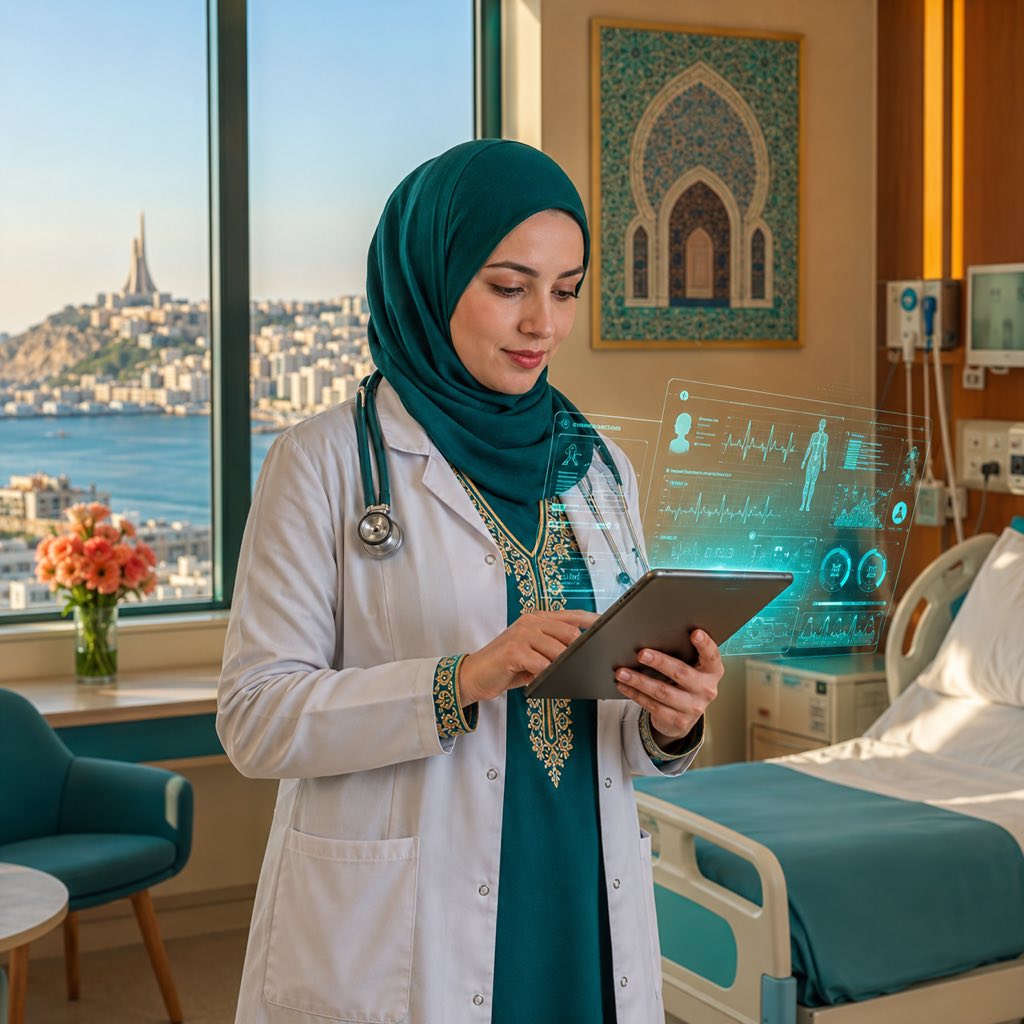
What the Health Ministry Actually Set in Motion
In early 2026, Algeria’s Ministry of Health moved a long-running digitization ambition into concrete policy. At a February 2026 national seminar on innovation and digital transformation of public services, the ministry detailed a national health network that will interconnect 2,599 health establishments and structures across the country over a fiber-optic backbone, built in collaboration with Algérie Télécom and the High Commission for Digitization. By April 2026, Health Minister Mohamed Seddik Aït Messaoudene confirmed during a working visit to Guelma that the platform for remote monitoring of patient medical records had been finalized and was operational.
This is not a single app. It is a framework — a network layer, a data layer, and a rulebook for how remote consultations and diagnostics are delivered. The network layer is the fiber connection linking the 2,599 sites with transmission rates adapted to each facility’s needs. The data layer centralizes patient records in secure databases. The rulebook is the part that matters most for policy: access to those records runs through a secure information system anchored on a national patient identifier, the single key that ties a person’s history together across every connected facility.
For the first time, Algeria is defining what telemedicine and teleradiology officially mean inside the public health system, who can deliver them, and on what infrastructure. That is the difference between pilots and a framework.
Telemedicine, Teleradiology, and the AI Layer
The framework specifies the clinical services the network is built to carry. On the telemedicine side, the ministry described digital applications for remote appointment booking, consultations, and examinations without requiring the patient to travel, explicitly targeting residents of remote areas where specialist access has historically meant a long journey. Southern provinces, which cover more than 80% of Algeria’s land area, are the clearest beneficiaries — a population spread thinly across vast distances is exactly the case telemedicine was designed to solve.
Teleradiology is the second pillar: remote reading of radiology and medical imaging results, so that a scan taken in one facility can be interpreted by a specialist sitting somewhere else entirely. The ministry has paired this with an artificial intelligence layer intended to reduce medical errors, save time, and improve patient follow-up. The national patient identifier closes a costly loop here — by tying every image and result to one record, the system is designed to prevent the unnecessary duplication of exams that happens when a patient’s prior imaging is invisible to the next doctor they see.
The framework also extends beyond consultations. Centralized records carry medication-availability tracking and hospital-bed monitoring, and connect to a separate digital workflow for inter-hospital patient transfers that requires urgent cases to receive a response within a maximum of 48 hours, announced in December 2025. Together these are the operational scaffolding around the clinical core.
Advertisement
Why the Patient Identifier Is the Regulatory Center of Gravity
The most consequential design choice in the framework is the national patient identifier. It is what converts a collection of connected hospitals into a coherent health record system — and it is also where the governance questions concentrate. A single identifier that follows a citizen across every facility is enormously valuable for continuity of care, but it raises the stakes on data protection, access control, and audit. The ministry has signalled awareness of this, emphasizing compliance with national data-protection legislation and reinforced cybersecurity to protect the sites where health information is stored.
This is where the policy framing matters. The identifier is not just a technical convenience; it is the anchor for every rule that follows about who may view a record, under what conditions a remote consultation is logged, and how an AI-assisted reading is attributed. The countries furthest along in digital health — and the WHO’s Global Strategy on Digital Health, which Algeria’s direction tracks closely — treat interoperable, person-centred identifiers as the foundation that everything else, from teleradiology to research, is built on. Algeria is building that foundation now, alongside complementary pieces including Electronic Medical Records deployment and a national cloud for hosting health data.
What Algerian Health-Tech Builders and CTOs Should Do
The framework is being defined in real time, which means the next 6 to 12 months are the window to align products, procurement, and compliance posture with the rules as they settle. The stakeholders who act early will be building on the standard rather than retrofitting to it.
1. Architect every product around the national patient identifier from day one
If you are building telemedicine scheduling, teleradiology viewers, or remote-monitoring tools for the Algerian market, treat the national patient identifier as a hard architectural requirement, not an integration to bolt on later. The whole value of the secure information system the ministry described is that one identifier resolves a patient across 2,599 sites. A product that maintains its own siloed patient IDs will be incompatible with the framework and will not survive procurement. Design your data model so the identifier is the primary key for every record, every image, and every consultation log — and document how you avoid duplicating it. Don’t assume you can map identifiers after the fact; the framework’s entire premise is a single shared key.
2. Build data-protection and cybersecurity compliance in as a feature, not a checkbox
Because the identifier links a citizen’s full history, any tool touching it sits inside the highest-sensitivity tier of Algerian data-protection obligations. The ministry has explicitly tied the framework to national data-protection legislation and reinforced cybersecurity for storage sites. Build access logging, role-based permissions, and encryption-at-rest into the core of the product, and be ready to evidence them — not describe them — during evaluation. The contrast to avoid is the common health-tech pattern of treating security as a late-stage hardening pass. In a framework where one breach exposes a linked national record, security posture is a precondition for participation, not a differentiator.
3. Design for the low-bandwidth, remote-area use case the framework is built to serve
The network gives 2,599 sites fiber with transmission rates adapted to their needs, but the clinical mission is reaching remote-area residents and the southern provinces that cover over 80% of the territory. Optimize teleradiology viewers and telemedicine clients for variable bandwidth — progressive image loading, offline-tolerant consultation capture, compression that preserves diagnostic quality. Don’t design only for a well-connected urban hospital and assume it degrades gracefully; the highest-value consultations are precisely the ones happening at the thin edge of the network. Test against the conditions a clinic in a distant wilaya actually faces, not a head-office demo.
4. Position teleradiology AI as decision support with clear attribution, not autonomous reading
The ministry framed AI as a tool to reduce errors and save time — assistive, inside a clinician’s workflow. Build AI-assisted reading features that surface findings for a radiologist to confirm, log who confirmed what, and tie every AI output to the patient identifier and a named human reviewer. Avoid any positioning that implies the AI replaces the specialist; that framing will not pass clinical or regulatory scrutiny, and it misreads the policy. The framework’s value proposition is a specialist reading a remote scan faster and more accurately — the AI accelerates the human, and your product’s accountability trail has to make that explicit.
The Structural Lesson
Algeria’s telemedicine framework is a reminder that in digital health, the rulebook is built before the apps mature, and the infrastructure decision and the governance decision are the same decision. By choosing a national patient identifier as the anchor and a fiber network across 2,599 sites as the backbone, the Health Ministry has set the terms that every downstream product — every consultation tool, every teleradiology viewer, every monitoring dashboard — will have to meet. The builders and IT directors who internalize that the identifier and the data-protection regime are the framework, rather than features layered on top, are the ones who will ship products that fit. The opportunity over the next year is large: a coherent national network is the kind of foundation that takes a health system from scattered pilots to scaled, equitable remote care — and the standard for that care is being written right now.
Frequently Asked Questions
What is Algeria’s national health network and how big is it?
It is a fiber-optic communication network the Health Ministry is building to interconnect 2,599 health establishments and structures across Algeria, in collaboration with Algérie Télécom and the High Commission for Digitization. Transmission rates are adapted to each facility’s needs, and the network carries telemedicine, teleradiology, and centralized patient records. It is the infrastructure backbone for the country’s broader digital health framework.
How does the national patient identifier work in telemedicine and teleradiology?
The identifier is a single key that ties a person’s medical history together across every connected facility, accessed through a secure information system. In teleradiology it links each scan and result to one record so a specialist anywhere can read it, and it is designed to prevent unnecessary duplication of exams. For telemedicine, it ensures a remote consultation is logged against the patient’s continuous record rather than a siloed one.
What should an Algerian health-tech company do to align with the framework?
Architect products around the national patient identifier as the primary key from day one, and build data-protection and cybersecurity compliance into the core rather than adding it late. Optimize teleradiology and telemedicine tools for the variable-bandwidth, remote-area conditions the framework is built to serve, and position any AI features as decision support with clear human attribution. Acting in the next 6 to 12 months means building on the standard as it settles.
Sources & Further Reading
- Further Reading
- Numérisation des prestations de santé : le ministère prépare la télémédecine et la lecture à distance des examens — L’Algérie Aujourd’hui
- Achèvement de la mise en place d’une plateforme numérique de suivi à distance des dossiers médicaux des patients — APS
- Santé : une plateforme numérique pour le suivi médical à distance — Algérie Éco
- Suivi à distance des dossiers médicaux des patients — Horizons
- Algeria Launches Digital System to Overhaul Hospital Transfer Process — We Are Tech Africa
- Global Strategy on Digital Health 2020–2025 — World Health Organization
🔗 Related Intelligence

Healthcare Tech Careers in Algeria: Clinical Informatics and Health Data Engineering Demand Rises

Algeria Healthtech 2026: Telemedicine Surge Meets Saidal’s Pharma Pivot
Cybersecurity in Algerian Healthcare: Hospital Systems, Patient Data

AI Agents in Algerian Healthcare: From Clinic Digitalization to Autonomous Triage