Why TikTok Shop Is Not Just Another Sales Channel
When brands first started listing products on TikTok Shop in 2022–2023, the prevailing assumption was that it was an extension of social media advertising — another inventory of placements, another CPM-optimized channel. That framing is now clearly wrong.
TikTok Shop’s $66 billion global GMV in 2025, nearly doubling the $33.2 billion of 2024, is the number that forces a reclassification. This is not a social media advertising channel with a shoppable feature — it is a commerce platform with a social distribution mechanism. The distinction matters because it changes how brands should structure their investment, measure success, and build internal capabilities.
The platform’s primary strength, as Retail Dive’s analysis identifies, is the fusion of entertainment and commerce. TikTok’s algorithm exposes products to users who have demonstrated relevant interests — even if they have never interacted with the brand before. The discovery function is algorithmic and intent-rich, unlike Meta ads (intent-poor, demographic-targeted) or Google Shopping (intent-rich, but post-search). A brand’s shoppable video can reach a million relevant potential buyers without any paid distribution — or it can be amplified selectively once it has proven organic traction.
The global social commerce market that TikTok Shop is leading has reached $2.6 trillion in 2026, according to market research firm projections, with the US market alone at $126.6 billion. TikTok Shop is not a fringe experiment within this market — it is the fastest-growing platform in the segment.
The Three Mechanisms That Drive TikTok Shop GMV
Understanding TikTok Shop’s mechanics is prerequisite to building a playbook. There are three distinct GMV-generating mechanisms, and most brands underperform because they treat them as interchangeable.
Mechanism 1: Organic Shoppable Content (Validation Layer)
Organic shoppable content — videos that tag products and enable in-video purchase — is the validation layer of TikTok Shop strategy. Before spending on creator partnerships or live shopping infrastructure, brands should test whether their product generates organic engagement when tagged in shoppable videos.
A product that generates purchases from an unsponsored, organically-distributed video is a product with real TikTok-native demand signal. A product that generates views but not purchases has a content-to-conversion problem — usually a pricing, trust, or review count issue — that paid amplification won’t solve. Moburst’s analysis frames this as the canonical first step: “validate organic shoppable content before amplifying with paid budget.”
The validation threshold is modest: 10–20 organic product videos with consistent conversion rates (above 2%) suggest the product is ready for creator scaling. Below that rate, iterate on the content format, product positioning, and pricing before investing in creator partnerships.
Mechanism 2: Creator Affiliate Partnerships (Scale Layer)
Once organic traction is confirmed, creator affiliate partnerships are the primary scaling mechanism. TikTok’s affiliate system allows creators to tag products in their content and earn a commission on resulting sales — aligning creator incentives directly with brand GMV, without upfront production costs.
Moburst’s data shows affiliate links on TikTok achieve engagement rates 160% higher than Instagram’s affiliate links — a function of TikTok’s algorithmic amplification of performing content combined with its younger, purchase-intent-higher demographic. The commission-based structure eliminates the upfront cost risk: brands pay only for results, making the model capital-efficient relative to sponsored content.
The practical implication is to build a diverse creator affiliate programme rather than concentrating on 2–3 high-follower accounts. TikTok commerce data consistently shows that mid-tier creators (50K–500K followers) outperform macro-influencers (1M+ followers) on conversion rate — their audiences are more niche, more trusting, and more responsive to specific product recommendations. A brand running 50 mid-tier creator affiliates typically generates more GMV than the same budget concentrated in 3 macro-influencer partnerships.
Mechanism 3: Live Shopping Events (Conversion Layer)
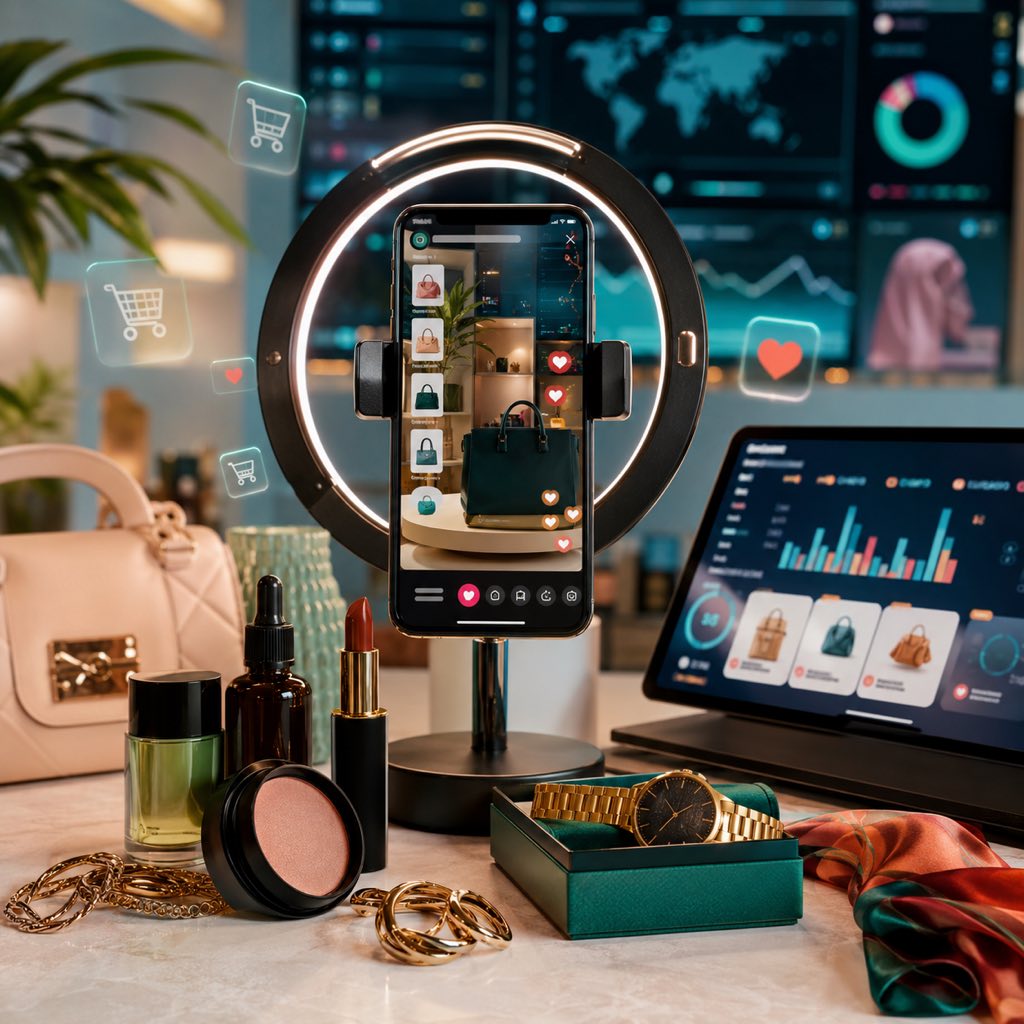
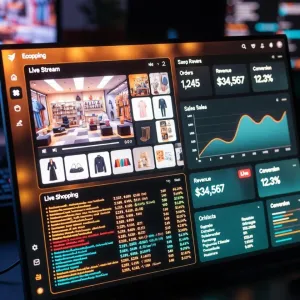
Live shopping — TikTok Live streams with real-time product showcasing and in-stream purchasing — is the highest-conversion mechanism on the platform, and the one most brands are under-investing in. Black Friday/Cyber Monday 2025 live shopping events achieved 84% year-over-year sales growth, with over 6,000 daily TikTok Shop Lives occurring in the UK alone during peak periods.
Live shopping works because it collapses the consideration timeline. A viewer watching a real-time product demonstration with scarcity cues (limited stock, time-bound offers) and social proof (other viewers asking questions, posting purchase confirmations) makes a purchase decision in seconds rather than the days or weeks typical of traditional e-commerce consideration paths. Conversion rates during live events consistently outperform standard product page traffic.
Building live shopping capability requires investment: a dedicated stream host or creator partner, a product-switching workflow for multi-item sessions, and integration between TikTok’s live commerce tools and inventory management. But the conversion leverage — particularly for brands in beauty, fashion, home goods, and electronics — justifies the operational investment.
Advertisement
What This Means for Brand Teams Building in 2026
The TikTok Shop playbook is not a growth hack — it is a structural content-commerce programme that requires its own budget line, team capability, and measurement framework.
1. Build the Measurement Framework Before Scaling Spend
The most common failure mode for brands investing in TikTok Shop is measuring it like a paid social channel — CPM, ROAS, click-through rate. These metrics miss TikTok Shop’s native success signals: GMV per creator, affiliate conversion rate by product, live event revenue per stream hour, and organic video-to-purchase rate.
Before scaling any investment, instrument these metrics. A brand that knows its affiliate conversion rate by creator tier, product category, and content format can allocate its creator budget with 3–5x the efficiency of a brand measuring only aggregate GMV.
2. Match Product Selection to Platform Affordances
Not all products perform equally on TikTok Shop. The platform over-indexes for visually demonstrable products (beauty, skincare, fashion, home organization, kitchen tools), impulse-accessible price points ($15–$80 for impulse; $80–$300 for considered but platform-validated), and products with a transformational narrative (“before and after”, “problem and solution”). Average US TikTok Shop buyer spending was $708 in 2024, suggesting buyers are not exclusively low-ticket — but the discovery mechanics favour products with a compelling demonstration angle.
Products that underperform on TikTok Shop are typically: highly technical products requiring long specifications review, products without visual differentiation, and products where trust is primarily established through brand heritage (luxury, pharmaceuticals) rather than demonstrated functionality.
3. Treat Creator Compliance as Infrastructure, Not Afterthought
FTC disclosure requirements, platform-level affiliate transparency rules, and the EU’s Digital Services Act each impose obligations on creator partnerships that brands are legally responsible for. A brand that runs 200 creator affiliates without a compliance briefing and documentation process is accumulating legal exposure that scales with its GMV.
The operational solution is a creator onboarding packet that covers: disclosure language (platform-level tags plus in-video disclosure for US content), prohibited claims (no medical, financial, or comparative claims without substantiation), and a contract that assigns compliance responsibility appropriately. This is a one-time setup cost that eliminates ongoing regulatory risk as the programme scales.
The Structural Lesson
TikTok Shop’s growth from $33 billion to $66 billion in a single year is not a platform-specific phenomenon — it is evidence that social commerce’s share of total e-commerce spend is structurally increasing. The global social commerce market’s trajectory to $8.5 trillion by 2030 makes TikTok Shop’s current scale a foundation, not a ceiling.
Brands that build their TikTok Shop capabilities in 2026 — before the channel becomes fully crowded and creator acquisition costs rise — are building a durable GMV engine. The platform’s algorithm rewards content quality and engagement history, meaning early-mover brands compound their discovery advantage over time. The playbook is proven. The GMV opportunity is real. The question for brand teams in 2026 is whether they are willing to build the operational infrastructure to capture it.
Frequently Asked Questions
What is TikTok Shop’s actual GMV and how fast is it growing?
TikTok Shop generated $66 billion in global GMV in 2025, nearly doubling from $33.2 billion in 2024. In the US alone, it produced $15.8 billion — a 108% year-over-year increase. The platform projects $20–23 billion in US sales for 2026. These figures position TikTok Shop as a significant commerce platform, not just a social media feature.
Why do TikTok Shop live shopping events outperform standard product pages?
Live shopping events collapse the consideration timeline by combining real-time product demonstration, social proof (visible viewer engagement and purchase activity), and scarcity mechanics (limited stock, time-bound offers) into a single experience. This removes the days-long decision window typical of standard e-commerce browsing and converts viewers in seconds. Black Friday/Cyber Monday 2025 live events achieved 84% year-over-year sales growth, and 6,000+ TikTok Shop Lives run daily in the UK during peak seasons.
How should brands choose between macro and mid-tier creator partners on TikTok Shop?
Mid-tier creators (50,000–500,000 followers) consistently outperform macro-influencers (1M+ followers) on TikTok Shop conversion rates. Their audiences are more niche, more trusting of specific product recommendations, and more likely to purchase directly from affiliate links. Brands should build a diversified affiliate programme of 30–100 mid-tier creators rather than concentrating the same budget in 3–5 macro-influencers. Commission-based affiliate structures (no upfront cost) make this approach financially viable at any scale.
Sources & Further Reading
🔗 Related Intelligence

Beyond the Billion-Dollar Headline: How Brands Actually Build Profitable Social Commerce Programs in 2026
Social Commerce Explodes: TikTok Shop, Live Shopping
Live Commerce in MENA: How Brands Are Turning Livestreams Into Sales Machines

Live Commerce Hits $1 Trillion: The Video Shopping Revolution Beyond China