Why Algeria’s Restaurant Market Needs Its Own Operating System
Food delivery in Algeria is not a solved problem — it is a contested, fragmented, and still-maturing market. Yassir dominates the consumer-facing side with $193 million raised and 8 million users, but the restaurant-side infrastructure — the software that restaurants use to manage orders, menus, drivers, and customer data — remains largely manual. Felhanout, founded by Ahmed Fatmi (a Master’s in Strategic Management graduate from the University of Oran), is building precisely that missing layer.
The core insight behind Felhanout is a structural critique of the existing delivery model: commission-based platforms extract 25–30% of each order from the restaurant. For thin-margin food businesses — which describes most of Algeria’s independent restaurants — that commission erodes the economics of digital participation. Felhanout’s model removes the commission entirely, replacing it with a subscription fee of 9,000 DZD per quarter (approximately $20/month) and a 3-percentage-point participation in the restaurant’s self-activated discount rate.
That inversion — from platform tax to restaurant infrastructure — is the bet. If it works, Felhanout becomes the default operating layer for a sector that currently has no dominant B2B software player. If it does not scale to sufficient volume quickly enough with $120,000 in bootstrap capital, the financial constraints will compress the window. The company acknowledges the risk: $120,000 was described as “nearly depleted” at the time of the April 2026 launch.
The Three-Layer Architecture of Felhanout’s Platform
What distinguishes Felhanout from a simple QR menu app is the layered architecture that enables different revenue streams at each level:
Layer 1 — Delivery SaaS: Each restaurant gets a white-label ordering link, a phone-to-digital-order conversion system, and a driver dispatch network. The restaurant controls its driver relationships. Felhanout charges a flat 25 DZD per delivery — not a percentage of order value. This predictable cost structure appeals to restaurants with higher average order values.
Layer 2 — Digital QR Menu (NResto): Free for the first 365 days, NResto gives restaurants a digital menu accessible via QR code. Felhanout monetizes this layer through contextual advertising — when customers browse the menu, they see relevant promotions. The restaurant activates a discount rate (starting at 8–10%), and Felhanout takes 3 percentage points of whatever rate the restaurant sets. The restaurant benefits from increased traffic; Felhanout earns from the discount margin.
Layer 3 — Ndeliv (White-Label Delivery Network): The third layer, Ndeliv, is announced and in development. It will function as a white-label delivery logistics layer — enabling restaurants to offer branded delivery without building their own driver fleet. The two mobile applications (FelHanout Pro for restaurant operators and FelHanout Rider for drivers) are already live on both the App Store and Google Play.
The architecture is designed for progressive adoption: a restaurant that starts with the free QR menu (NResto) is already inside the ecosystem when the subscription model activates after 90 days. That onboarding funnel is the platform’s primary growth mechanism.
Advertisement
What Algerian Restaurant SaaS Founders Should Do
Felhanout’s launch provides a real-time case study in the commercial challenges of building B2B software for an informal, cash-heavy sector. The lessons are instructive — both for founders replicating this model and for investors evaluating the sector.
1. Sequence the free tier first, the paid tier second
The 365-day free NResto trial is not generous charity — it is a deliberate adoption strategy. Restaurants in Algeria’s informal economy are skeptical of recurring software costs. A full year of free digital menu service generates daily operational habit before the subscription conversation begins. By the time the payment discussion arrives, the restaurant operator has integrated the QR code into customer interactions, trained staff, and seen the data on how digital menus affect order composition. The switching cost from that point is non-trivial. Algerian B2B founders targeting informal sector businesses — food, retail, beauty services — should adopt this sequencing explicitly: prove behavioral change first, monetize second.
2. Build the driver network before the merchant network
Felhanout launched with 400 drivers on standby alongside 90 partner restaurants. That supply-side pre-commitment is crucial: a restaurant that signs up for delivery infrastructure needs to be able to fulfill orders on day one. The failure mode of consumer-facing delivery platforms in Algeria has often been inconsistent driver availability — users order, wait, cancel, and do not return. By pre-seeding the driver network before the commercial launch, Felhanout removed the supply-side cold-start problem. For any Algerian founder building a two-sided marketplace — drivers and restaurants, mechanics and car owners, plumbers and households — the driver (or supply-side) pre-commitment has to precede the merchant (or demand-side) launch.
3. Design pricing in DZD, not in USD benchmarks
Felhanout’s subscription fee of 9,000 DZD per quarter is calibrated to the real cost structure of an Algerian independent restaurant. At approximately $20/month USD, it is an order of magnitude cheaper than comparable restaurant SaaS in Europe (Square for Restaurants, Lightspeed, Toast) which charge $50–$200/month. That calibration is not a concession — it is a pricing strategy. A product priced for the actual purchasing power of the target market creates broader adoption than one priced at international benchmarks that local businesses cannot sustain. The monetization upside comes from volume (10,000 restaurants at $20/month) and from the discount margin layer, not from high per-seat pricing.
4. Use the bootstrap phase to validate unit economics before raising capital
Felhanout’s founder is raising a seed round. The sequence — bootstrap first, validate metrics, then raise — is strategically sound in Algeria’s current fundraising environment, where the Algerian Startup Fund (ASF) and international investors like Partech Africa and 4DX Ventures require demonstrated traction. The 1,700+ restaurants across 37 cities, achieved before external capital, is a stronger fundraising narrative than a pre-launch pitch deck. Algerian founders should treat the bootstrap phase as a structured experiment: what is the cost to acquire one restaurant? What is the churn rate after the free trial expires? What is the average discount rate that restaurants activate? These numbers, collected with real money at stake, are what seed investors need to commit.
Where This Fits in Algeria’s 2026 Food Service Ecosystem
Felhanout is not competing with Yassir — at least not yet. Its current footprint of 1,700+ restaurants across 37 cities describes a B2B infrastructure play, not a consumer brand. The comparison that matters is not Yassir versus Felhanout but Felhanout versus the current alternative: spreadsheets, WhatsApp order management, and informal phone dispatch.
According to Mag Startup’s analysis, Felhanout’s target for year one is 200–400 restaurants in Algiers, validated by the flywheel — restaurants that activate NResto see digital order conversion that justifies the subscription. The 1,700+ restaurants figure across 37 cities suggests the network is growing faster than the original flywheel model projected, though the activation rate (the share of restaurants generating paid subscription revenue) is the metric that will determine whether the unit economics are sustainable before capital runs out.
The broader question for Algeria’s food service sector is whether the country’s approximately 150,000 registered restaurants will ultimately be served by a single operating system or by a fragmented set of point solutions. Felhanout is betting on consolidation — that the restaurant that adopts digital menus also wants integrated delivery management, advertising, and analytics from the same platform. That is the same bet that Toast made in the United States and that Waiteraid made in India. In both markets, the integrated operating system won. Whether Algeria’s regulatory environment, informality levels, and internet infrastructure support the same outcome remains the open question that the next 18 months will answer.
Frequently Asked Questions
How does Felhanout make money without charging commission on orders?
Felhanout monetizes through three channels: a quarterly subscription fee of 9,000 DZD (~$20/month) per restaurant after a 90-day free trial; a 3-percentage-point share of the discount rate that restaurants activate on their menus (the restaurant sets the discount, Felhanout takes 3 points of whatever rate is chosen); and a flat 25 DZD per delivery completed through the logistics layer. No percentage commission on order value is charged at any tier.
What does “restaurant operating system” mean in practice for an Algerian restaurant owner?
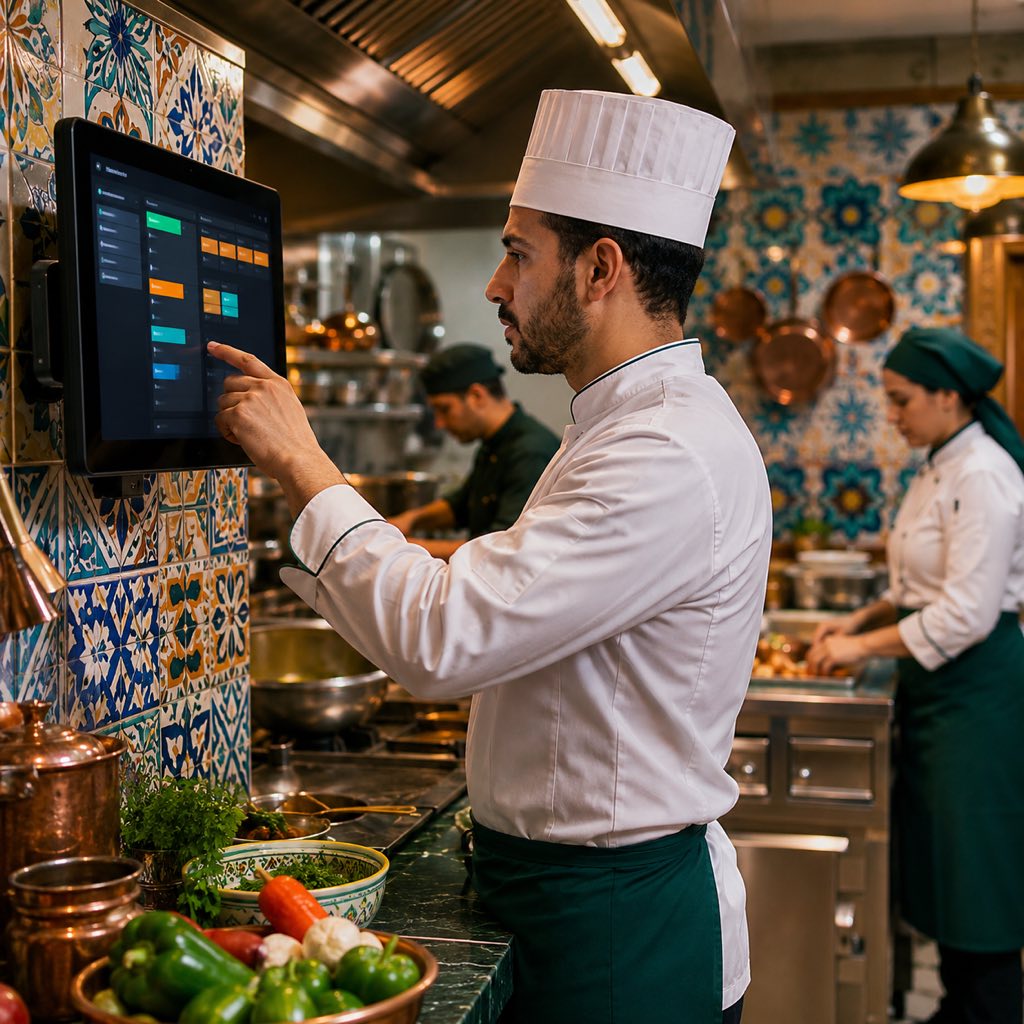
It means a single platform that handles four operational workflows: digital menu display via QR code (NResto); order management from multiple channels — table, social media, phone, and app — using the FelHanout Pro application; driver dispatch and management for delivery orders via FelHanout Rider; and promotional/discount activation with built-in analytics. Each component can be adopted independently, but the platform is designed to create cross-component value: a restaurant that starts with the QR menu has a smoother path to activating delivery and promotional tools.
Is Felhanout planning to expand beyond Algeria?
The company’s stated vision is MENA-region expansion following validation of the Algerian market. The founder’s goal of 10,000+ restaurants in major cities within three years implies a scaling trajectory that would exhaust the Algerian market opportunity and necessitate geographic expansion. No specific country launch dates have been announced as of May 2026.
Sources & Further Reading
🔗 Related Intelligence
Algeria’s Food-Tech Gap: Cold Chain and B2B Marketplace Startups as the Next Frontier

Felhanout Launches in Algeria: 90 Restaurants, 400 Drivers, and a 0% Commission Bet Against Yassir
B2B SaaS Made in Algeria: Local Startups Taking on ERP, HR, and CRM Markets

Algeria’s B2B SaaS Wave: Enterprise Software Startups Challenge Foreign Solutions