The Export Gap Algeria Is Leaving on the Table
Algeria imports approximately $10 billion in food annually, making it one of Africa’s largest food importers by value. Yet Algeria has significant agricultural production capacity — in citrus, dates, olives, vegetables, and processed dairy — that could serve European export markets if it could meet EU food safety and traceability standards consistently. The gap between production capability and export certification is not primarily a farming problem. It is a logistics, documentation, and cold-chain integrity problem.
The European Union’s Rapid Alert System for Food and Feed (RASFF) tracks food safety notifications — instances where food products entering the EU trigger alerts for contamination, labeling violations, or traceability failures. Algerian products have appeared in RASFF notifications on multiple occasions, most visibly in September 2024 when the EU banned Algeria’s El Mordjene dairy spread over dairy compliance failures, citing discrepancies in microbial levels and contaminant thresholds. That ban affected one of Algeria’s most commercially successful food exports and generated significant reputational spillover for other Algerian food products at EU border inspection points.
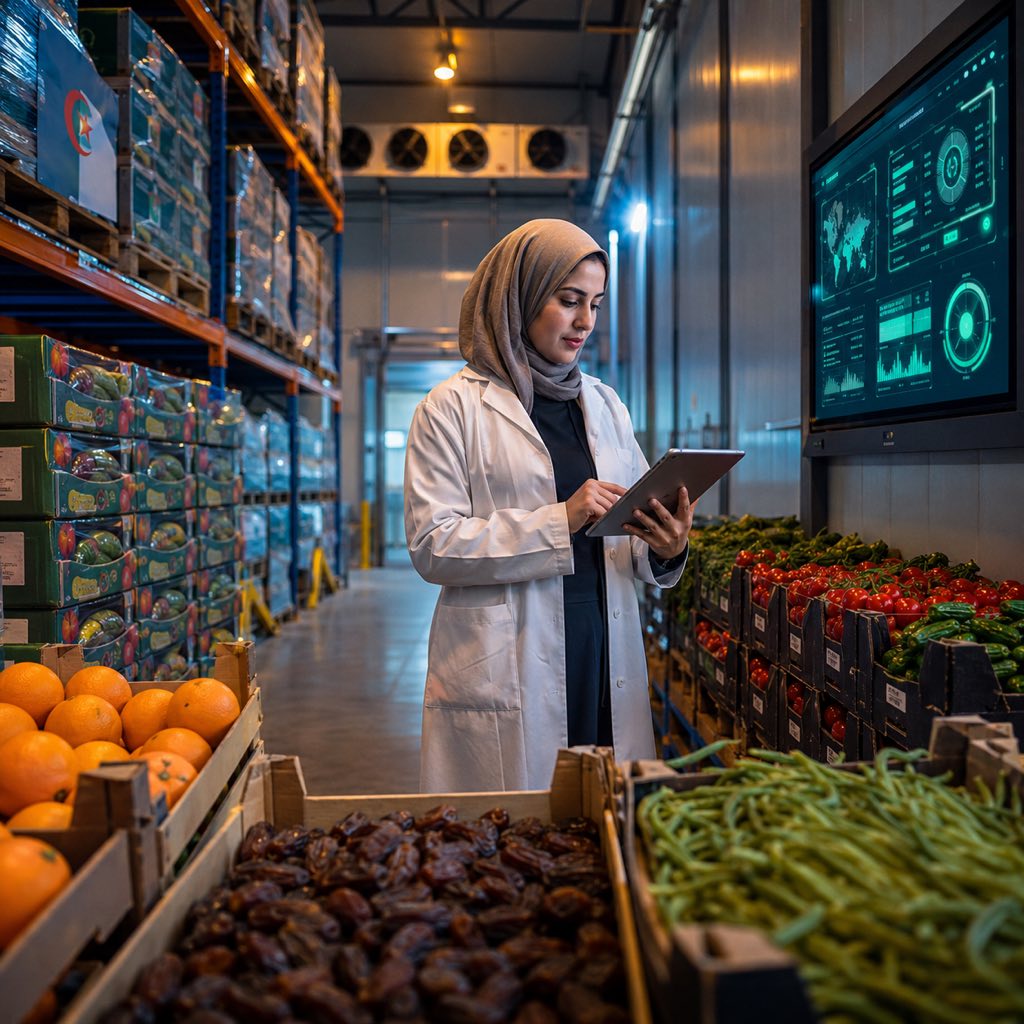
The underlying cause is structural. EU food safety certification requires documented temperature chain data from origin to border — what inspectors call “unbroken cold chain evidence.” A crate of citrus or a pallet of dairy that passes through multiple intermediary handlers without continuous temperature logging cannot produce this documentation, regardless of actual product quality. Algerian agri-exporters, particularly SMEs and smallholder cooperatives that lack access to sophisticated logistics infrastructure, routinely fall short of this documentation standard even when the physical product would pass quality testing.
Why Traditional Cold Chain Monitoring Fails at Scale
Manual cold chain monitoring — temperature loggers that record data at fixed intervals, checked at delivery — has a fundamental gap: it tells you what happened after the damage is done. A shipment of fresh produce that experienced a temperature excursion between the packing house and the port may have been outside the safe range for 4-6 hours before the next scheduled check. By the time the issue is discovered at the EU border, the product may be within days of spoilage, and the documentation records cannot demonstrate whether the excursion was isolated or sustained.
The EU’s food safety framework, governed by Regulation (EC) No 178/2002, requires not just temperature data but traceable documentation linking each pallet to its origin batch, handling events, and temperature history. Algeria’s agricultural exporters largely rely on paper-based systems and disconnected digital records that cannot produce this chain-of-custody documentation in the standardized electronic formats that EU customs and inspection systems expect.
Adding the EU Carbon Border Adjustment Mechanism (CBAM), which entered its definitive regime in 2026, creates a second compliance layer. CBAM now affects agricultural value chains through fertilizer-related carbon reporting requirements. Algerian agricultural exporters who have not built digital data collection infrastructure face the dual burden of food safety documentation and carbon footprint reporting — both required for seamless EU market access.
Advertisement
What Algerian Exporters and Agricultural Ministries Should Do About It
1. Deploy IoT Cold Chain Sensors as the Data Foundation
The first step is instrumentation, not software. Cold chain ML monitoring is only as good as the underlying sensor network. Algerian agricultural exporters — particularly those in citrus (northeast), dates (Biskra and Adrar regions), and processed dairy — should deploy IoT temperature and humidity sensors at three critical transition points: packing house exit, loading dock, and ship hold. These sensors transmit continuous readings to a cloud platform and generate timestamped, tamper-evident logs that satisfy EU documentation requirements.
The hardware cost for IoT cold chain sensors has dropped significantly: commodity temperature loggers with GSM connectivity cost $15-30 per unit, and a container-level deployment covering a full export season runs well under $5,000 per exporter per year. Algeria’s Ministry of Agriculture has piloted smart agriculture infrastructure in select wilayas; cold chain sensor deployment is a natural extension of this infrastructure to the post-harvest logistics chain. The key is standardization: sensors must produce data in formats compatible with EU customs’ Import Control System 2 (ICS2), which became fully mandatory in 2024.
2. Build ML Anomaly Detection to Flag Temperature Excursions in Real Time
Sensor data alone does not constitute AI-powered cold chain monitoring. The ML layer is what transforms continuous data streams into actionable alerts and predictive risk scoring. A properly configured anomaly detection model learns the normal temperature profile for each product type and transit route — the expected thermal variance inside a refrigerated container on a Skikda-to-Marseille crossing in July, for example — and flags deviations that exceed acceptable thresholds before they become compliance failures.
The practical benefit is intervention time. An ML alert sent to the logistics operator 30 minutes after a temperature excursion begins allows corrective action — checking the refrigeration unit, adjusting the set point, notifying the port handler — that a next-day manual review cannot provide. For perishable exports where a four-hour excursion can mean the difference between a compliant shipment and a RASFF notification, this intervention window has direct financial value.
Several agricultural tech companies operating in North Africa already offer IoT cold chain monitoring with ML alerting: platforms built for the East African flower export market (where EU standards are equally stringent) demonstrate the model that Algerian agri-tech startups or the Ministry of Agriculture’s technology arm could adapt. Algeria’s national AI strategy, launched December 2024, specifically identifies agriculture as a priority sector with a projected $800 million to $1.2 billion value contribution from precision technology by 2030. Cold chain monitoring is an immediately applicable component of that agricultural AI roadmap.
3. Automate EU Compliance Documentation Using AI-Generated Certificates
The documentation burden is often the decisive barrier for Algerian agri-SMEs considering EU exports. Even when a shipment has clean cold chain data, assembling the required paperwork — health certificates, phytosanitary certificates, Certificate of Conformity, origin documentation — is time-intensive and error-prone when done manually. A single missing field or inconsistent batch reference number can trigger an EU border inspection that delays clearance by days, imposing demurrage costs on perishable cargo that may exceed the shipment’s entire margin.
AI-powered document automation — integrated with the IoT cold chain platform — can pre-populate these certificate templates from live sensor data, batch records, and exporter profile databases, then generate a compliance dossier in EU-standardized electronic format automatically at the moment of loading. This reduces the administrative burden per shipment from hours to minutes and eliminates the most common data entry errors that generate RASFF notifications.
The Algerian government’s effort to cut the $10 billion food import bill through science and technology creates an institutional entry point: the same Ministry of Agriculture infrastructure that supports domestic food security programs can be extended to cover export compliance documentation. Pilot programs in two or three export-intensive wilayas — Biskra (dates), Annaba (vegetables), Bejaia (olive oil) — would generate the data needed to refine and scale the system nationally.
Where This Fits in Algeria’s Agricultural Export Strategy
The EU food safety compliance problem is not unique to Algeria. Morocco has successfully navigated similar EU inspection challenges for its tomato, strawberry, and citrus exports by investing heavily in traceability infrastructure — cold chain monitoring, batch tracking from field to port, and pre-clearance arrangements with EU border inspection bodies. As a result, Morocco’s agricultural exports to the EU have grown consistently, now exceeding $2 billion annually. Algeria, with comparable agricultural production capacity and significantly closer geography to EU markets, has the structural conditions to replicate this trajectory.
The AI-powered cold chain monitoring stack described here — IoT sensors, ML anomaly detection, automated compliance documentation — is not a five-year technology roadmap. The components exist today. The hardware is affordable. The ML models are trainable on historical Algerian export data. What is required is a coordinated push from the Ministry of Agriculture, major agri-exporters, and the logistics infrastructure at Algeria’s ports to standardize on a common platform that generates EU-compatible documentation as a byproduct of normal operations.
Non-hydrocarbon exports currently stand at approximately $5.1 billion. Algeria’s national AI strategy targets doubling this figure. Unlocking even 10-15% of the potential EU agricultural export market — through consistent compliance rather than innovation — would contribute meaningfully to that target without requiring new farmland or new product categories. The crop is already growing. The technology to get it across the EU border reliably is available. The missing piece is deployment.
Frequently Asked Questions
Why do Algerian agricultural exports fail EU food safety inspections?
The most common failure modes are cold chain documentation gaps (no continuous temperature record from origin to border), microbial or contaminant levels that fall outside EU thresholds, and traceability failures — the inability to link a product to its origin batch with the documentary specificity EU customs requires. The September 2024 EU ban on El Mordjene dairy products illustrates all three: the product may have been acceptable by Algerian standards but failed EU microbial and documentation requirements.
What is IoT cold chain monitoring and how does it work?
IoT cold chain monitoring uses small wireless sensors attached to pallets or inside containers that continuously measure and transmit temperature and humidity data. Each reading is timestamped and stored in a tamper-evident cloud record. If temperature falls outside the acceptable range, the system triggers an alert to the logistics operator in real time. At delivery, the complete temperature log is available as an auditable record for EU customs and food safety inspection.
What is the EU’s CBAM and how does it affect Algerian agricultural exports?
The Carbon Border Adjustment Mechanism (CBAM) entered its definitive regime in 2026 and requires importers to report the carbon footprint of certain goods entering the EU. While the initial scope focused on industrial products, agricultural value chains are affected through fertilizer use. Algerian exporters who rely heavily on fertilizers — which have significant carbon footprints — must now provide verified carbon data alongside traditional food safety documentation, adding another layer of compliance complexity.
Sources & Further Reading
- EU Bans Algeria’s El Mordjene Spread Over Dairy Compliance Failures — Dairy Business Africa
- Carbon at the Border, Food at Risk: Arab Agricultural Exporters and EU CBAM — CEDARE
- Algeria to Cut $10 Billion Food Import Bill Through Science and Technology — Milling MEA
- Algeria Unveils AI Strategy to Boost Digital Transformation — Ecofin Agency
- Why Algeria Is Positioned to Become North Africa’s AI Leader — New Lines Institute
- Strengthening Agricultural Logistics: Cold Chain Solutions for Global Exports — Maersk Insights
🔗 Related Intelligence
Smart Agriculture in Algeria: Can AI Feed 47 Million People More Efficiently?

AI in Algerian Fields: Smart Farming and Oil & Gas Operations Lead First Wave

Smart Farming in Algeria: AI Agritech Startups Target Wheat & Crop Security
Algeria’s Agripreneurs Programme: How EU-Backed AI and Drones Reshape Farming