Algeria’s financial sector has a paradox at its core. The country is 99% Muslim, with a substantial proportion of the population holding religious convictions that prohibit riba — the charging or payment of interest. Yet for decades, the financial system has been built almost entirely on interest-bearing products: conventional mortgages, overdraft facilities, credit cards with interest, and standard savings accounts. The gap between the religious preferences of the population and the financial products available to serve them represents one of the most significant untapped market opportunities in North Africa.
The Islamic finance sector is beginning to close this gap — but slowly, and until recently, almost entirely without digital infrastructure. That is now changing.
The Underserved Muslim Consumer
The scale of the demand-supply mismatch is visible in Algeria’s informal economy. Government authorities estimate that approximately 10,000 billion DZD circulates outside the formal banking system — savings held in cash rather than deposited in banks, in part because many Algerians are unwilling to earn interest on their deposits. When the government structured its inaugural sovereign sukuk offering in late 2025, it explicitly targeted this pool of informal savings, designed an interest-free instrument, and made it available exclusively to Algerian citizens. This decision — to launch a $2.3 billion Islamic bond instrument as the country’s first sovereign capital markets product — is the clearest official signal yet that Islamic finance is no longer a niche policy concern in Algeria.
The Sharia-Compliant Product Landscape
Understanding what is available — and what is not — requires a quick map of the Islamic finance product universe:
Murabaha (cost-plus financing): The lender purchases an asset and sells it to the customer at a marked-up price, repaid in installments. No interest is charged; profit comes from the agreed mark-up. This is the most widely used product in Algeria and globally, accounting for 30.4% of Algeria’s Islamic financing by volume (139.5 billion DZD) at the end of 2023 — the latest year for which a full product-level breakdown is publicly available. (Total Islamic finance deposits across all banks reached DZD 794 billion at end-June 2024, and approached 900 billion DZD by end-2024, representing approximately 6% of the national banking market.)
Ijara (leasing): The bank purchases an asset and leases it to the customer, with ownership transferring at the end of the lease period. Ijara accounted for 21.9% of Islamic financing (100.4 billion DZD) in Algeria at the close of 2023.
Musharaka (partnership financing): Both bank and client contribute capital to a venture and share profits and losses proportionally. Suitable for business financing.
Mudaraba (profit-sharing): One party provides capital, the other provides labor and management. Profits split by agreement; losses borne by the capital provider only.
Takaful (Islamic insurance): A cooperative mutual fund where participants contribute to cover each other against defined losses, avoiding conventional insurance’s speculative elements.
Sukuk (Islamic bonds): Asset-backed certificates that generate returns from ownership of underlying assets rather than interest payments. Algeria’s inaugural sovereign sukuk is structured as an ijara-based instrument backed by public real estate.
Existing Islamic Banks in Algeria
Two dedicated Islamic banks operate in Algeria. Al Baraka Bank Algeria, part of the Bahrain-headquartered Al Baraka Group, is the longest-established Islamic financial institution in the country and has set digital transformation as a strategic priority. Al Salam Bank Algeria is the second dedicated Islamic bank, together with Al Baraka commanding the specialist segment of the market.
But the more significant growth has been in Islamic windows launched by conventional state banks. The Crédit Populaire d’Algérie (CPA) Islamic window reached over 70,000 customer accounts at the close of 2024, with 47 billion DZD in customer savings — a meaningful scale for a product line that did not exist as recently as a decade ago. Banque Nationale d’Algérie (BNA) offers Salam, Istisna’, and Islamic investment certificates. Banque de Développement Local (BDL) runs an Islamic window covering Ijara and Murabaha products. Algeria’s state banking network, with its reach into all 58 wilayas, gives these Islamic windows a distribution advantage that no specialist fintech startup can match.
The Digital Gap
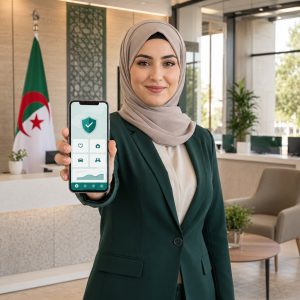
Where Algeria’s Islamic finance sector is conspicuously weak is on the digital product layer. Islamic windows in conventional banks are largely branch-based operations. Account opening, product applications, and transaction management require in-person visits in most cases. There is no major Algerian app that functions as a sharia-compliant financial services hub — no equivalent to Wahed Invest (the US/UK halal investment platform) or Finterra (Malaysia’s blockchain-based Islamic finance platform).
This digital gap is not unique to Algeria. Even in the Gulf, where Islamic finance is most mature, digital-native Islamic fintech companies are newer than their conventional counterparts. But the gap is more pronounced in Algeria, where even conventional digital banking is nascent. The October 2024 Digital Bank Regulation (No. 24-64), which created a formal legal category for fully digital banks, opens the theoretical possibility of a licensed digital bank built entirely on Islamic finance principles — but none has yet applied for or received such a license.
Advertisement
The Regulatory Framework and Its Evolution
Bank of Algeria Regulation No. 20-02 (March 15, 2020) established the foundational framework for Islamic banking operations, approving eight core products: Murabaha, Musharaka, Mudaraba, Ijara, Salam, Istisna, and Islamic deposit and investment accounts. The defining condition is simple: no transaction may give rise to the collection or payment of interest.
Law No. 23-09 (June 21, 2023) — the updated Currency and Banking Law — gave additional legal anchoring to Islamic finance operations within the banking sector. In 2022, the government began licensing Takaful operators (both family and general) under Executive Decree No. 21-81. In October 2024, dedicated Islamic real estate and mortgage finance regulations were introduced, enabling Sharia-compliant home financing for the first time through formal channels. The Finance Law 2025 goes further, explicitly providing for Islamic consumer finance products in tourism, education, and healthcare using Murabaha, Ijara Muntahiya Bil Tamleek, and Diminishing Musharaka structures.
The regulatory scaffolding is being built methodically. Each piece creates room for another.
The Sovereign Sukuk Signal
Algeria’s inaugural sovereign sukuk — 297 billion DZD ($2.3 billion), launched November 2025 with a 7-year maturity and a 6% annual return structured as rental income — is a watershed moment that extends well beyond its immediate financing purpose. It creates the first liquid sharia-compliant instrument on the Algerian market, establishes a yield benchmark for Islamic securities, and signals to local and international Islamic finance institutions that Algeria is building the ecosystem for serious market development.
The government’s stated medium-term ambition — growing Islamic banking assets from the current $5 billion to $60 billion — would require a structural transformation of how Islamic financial products are distributed, priced, and accessed. Digital channels are not optional in that journey; they are essential.
Regional Benchmarks
The global Islamic fintech market reached an estimated $198 billion in transaction volume in 2024/25, projected to grow to $341 billion by 2029 at an annual rate of 11.5%. Saudi Arabia ($77.2 billion), the UAE ($10.5 billion), and Malaysia are the leading markets by volume.
Malaysia’s model is instructive: a mandatory national sharia advisory body creates product consistency, Islamic banking represents over 35% of total banking assets, and apps like Maybank Islamic and CIMB Islamic deliver the full product suite digitally. The UAE’s DIB (Dubai Islamic Bank) app and Abu Dhabi Islamic Bank’s mobile platform offer onboarding, financing applications, and investment management entirely through mobile interfaces.
Algeria is not starting from scratch — the regulatory foundation is in place, the banking network is extensive, and consumer demand is demonstrably there. The next layer to build on top of these foundations is a digital-first execution layer.
The Fintech Opportunity
For Algerian entrepreneurs and bank digital teams, the opportunity is substantial and relatively uncrowded:
Murabaha-based BNPL (buy-now-pay-later): A Sharia-compliant installment product for consumer goods purchases, structured as a cost-plus murabaha agreement, would serve the large segment of Algerians who currently avoid credit cards but would use interest-free installment financing. No major player has yet built this for the Algerian market at scale.
Halal investment apps: A retail-facing app for screening stocks against Sharia criteria, providing access to sukuk instruments, and managing halal investment portfolios would serve the growing digital-first middle class that is accumulating savings outside the banking system.
Digital takaful: Mobile-first insurance products structured as mutual contributions rather than conventional premiums would address the significant underinsurance in Algeria’s market while respecting religious sensitivities.
Frequently Asked Questions
What is halal fintech in algeria?
Halal Fintech in Algeria: Sharia-Compliant Products in a 99% Muslim Market covers the essential aspects of this topic, examining current trends, key players, and practical implications for professionals and organizations in 2026.
Why is halal fintech in algeria important for Algeria?
This topic is significant for Algeria because it intersects with the country’s digital transformation goals, economic diversification strategy, and growing technology ecosystem. The article provides specific context for Algerian stakeholders.
How does the sharia-compliant product landscape work?
The article examines this through the lens of the sharia-compliant product landscape, providing detailed analysis of the mechanisms, trade-offs, and practical implications for stakeholders.
Sources & Further Reading
- Islamic Finance in Algeria Reaches 900 Billion DZD in Deposits — Algeria News Gate
- Algeria’s Islamic Banking Voyage of Discovery — ICIEC
- Al Baraka Bank and Al Salam Bank Leading Islamic Finance in Algeria — Algeria News Gate
- Algeria Embraces Sovereign Sukuk Financing in 2025 — Al Majalla
- Algeria Set for Inaugural $2.3 Billion Sovereign Sukuk — Bloomberg
- Algeria Turns to Islamic Finance to Fix Economy — Daily Sabah
- Regulation of Islamic Finance Operations in Algeria — Islamic Finance News
- Global Islamic Fintech Market to Grow to $341 Billion by 2029 — Economy Middle East
- Saudi Arabia, UAE, Malaysia Lead Islamic Fintech — Arab News
- Algeria to Issue First Sukuk — AGBI
- Algeria Rolls Out New Digital Banking Rules — Launch Base Africa