The Scale of the Challenge — and the Opportunity
Algeria’s SME sector is larger than many analysts assume. By end-2022, the National Center for the Commercial Register (CNRC) counted 1,359,803 registered SMEs, a figure that grew at 5.71% annually between 2021 and 2025. These businesses span commerce, light industry, services, and agriculture across all 58 wilayas. They represent the backbone of employment and consumption, yet their digital footprint remains thin.
The Algerian government has been explicit about what it wants to change. Algeria’s National Digital Transformation Strategy (SNTN), unveiled by High Commissioner for Digitalization Meriem Benmouloud, sets a target for the digital sector to contribute 20% of GDP by 2030, up from a currently marginal share. One of its core levers is bringing 80% of SMEs and SMIs into active digital systems. The strategy is supported by over 500 digitalization projects targeting both public services and private-sector enablement, announced on December 25, 2024.
The country’s current standing tells the story of the gap. Algeria ranks 116th out of 193 countries on the UN e-Government Development Index (EGDI) 2024, with a score of 0.5956 — an improvement from 0.5611 in 2022 but still far from the top tier that would indicate a digital-ready business environment. For SME owners, that aggregate ranking translates into specific friction: cumbersome administrative filings, fragmented payment infrastructure, and limited access to cloud-based business tools in Arabic or Darija.
Five Digital Tools SMEs Can Deploy Right Now
The strategy is national; the implementation is local. SME owners do not need to wait for government projects to complete before beginning their own digitalization. Five categories of tools are already accessible, affordable, and compatible with Algeria’s regulatory environment.
Accounting and invoicing platforms. Cloud-based accounting tools compatible with Algeria’s G50 tax declaration requirements are available from local providers. Chargily, which has built a payment and invoicing stack explicitly for the Algerian market, allows merchants to generate compliant invoices and track cash flow without a full accounting team. For sellers registered under the auto-entrepreneur regime at anae.dz, the 0.5% IFU flat-rate tax simplifies declaration to near-zero compliance overhead.
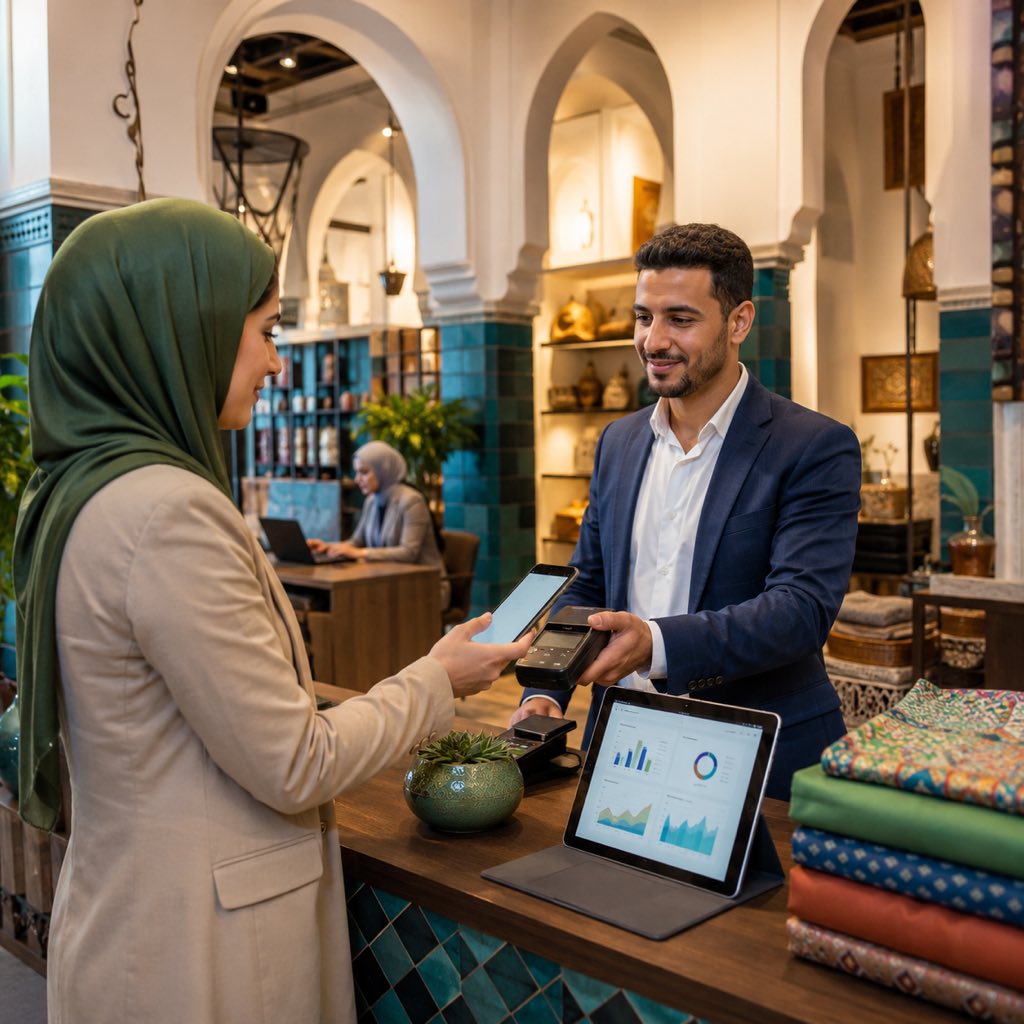
E-payment acceptance via BaridiMob. Algérie Poste’s BaridiMob — with over 5 million Android downloads as of 2025 — is the most accessible entry point into digital payments for SMEs that lack CIB terminal access. The Baridi Pay QR service launched in June 2025 allows a merchant to display a QR code on invoices, in a shop window, or in a WhatsApp message, and receive instant DZD transfers confirmed by SMS. Integration cost is zero. For SMEs previously dependent on cash-on-delivery, this represents a concrete first digital payment channel.
Social commerce infrastructure from platforms like Ecommaps. Algeria’s social-commerce ecosystem documented by Ecommaps shows that internet penetration has surpassed 77%, creating a large addressable audience for structured online storefronts. Ecommaps and similar platforms offer SMEs a .dz-compliant storefront (required under Law 18-05 for businesses selling to Algerian residents), national logistics with coverage across all 58 wilayas, and order management tools that can replace manual Facebook-DM tracking.
Government digital services via e.gov portals. Approximately 75% of Algeria’s 500+ digitalization projects concentrate on simplifying administrative procedures, which directly reduces the compliance burden on SMEs. CNRC registration, CNAS declarations, and import/export document processing are progressively moving online. SMEs that adopt these platforms early reduce staff time spent on administrative visits.
Connectivity grants and ANGEM micro-financing. ANGEM, the micro-enterprise support agency, has reached over 1 million financing beneficiaries across agriculture, industry, services, and very small industry. The agency is developing a dedicated e-commerce platform to promote micro-enterprise products nationally. SMEs that formally register and engage with ANGEM gain access to a lending pipeline that is being increasingly connected to digital business evidence. According to the US Trade Department’s Algeria Digital Economy guide, the government is explicitly targeting expanded private-sector participation in its digital infrastructure — SMEs that engage early gain preferential access to public procurement and co-investment programs.
Advertisement
What This Means for Algeria’s SME Owners
The 80% digitalization target is ambitious, but the practical ask for any individual SME is modest: adopt one digital system, not all of them at once.
1. Start with payment digitalization — the return is immediate
Digital payment acceptance reduces delivery fraud, eliminates COD collection risk, and produces a transaction record that supports loan applications. A seller who processes even 20% of orders via Baridi Pay QR by end-2026 is better positioned for ANADE financing than a purely cash-based peer. The Bank of Algeria’s Instruction No. 06-2025 has created a legal, tiered pathway for any SME to access PSP services without needing a corporate bank account at Level 1.
2. Register on the auto-entrepreneur platform to protect your income
For SMEs in digital services — web design, content creation, social media management, programming — the anae.dz auto-entrepreneur regime offers legal status at 0.5% tax on turnover. Unregistered service providers face potential fines and cannot legally invoice corporate clients. Registration takes hours, not weeks, and enables access to ANADE financing and the formal procurement market.
3. Document your operations to build a digital credit profile
Traditional bank lending in Algeria depends on collateral. Digital lending — still nascent but growing — depends on transaction data. SME owners who adopt cloud invoicing, digital payment records, and formal accounting now are building the data asset that unlocks next-generation credit products. The SNTN’s emphasis on financial infrastructure suggests that the regulatory environment for data-backed lending will expand in the 2026–2030 window.
The Structural Lesson: Digitalization Follows Incentives, Not Mandates
Government strategies set targets; they rarely deliver adoption directly. Algeria’s 80% SME digitalization figure will only be reached if the incentive structure for SME owners shifts materially. Three factors will determine the pace of adoption more than any government decree.
First, the cost of formalization must remain low. The auto-entrepreneur regime’s 0.5% flat rate is a good precedent — if regulators replicate that simplicity in the PSP and e-invoicing space, adoption will accelerate. If compliance costs rise, informal commerce will remain the rational choice for micro-sellers.
Second, logistics infrastructure must deliver nationwide. An SME in Tamanrasset or Adrar cannot digitize its sales process if logistics partners cannot serve the delivery leg. The expansion of logistics coverage to all 58 wilayas is a prerequisite for digital commerce adoption beyond the northern urban belt.
Third, digital literacy must reach owners, not just their children. Many SME owners over 40 are not early adopters of smartphone-based business tools. Practical, Arabic-language training — through CACI chambers, local vocational centers, or WhatsApp-based micro-courses — will matter more than strategy summits.
The infrastructure is ready. The question is whether the outreach is.
Frequently Asked Questions
What does Algeria’s 80% SME digitalization target actually mean in practice?
The target, part of Algeria’s National Digital Transformation Strategy (SNTN), aims to bring 80% of SMEs and small industries (PME/PMI) into active use of digital systems — including digital payment acceptance, online invoicing, and e-government services — by 2030. In practice, it means the government is building regulatory infrastructure (PSP rules, auto-entrepreneur regime, e-government portals) and expects businesses to adopt at least a baseline of these tools. The 500+ digitalization projects announced in December 2024 include both public-service streamlining and private-sector enablement measures.
Which digital tools are available to Algerian SMEs without needing a corporate bank account?
BaridiMob Level 1 wallets require only a national ID and allow balances up to 100,000 DZD, enabling payment collection without a bank account. The Baridi Pay QR service accepts transfers via the BaridiMob app. The auto-entrepreneur platform at anae.dz allows registration and simplified tax filing for eligible digital service providers. Ecommaps provides a .dz-compliant online storefront with integrated national logistics and order management — all without requiring a corporate banking relationship at the entry level.
How can an Algerian SME use digital transactions to access financing?
Digital transactions create a verifiable financial record — the primary input for data-driven lending models. ANADE provides micro-financing to registered businesses, and ANGEM has supported over 1 million micro-enterprise beneficiaries. Lenders — including the emerging PSP-backed fintech lenders entering the market under Instruction No. 06-2025 — will increasingly use transaction volume, consistency, and growth as loan eligibility criteria. An SME that routes even 30% of its revenue through documented digital channels by 2026 will be significantly better positioned for credit access than one operating entirely in cash.
—
Sources & Further Reading
- Algeria Aims for Full Digital Transformation by 2030 — WeAreTech Africa
- Algeria Plans Digital Transformation Agenda — Digital Economy Magazine
- Algeria Ecommerce Research 2026 — Ecommaps
- Algeria Opens for Fintech: New PSP Rules — Launch Base Africa
- Algeria’s Fintech Ecosystem in 2026 — The Fintech Times
- SME Sector as Economic Growth Basis: Algeria Case Study — ResearchGate
🔗 Related Intelligence

Algeria SME Cloud: How Small Businesses Can Access Digital Services in 2026

Algeria E-Procurement Portal: Digital Tender Access for Startups and SMEs in 2026

SMEX Algeria 2026: Arab SMEs Build Shared Digital Export Platforms Across the Region

Algeria’s Government Doubles Down on Digital Entrepreneurship: New Initiatives and What They Mean