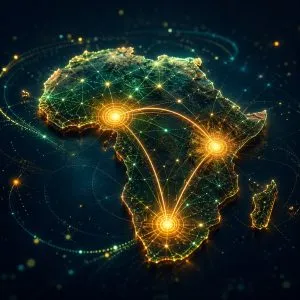
The Megawatt Trap: Why Africa’s Digital Plans Are Hitting a Power Wall
For two decades, Africa’s data center industry grew incrementally — one 5 MW facility here, a 20 MW expansion there — tracking the pace of corporate IT demand in the continent’s largest economies. That planning framework made sense when the primary use case was email servers and ERP systems. It is catastrophically ill-suited to the era of AI training and inference workloads, where a single large language model training run consumes more electricity than a mid-sized city.
Africa’s data center capacity currently sits at 300–400 MW across the entire continent. Northern Virginia’s data center corridor, by comparison, has over 4 GW installed — with 1 GW added every year. This is not a gap that can be closed by building more of the same kind of facilities at the same pace. The math requires a qualitative shift in how Africa plans, finances, and builds digital infrastructure.
The structural problem is planning horizon misalignment. Africa’s energy planning frameworks — designed for utility-scale power generation tied to industrial or residential demand — operate in 5–10 year cycles oriented toward incremental MW additions. AI infrastructure investment requires gigawatt-scale thinking in 2–3 year deployment windows, coordinated across power generation, transmission, and data center development simultaneously. These two planning cultures do not naturally communicate, and the gap between them is where Africa’s digital ambitions are stalling.
McKinsey projects that data center capacity in the five largest African markets will need to grow from around 400 MW today to between 1.5 and 2.2 GW by 2030 — a 4–5x increase in four years. That trajectory would require annual capacity additions of 200–400 MW per year, sustained across multiple countries simultaneously, in markets where permitting, land acquisition, grid connection, and financing each move on independent timelines that rarely align.
Three Structural Barriers That Go Beyond Power
Barrier 1: Generation Capacity Must Be Co-Located, Not Just Available
Africa’s renewable energy potential is enormous — the continent receives more solar irradiation than any other landmass and has unexploited hydroelectric, geothermal, and wind resources. But available generation capacity on paper is not the same as deliverable power to a specific location. A data center cannot draw on a solar farm in Morocco from a server hall in Lagos — the transmission infrastructure that would make that possible does not exist, and building it would take a decade and tens of billions of dollars.
The practical implication is that data center development in Africa must be co-designed with dedicated power generation. The model that is emerging — described by the African Energy Chamber — is “digital infrastructure hubs” where power generation, transmission, and server capacity are developed as a single coordinated investment. Nigeria’s LNG-to-power projects and Algeria’s solar expansion both represent potential anchor generation assets for this kind of co-located development.
Barrier 2: The Financing Gap Cannot Be Closed by National Governments Alone
Gigawatt-scale data center development requires capital at a scale that exceeds the individual balance sheets of most African governments and development finance institutions. A single 500 MW AI data center campus — the kind being built in Northern Virginia, Singapore, and the UAE — costs USD 2–4 billion in infrastructure alone, before accounting for the power generation assets it requires. Africa needs blended finance structures that combine multilateral development bank guarantees, sovereign wealth fund anchors, and private infrastructure equity to de-risk early-stage development at this scale. The African Energy Week 2026 AI and Data Center Track (October 2026, Cape Town) is the primary policy forum where these financing structures will be negotiated — and where early-mover governments that have shovel-ready sites will attract the first investment commitments.
Barrier 3: AI Workloads Have Different Power Quality Requirements Than Traditional IT
A subtle but operationally critical problem: AI training clusters require not just large amounts of power but highly stable, low-variance power delivery. GPU clusters are sensitive to voltage fluctuations that would be inconsequential for a web server — even brief fluctuations can corrupt training runs that took weeks to configure. Africa’s power grids in most markets are characterized by exactly the volatility that AI infrastructure cannot tolerate: load shedding, frequency instability, and brownout conditions. This means that data centers serving AI workloads in Africa must invest in on-site power conditioning, backup generation, and uninterruptible power supply (UPS) infrastructure at a scale and cost that significantly increases the total project budget compared to equivalent facilities in stable-grid markets.
Advertisement
What Enterprise and Policy Decision-Makers Should Do
1. Stop Planning in Megawatts — Reframe Every Digital Infrastructure Decision at Gigawatt Scale
The most immediate practical change that African digital economy planners — government ministries, development finance institutions, and large enterprise IT teams — can make is to adopt gigawatt-scale thinking as the baseline planning unit. This means evaluating every proposed data center investment against the question: “Does this facility form part of a gigawatt-scale hub, or is it a standalone megawatt-scale build that will be stranded when AI demand arrives?” Standalone builds that cannot be expanded to 100+ MW over 5 years are legacy investments before they are commissioned. Every procurement specification for new data center capacity should require a site expansion plan to at least 500 MW as a condition of shortlisting.
2. Develop Dedicated Power-Digital Co-Investment Structures Before Announcing Hub Projects
African governments and development authorities that want to attract hyperscaler or private data center investment need to present a credible co-investment structure — not just a site with a permit. The critical difference between markets that attract investment and those that do not is power commitment: signed agreements with generation assets (solar PPA, gas-fired peaker, hydroelectric priority allocation) that guarantee the first 100–200 MW of the planned hub. The AEW 2026 Digital and Energy Transformation platform is specifically designing policy frameworks for this co-investment structure — governments that engage with that process before October 2026 will be the first movers in the hyperscaler RFP rounds that follow.
3. Build Grid Stability Before Capacity — Power Quality Is the Hidden Prerequisite
Investment in grid stability infrastructure — automatic voltage regulators, frequency control systems, and smart grid monitoring — should precede data center development rather than following it. A 200 MW data center that experiences weekly load-shedding events is not a competitive AI infrastructure asset; it is an expensive liability. Governments should evaluate grid stability as the primary infrastructure prerequisite, ahead of land availability, connectivity, and even generation capacity. Markets with stable grids will attract AI data center investment first, independent of whether they have the lowest land cost or the most favorable tax incentives.
What Comes Next
The 2026–2028 period will determine whether Africa closes the gigawatt gap or cedes the AI economy to hyperscaler deployments concentrated in South Africa, Egypt, and Nigeria while the rest of the continent imports AI compute via API. The decision points are specific: which governments will commit to co-located power-digital hub development, which development finance institutions will design the blended finance vehicles, and which private operators will take first-mover risk on new markets.
Africa’s natural gas resources — Algeria, Nigeria, Mozambique, Tanzania — represent a specific strategic asset in this context. Africa’s gas-to-power potential for data center development offers a baseload-stable power source that solar and wind cannot provide without storage at scale. Gas-powered data centers are not a permanent solution — the transition to renewables is both inevitable and necessary — but they offer the 5–10 year stable power bridge that allows gigawatt-scale infrastructure to develop while renewable capacity and storage technology mature.
The gigawatt transition is not optional for Africa’s digital economy. It is the infrastructure layer on which every other digital ambition — AI adoption, fintech scaling, e-government, digital health — ultimately depends. Countries that treat power planning as separate from digital planning will find their AI strategies constrained at the most fundamental level: they will have the algorithms but not the electricity to run them.
Frequently Asked Questions
Why does AI infrastructure require so much more power than traditional data centers?
AI training workloads — running large language models or training vision systems — require dense clusters of GPUs operating continuously at near-maximum utilization. A single GPU cluster running a frontier model training job can consume 10–50 MW for weeks at a time. Traditional data centers supporting web servers and corporate IT operate at 10–30% average utilization; AI data centers run at 60–80%. The power density per rack (kW per server rack) is also 5–10x higher for AI workloads than for conventional servers, requiring heavier investment in power distribution and cooling infrastructure.
What is Africa’s current data center capacity and where is it concentrated?
Africa’s total operational data center capacity is approximately 300–400 MW, according to the African Energy Chamber. This is heavily concentrated in three markets: South Africa (the largest market, particularly Johannesburg), Egypt (Cairo), and Nigeria (Lagos). Kenya and Morocco have smaller but growing presences. The rest of sub-Saharan and North Africa has minimal commercial data center capacity — most enterprise computing is served from South Africa or from European cloud regions via undersea fiber cables.
What is the African Energy Week 2026 AI and Data Center Track?
African Energy Week (AEW) 2026, scheduled for October in Cape Town, launched a dedicated AI and Data Center Platform in May 2026. The track focuses on aligning Africa’s energy planning with digital infrastructure investment needs — specifically the transition from megawatt-scale incremental additions to gigawatt-scale hub development. It is the primary policy forum where African governments, energy companies, development finance institutions, and data center operators will negotiate the financing and regulatory frameworks for the next generation of African AI infrastructure.
—
Sources & Further Reading
- Africa Must Think in Grid-Scale Power to Compete in the AI Economy — Business Tech Africa
- From Megawatt to Gigawatt: Why Africa Must Think in Grid-Scale Power — Ghana Eye Report
- Africa Needs Grid-Scale Energy to Power AI Data Centres — Tech In Africa
- African Energy Week 2026 Launches AI and Data Center Platform — Hipther
- Can Africa’s Natural Gas Power the Continent’s Digital Future? — World Oil
- African Energy Chamber Press Release: From MW to GW — Africa-Newsroom
🔗 Related Intelligence

Africa’s $10B AI Initiative: 40 Million Jobs by 2035 and the Infrastructure Bet Behind It

Africa’s Developer Pivot: From Gig Coder to AI-Augmented Strategist
Africa Data Hub: MTN and a Gulf Data-Centre Tycoon Bet 150MW on the Continent’s AI Future

East Africa’s Regional AI Alliance: A Blueprint for Shared Sovereignty in the Developing World