
From Research Repository to Venture Engine
CERIST — the Centre de Recherche sur l’Information Scientifique et Technique — is the institution that introduced the internet to Algeria and built much of the country’s early digital infrastructure. For decades, it operated primarily as a research organisation: generating scientific knowledge, maintaining national IT systems, and publishing technical documentation. The Deeptech Innovation Hub changes that identity fundamentally.
Supervised by Algeria’s Ministry of Higher Education and Scientific Research and launched in 2025, the hub is explicitly designed to do one thing: convert advanced research into scalable commercial ventures. Not to publish papers, not to run workshops, but to take AI models, cybersecurity frameworks, and sovereign software developed inside Algerian research labs and turn them into companies capable of attracting investment and generating revenue.
The hub operates as part of the National Venture Studio Programme — a $600 million public-private initiative co-anchored by the Algerian Startup Fund (ASF) and MENA venture studio DeepMinds. But the hub itself is the physical and technical infrastructure layer: the place where founders and researchers work, where compute runs, and where the transition from laboratory prototype to market-ready product actually happens.
CERIST Director Dr. Imane Benkhelifa has described the institution as “uniquely positioned to convert our scientific strength into venture-ready innovation at national scale” — a statement that reflects both the decades of research output waiting for commercialisation and the new operational mandate to actually do it.
What the Hub Provides
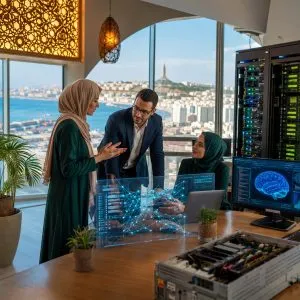
The Deeptech Innovation Hub is not a co-working space with mentors. It is a structured acceleration environment built around four interconnected capabilities.
High-performance computing infrastructure is the foundational resource. Algerian AI startups have historically faced a brutal constraint: training production-quality machine learning models requires GPU compute that costs $50,000–$500,000 on commercial cloud platforms — a price point that eliminates most early-stage ventures before they can generate a proof of concept worth funding. The hub is part of a $600 million national programme targeting 1,000 startups across all 58 provinces by 2030. Founders accepted into the programme access compute as a programme resource, not a capital expenditure.
Advanced data systems complement the compute layer. Algeria has substantial proprietary data assets — national satellite imagery, Darija and MSA language corpora, industrial telemetry from the hydrocarbon sector, and healthcare records from public institutions. The hub’s data infrastructure is designed to enable founders to work with these datasets under structured access agreements, creating AI models trained on Algerian data that foreign platforms cannot replicate.
Structured acceleration — provided in partnership with DeepMinds — covers business model design, use case validation, go-to-market planning, and investment readiness. This is the operational scaffolding that converts a technically sound research project into a company a rational investor would fund. The emphasis is on speed: the programme is designed to move from concept to company in months, not years.
Investor and corporate connectivity closes the loop. The hub connects founders to the ASF’s investment network, to the corporates and public institutions that represent the most likely first customers for deep-tech products, and to international partners through DeepMinds’ MENA network. The DeepX Summit — held on April 25–26, 2026, at the Cultural Center of the Great Mosque in Algiers — provided a first demonstration of this connectivity in action, bringing scientists, venture builders, and corporate decision-makers into the same room with a brief to do deals, not just network.
Advertisement
Why AI and Cybersecurity Are the Right Sectors to Lead
The hub’s two priority sectors — artificial intelligence and cybersecurity — are not arbitrary. They reflect a specific strategic calculus about where Algeria can build defensible technology that replaces imported solutions rather than competing with better-funded foreign alternatives on their own terms.
Algeria’s public and private institutions collectively spend significant capital on foreign cybersecurity software. The global cybersecurity market exceeded $200 billion in 2024, yet virtually none of that value accrues to Algerian companies. Every data breach, every ransomware incident, every network intrusion that affects an Algerian bank or government ministry is, at some level, a failure of locally available security capability. Building Algerian cybersecurity companies — ones that understand the local threat landscape, speak Arabic, and can integrate with Algerian regulatory requirements — addresses a real domestic market that no foreign vendor serves as well as a local one could. The CERIST hub’s structured 24-month programme is designed to close this gap by 2027.
The AI case is similar but broader. Algerian Arabic (Darija), Tamazight, and even MSA are systematically underrepresented in the training data of leading international language models. The gap is not incidental — it reflects the commercial incentives of companies building products primarily for English, Mandarin, and Spanish speakers. An Algerian AI company that trains on locally sourced language and domain data has a structural advantage in serving Algerian enterprise and government customers that a foreign model cannot easily close.
What Algerian Founders and Researchers Should Do Now
The hub’s launch creates actionable opportunities for founders and researchers ready to move from research to market. The window for early cohorts — when programme teams have the most capacity to work intensively with individual projects — is open now.
1. Submit a Venture Concept, Not a Research Paper
The hub’s admission process is designed for commercialisation, not academic validation. A strong application describes a specific market problem (e.g., “Algerian SMEs lose an estimated X hours per week to manual Arabic document processing”), a research-backed solution (a trained model or validated algorithm), and an identified first customer willing to pay for a pilot. Founders who arrive with a named enterprise contact or a letter of intent from a government institution move significantly faster through the programme than those presenting a technical proof of concept without a defined buyer. Spend two weeks before applying converting your research output into a customer problem statement.
2. Treat GPU Access as a Time-Limited Strategic Advantage
The hub’s computing infrastructure represents a funding advantage worth hundreds of thousands of dollars to early-stage ventures — but it is a shared resource that will become more competitive as cohorts scale. Use the access window to build something that creates a proprietary data or model advantage: train on Algerian-specific datasets, fine-tune on local domain data, or develop a benchmark on Algerian language tasks that can be published to establish technical credibility with investors. The goal is to emerge from the programme with a model that required CERIST-scale compute to build but now runs cost-efficiently in production — turning an infrastructure advantage into a defensible IP position.
3. Map Your Cybersecurity Project to a Regulated Algerian Sector
Algeria’s cybersecurity market has clear demand concentration: banking (regulated by the Bank of Algeria), telecommunications (regulated by ARPCE), and government IT systems (overseen by ANSSSI) are the sectors where procurement decisions are made, budgets exist, and the cost of a breach is high enough to justify purchasing serious security products. Founders building cybersecurity ventures should map their product to one of these sectors before entering the hub, identify the specific regulation their product helps clients comply with, and develop an evaluation checklist that a compliance officer in that sector can use to justify purchase. CERIST’s institutional relationships with public bodies can open doors to pilot programmes that commercial sales teams would take years to access.
4. Pair with a CERIST Researcher as Co-Founder, Not Just as an Advisor
The hub’s most underutilised resource is not the GPU cluster — it is the research talent already inside CERIST. Decades of work on Algerian language processing, network security, and distributed systems exists in institutional form but has not been commercialised. Founders with a product vision but limited research depth should actively seek co-founders from CERIST’s researcher pool. A technical co-founder who comes with existing proprietary research, published results, and institutional relationships is worth more than a commercially experienced co-founder without deep-tech credibility when pitching to the ASF or to international deep-tech investors. Ask the programme coordinators explicitly to facilitate researcher-founder matching.
5. Plan Your First Customer Before Your First Product
The most common failure mode for deep-tech ventures is building an elegant technical solution and then discovering that the identified customer either lacks the budget or the authority to purchase it. Before entering the hub, identify two or three potential customers, have a 30-minute conversation with each, and confirm that they have a budget line, a procurement process, and a decision-maker who can commit. In Algeria’s enterprise and public sector context, this means identifying the IT director, the compliance officer, or the innovation head — not the CEO — as the actual buyer. The hub’s investor-readiness curriculum will stress this point, but founders who arrive having already done it compress their programme timeline significantly.
Where This Fits in Algeria’s Startup Architecture
The Deeptech Innovation Hub occupies a specific and previously empty position in Algeria’s startup support architecture. The ASF provides capital. ANSEJ and ANADE support micro-enterprise creation. University incubators provide early ideation support. What has been missing is a high-intensity, infrastructure-backed, research-to-market bridge that operates at the speed venture investors expect.
The hub fills that gap. It is not a replacement for the ASF or for university incubators — it is the layer between them, converting research output into investment-ready ventures and connecting them to capital through the ASF’s network.
Whether this model scales to 1,000 ventures across 58 provinces over five years will depend on the quality and consistency of the venture-building methodology applied at each location. The inaugural DeepX Summit in April 2026 provided a first signal: the quality of the scientific and entrepreneurial talent in the room suggested the pipeline is real. The hub now has to convert that pipeline into companies.
Frequently Asked Questions
How does the CERIST Deeptech Innovation Hub differ from a standard university incubator?
University incubators typically provide office space, mentorship, and introductions — but not computing infrastructure, investor connectivity, or structured venture-building methodology. The CERIST hub provides GPU-powered AI infrastructure and advanced data systems that would cost hundreds of thousands of dollars on commercial cloud platforms, combined with DeepMinds’ venture-building curriculum and ASF’s investment network. It is an infrastructure-backed, commercially oriented programme, not an academic support structure.
What is the minimum technical readiness required to apply?
The hub targets ventures at the research-to-market bridge stage: projects should have a validated technical concept (a working prototype, a trained model, or a published algorithm) and an identified commercial use case. Pure research projects without a defined market application are better served by CERIST’s academic research programmes first. The hub’s structured acceleration process requires founders to engage with customer discovery and business model design from day one.
Is the programme available to founders outside Algiers?
Yes — the programme explicitly covers all 58 wilayas as part of the broader National Venture Studio Programme mandate. CERIST’s national network of research labs and university partnerships serves as the deployment infrastructure for regions outside the capital. Founders in Oran, Constantine, Annaba, and other cities can access the programme through their regional university research network and CERIST’s wilaya-level contacts.
Sources & Further Reading
- Algeria’s CERIST Launches Deeptech Innovation Hub — iAfrica
- CERIST and DeepMinds Sign Strategic Partnership — DeepMinds
- Algeria Builds First AI and Cybersecurity Hub — EcoFinAgency
- CERIST Launches Deeptech Innovation Hub in Algiers — Middle East AI News
- DeepMinds Launches DeepX, MENA’s First DeepTech Venture Building Summit — Zawya
- Algerian Startup Fund Overview — ASF
🔗 Related Intelligence

CERIST Deeptech Hub: Algeria Launches GPU-Powered AI Venture Accelerator

Sidi Abdellah AI and Cybersecurity Cluster: What Algerian Startups Can Access Right Now

Algeria’s AI & Cybersecurity Cluster: How Startups Can Join and Benefit
Algeria’s First AI Cluster: Inside the Sidi Abdellah Tech Hub Launch