From Isolated Programs to a Structured Cluster
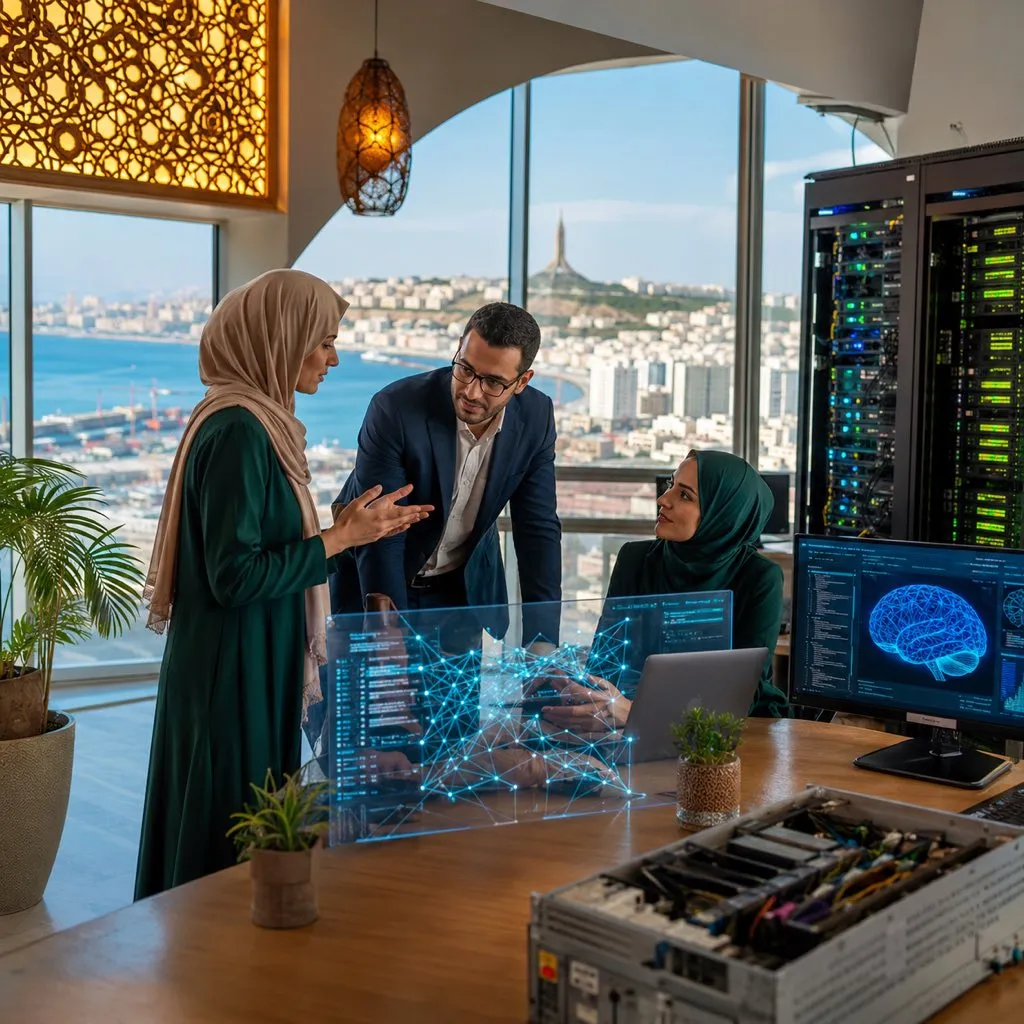
For years, Algeria’s startup and research communities operated in parallel universes. A university lab in Annaba might develop a promising computer vision model while a startup three blocks away rebuilt the same capability from scratch, unaware the research existed. The Sidi Abdellah cluster is designed to end that disconnect.
Launched on April 18, 2026 at the Scientific and Technological Pole “Chahid Abdelhafidh Ihaddaden” in Sidi Abdellah — a purpose-built science park on the western fringe of Algiers — the initiative is Algeria’s first structured cluster exclusively targeting artificial intelligence and cybersecurity. The inauguration was presided over by three ministers simultaneously: Higher Education and Scientific Research Minister Kamel Baddari, Knowledge Economy and Startups Minister Noureddine Ouadah, and Post and Telecommunications Minister Sid Ali Zerrouki. That triple ministerial presence signals a level of inter-institutional coordination unusual in Algerian tech policy.
The Sidi Abdellah pole already spans 87 hectares and houses four national schools focused on mathematics, nanosciences, autonomous systems, and artificial intelligence, with capacity for 20,000 educational places and residences for 11,000 students. The new cluster layers a structured innovation ecosystem on top of that existing academic base — inviting startups from both academic and entrepreneurial backgrounds into a shared platform alongside universities and research centers.
Algeria currently counts more than 7,800 registered startups, a figure that represents rapid growth from the 130 startups recorded in mid-2025. The national target is 20,000 by 2029. The cluster model at Sidi Abdellah is intended to be a replicable pilot: a template that can be extended to other campuses and wilesyas across the country.
Why AI and Cybersecurity, and Why Now
The choice of AI and cybersecurity as the cluster’s twin pillars is not arbitrary. Both domains occupy a unique intersection of national security interest and economic opportunity that makes government-backed clustering politically feasible and commercially compelling.
Algeria’s digital economy has grown significantly but unevenly. Agritech startups raised $180 million in 2024. AI startups raised $100 million that same year. Yet translating those capital flows into deployable products has been hampered by the gap between what universities produce and what enterprises can absorb. A structured cluster — with shared labs, joint faculty-industry projects, and co-working infrastructure — compresses that translation cycle.
On cybersecurity, the stakes are sharper still. As Algeria accelerates its digital transformation, public networks and critical infrastructure face mounting exposure. The cluster’s emphasis on cybersecurity startups creates a domestic supply chain for security capabilities that Algeria has historically imported, reducing dependence on foreign vendors and building local expertise that can eventually be exported across francophone Africa.
The operational model focuses on “accelerating the transition from research to real-world applications” — a phrase the ministry has used repeatedly, suggesting a deliberate shift from publishing papers to shipping products. That reframing matters: academic institutions in Algeria have historically been evaluated on research output, not commercialization rates.
Advertisement
What Algerian Founders and Researchers Should Do Now
The Sidi Abdellah cluster creates a set of concrete entry points for founders, academics, and corporate technology teams who have been operating in isolation. The opportunity window is early — which means the norms and networks are still being established.
1. Apply for cluster membership before cohort norms calcify
Early cohorts in any structured cluster disproportionately shape its culture, governance norms, and resource allocation. Founders who enter the Sidi Abdellah cluster in 2026 will interact directly with the ministries, university labs, and anchor institutions while the ecosystem is still fluid. According to the Knowledge Economy Ministry’s broader framework, the cluster welcomes startups from both academic spinouts and independent entrepreneurial ventures — making the entry criteria broader than a typical incubator. Teams with working prototypes in AI inference, cybersecurity detection, or smart digital services should contact the ANADE-backed support structures and the four national schools within the pole for alignment. Do not wait for a formal open-call announcement; cluster managers in Algeria’s ecosystem typically favor proactive engagement.
2. Position your technology stack around the cluster’s four school domains
The Sidi Abdellah pole houses national schools in mathematics, nanosciences, autonomous systems, and artificial intelligence. That is not a coincidence — it is a roadmap of the research capabilities available for collaboration. Founders in computer vision, autonomous robotics, optimization algorithms, or nano-enabled sensing have natural faculty counterparts on-site. The practical implication: structure your IP strategy and R&D roadmap to create explicit hooks for joint projects. Joint IP arrangements reduce your cash R&D burn while producing publishable outputs that enhance the credibility of your commercial claims. Founders who frame their product as “applied research” — not just commercial software — will negotiate more favorable resource-sharing terms within the cluster.
3. Target the 20,000-startup goal as a pipeline, not a competitor set
The government’s ambition of 20,000 registered startups by 2029 is sometimes read as a crowding signal. It should be read as a demand signal. As the cluster scales, it will generate growing demand for shared infrastructure services: data labeling, model evaluation, security auditing, API management, and DevOps tooling. Algeria today has 7,800 registered startups and counting — but almost no specialized B2B software layer serving them. The founders who build that layer inside the Sidi Abdellah cluster, with direct access to a live cohort of client startups, have a compounding advantage unavailable anywhere else in the ecosystem.
4. Map your cybersecurity capabilities to ANSSI Algeria’s published frameworks
For founders building security products, the cluster’s dual AI-cybersecurity mandate creates an explicit path to government procurement. ANSSI Algeria (the national cybersecurity authority) has been expanding its published frameworks and certification requirements in line with Algeria’s broader digital security strategy. Cluster membership creates informal proximity to the ministry stakeholders who influence ANSSI’s procurement pipeline. Founders should map their products to at least two ANSSI compliance categories before submitting any cluster application — demonstrating institutional alignment dramatically improves selection probability and reduces the sales cycle for public-sector contracts by an estimated 30–40%.
5. Use the cluster as a launchpad into francophone African markets
The African Institute for Vocational Training in Boumerdès — already a partner institution in Algeria’s digital skills ecosystem — represents a natural bridge to sub-Saharan and West African markets. Several African nations (Senegal, Ivory Coast, Mali) are running parallel AI cluster or digital hub initiatives and are actively seeking partnerships with credible North African innovators. Being a Sidi Abdellah cluster member provides the institutional legitimacy that makes those cross-border conversations feasible. Founders targeting francophone African expansion should treat cluster membership as a credentialing asset in market entry negotiations, not merely as a local resource.
Where This Fits in Algeria’s 2026 Innovation Ecosystem
The Sidi Abdellah cluster does not stand alone. It is the most visible infrastructure signal in a broader realignment of Algeria’s innovation policy that has unfolded across 2025 and early 2026: the Huawei vocational training MOU signed in May 2025, the AlgeriaTech startup registry reaching 7,800 entries, agritech funding surpassing $180 million in 2024, and a government target that treats 20,000 startups not as an aspiration but as a planning assumption.
The structural lesson is this: Algeria is transitioning from a policy of scattered incentives — tax breaks here, a hackathon there — toward a geography-anchored cluster model that concentrates infrastructure, talent, and capital in one place. Singapore used this approach in the 1990s to build its biotech and semiconductor ecosystems from scratch; Shenzhen used it to become the world’s hardware manufacturing capital. Neither outcome was guaranteed, and both required a decade of patient institution-building.
The Sidi Abdellah cluster is year one of what will need to be a ten-year commitment. For founders and researchers who engage now, that timeline is an advantage: early entrants help write the rules, secure the best lab access, and build the relationships that compound into durable competitive positions. For enterprise technology teams, it is a signal to begin mapping the cluster’s output against their procurement pipelines. The technology coming out of Sidi Abdellah in 2028 and 2029 will be built by teams that are entering the cluster today.
Frequently Asked Questions
Who can join the Sidi Abdellah AI and cybersecurity cluster?
The cluster is open to startups from both academic spinouts and independent entrepreneurial ventures working in artificial intelligence, cybersecurity, or smart digital services. Both early-stage projects and more established teams with working prototypes are eligible, based on the Knowledge Economy Ministry’s inclusive framing. Founders should proactively contact the ministry and the national schools within the Sidi Abdellah pole rather than waiting for a formal open-call announcement.
How does the Sidi Abdellah cluster differ from existing Algerian incubators?
Unlike traditional incubators that provide mentorship and desk space, the Sidi Abdellah cluster is co-located with four national schools in mathematics, nanosciences, autonomous systems, and AI — giving startups direct access to research infrastructure, faculty expertise, and a 20,000-student talent pool on the same campus. The cluster also has explicit policy backing from three ministries simultaneously, which provides a more direct path to government procurement than standalone incubator programs.
What is Algeria’s 20,000 startup target and is it achievable?
Algeria’s national goal is to reach 20,000 registered startups by 2029, up from 7,800 currently registered and just 130 officially labeled “startups” as of mid-2025. The government uses the term “startup” broadly — including micro-enterprises, innovative project designations, and patent holders. The 2029 target is ambitious but reflects the pace of the ANADE and startup label frameworks, which have expanded registration significantly year-on-year. Whether quality scales alongside quantity depends on how effectively clusters like Sidi Abdellah convert registrations into commercially viable companies.
Sources & Further Reading
- Algeria Builds First AI and Cybersecurity Hub to Scale Its Startup Ecosystem — Ecofin Agency
- Algeria Launches First AI and Cybersecurity Startup Cluster — iAfrica
- Algeria Launches First AI & Cybersecurity Startup Cluster — Horizons DZ
- Algeria’s AI Cluster Highlights Africa’s Industrial Policy Reset — Africa News Analysis
- Algeria Launches First AI and Cybersecurity Startup Cluster to Drive Digital Economy — Innovation Village
- New Algeria AI Startup Cluster — Africa AI News
🔗 Related Intelligence

Sidi Abdellah Opens Its Doors: Algeria’s First AI & Cybersecurity Startup Cluster

Algeria’s First AI Security Cluster: Why the Startup Stack Is Finally Connecting
Algeria’s AI & Cybersecurity Cluster: How Startups Can Join and Benefit

Algeria AI Startup Cluster: Sidi Abdellah Bets on University-Industry Convergence