
The Architecture of a National Bet
On June 1, 2025, three institutions signed a partnership that reframes Algeria’s startup ambition from scattered incubation to coordinated venture building at scale. The Algerian Startup Fund (ASF), the Centre de Recherche sur l’Information Scientifique et Technique (CERIST), and the MENA-focused venture studio DeepMinds announced the National Venture Studio Programme — a five-year, $600 million initiative targeting 1,000 high-impact technology ventures across all 58 of Algeria’s provinces.
The announcement followed years of incremental ecosystem activity: the ASF had processed 445 funding applications across 20-plus business sectors since its operationalisation in 2021, reaching 41 of 58 wilayas. What changed in 2025 was the decision to move from a reactive grant-and-loan model to a proactive venture-building model — one where program partners don’t wait for founders to arrive, but actively convert existing scientific research into fundable companies.
ASF General Manager Anys Rahabi summarised the ambition plainly: “This partnership reflects Algeria’s national ambition to unlock entrepreneurial energy and build ventures that deliver real value.” CERIST Director Dr. Imane Benkhelifa added that CERIST is “uniquely positioned to convert our scientific strength into venture-ready innovation at national scale” — a reference to the institution’s four decades of national IT infrastructure leadership, including introducing the internet to Algeria.
What Each Partner Brings
Understanding how the programme works requires mapping what each partner contributes — because this is not a fund-and-forget grant model.
ASF is the anchor investor and capital allocator. The fund offers regional investment tickets of up to 150 million DZD per project, and operates in partnership with six public banks to provide complementary financing. Its role is to ensure that promising ventures from the programme can access structured capital — equity tickets, bridge financing, and introductions to private co-investors.
CERIST brings the research pipeline and physical infrastructure. The institution leads the programme’s deployment through its national network of incubators, research labs, and university partnerships. For deep-tech startups in AI and cybersecurity specifically, CERIST’s Deeptech Innovation Hub (launched in parallel) provides high-performance computing infrastructure, GPU-powered AI capacity, and advanced data systems — removing the infrastructure barrier that typically kills research-to-market projects at the prototype stage.
DeepMinds operates as the venture-building execution arm. Unlike a traditional accelerator that takes applications and runs cohorts, DeepMinds embeds itself in the venture creation process — handling business model design, use case validation, go-to-market strategy, and investment readiness. CEO Dr. Abdenour Haddou describes the methodology as working “side by side with entrepreneurs to go from concept to company in months, not years.”
The combination is deliberate: capital access (ASF) plus scientific infrastructure (CERIST) plus operational execution (DeepMinds) addresses the three structural bottlenecks that have historically kept Algerian research from reaching market.
Advertisement
Why Deep Tech, Why Now
The programme’s focus on deep tech — AI, cybersecurity, and sovereign tech solutions — is not accidental. Algeria’s digital economy faces a specific strategic pressure: a large portion of national tech spending flows to imported software and foreign cloud infrastructure. Building sovereign, locally developed alternatives requires a different kind of startup than the consumer app wave that defined the ecosystem’s early years.
The Digital Algeria 2030 national strategy, which the programme explicitly supports, sets a target for technology to contribute a meaningfully higher share of GDP. To reach that target, Algeria needs not just more startups, but startups in sectors where intellectual property and recurring revenue can accumulate domestically. Deep tech — where value compounds in proprietary models, datasets, and engineering know-how — fits that criterion in a way that reselling imported SaaS products does not.
The decision to cover all 58 provinces also addresses a concentration problem. Algeria’s previous startup activity clustered in Algiers, with secondary presence in Oran and Constantine. The venture studio model, designed to find and develop founders in every wilaya, is explicitly a counterweight to this pattern — connecting university researchers in Tébessa or Bejaïa to the same infrastructure and investor networks available in the capital.
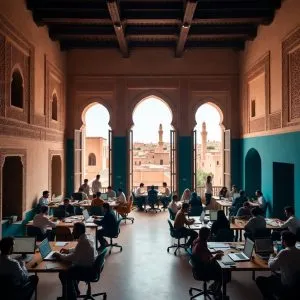
The inaugural DeepX Summit, held on April 25–26, 2026, at the Cultural Center of the Great Mosque in Algiers, provided the first public demonstration of this intent: scientists, venture builders, and corporate stakeholders convened in a single room with a brief to convert research into market-ready ventures — not just to present papers.
What Algerian Founders and Researchers Should Do Now
This programme creates a specific set of opportunities for founders, researchers, and institutions positioned to act. The window for early participation — when programme teams are actively recruiting founding cohorts and the infrastructure is newest — is open now.
1. Map Your Research to a Venture-Building Track Before Applying
The programme is not a grant competition: it is a venture-building partnership. Applicants who arrive with a market problem, a research-backed solution, and a named co-founder will move faster than those presenting a paper and asking what to do next. Before contacting ASF or DeepMinds, identify the specific commercial use case your research addresses, the first enterprise or government customer you would target, and the infrastructure gap CERIST’s GPU cluster could help you close. DeepMinds’ structured methodology rewards founders who have done this thinking in advance — their role is to accelerate commercialisation, not to originate ideas from scratch.
2. Use CERIST’s Infrastructure as a Competitive Moat, Not Just a Convenience
GPU access is an asymmetric resource for Algerian deep-tech founders. Training a production-quality AI model typically costs $50,000–$500,000 in cloud compute — a sum that kills most early-stage ventures before they can demonstrate value. Founders accepted into the Deeptech Innovation Hub gain access to this infrastructure without that capital barrier. The strategic move is to treat CERIST’s compute as a funded R&D advantage: use it to train proprietary models on Algerian datasets (Arabic-dialect NLP, national satellite imagery, local cybersecurity telemetry) that foreign competitors cannot replicate cheaply. A locally trained model on locally held data is a defensible moat — CERIST’s infrastructure is the mechanism to build it.
3. Approach the ASF’s 150M DZD Ticket as a Structured Instrument, Not a Grant
Many founders underestimate the due diligence requirements attached to ASF tickets. The fund operates in partnership with six public banks and expects founders to demonstrate product-market fit signals, a functioning team, and a credible financial model before committing capital. The 445 funding applications processed to date mean the fund has pattern-matched on what works and what doesn’t in the Algerian context. Founders should request a pre-application review session, present a unit-economics model — even a rough one — and prepare to answer questions about revenue timeline and employment creation. Founders who arrive with a realistic 24-month financial plan and named letters of intent from potential customers move through the process significantly faster.
4. Register Your Startup Label Before Applying to the Programme
Algeria’s startup label, administered by the Ministry for Knowledge Economy and Startups, is a formal prerequisite for most structured ecosystem support — including ASF capital and preferred rates with public bank partners. The label application process takes 4–8 weeks. Researchers and founders planning to enter the venture studio programme should begin the labelling process immediately, in parallel with building their application dossier. Waiting until after acceptance wastes 2–3 months of runway during the programme’s most intensive phase.
5. Build a Cross-Wilaya Team Deliberately
The programme’s 58-province mandate creates an unusual opportunity: a founder in Algiers who recruits a co-founder from Annaba, Sétif, or Tlemcen signals a geographic diversity that the programme is specifically designed to reward. Beyond the optics, cross-wilaya teams bring access to local regulatory relationships, university research pipelines, and pilot customer bases in regions outside the capital. For enterprise deep-tech sales — which is where most AI and cybersecurity revenue accumulates — having a co-founder with existing relationships in Oran’s industrial belt or Skikda’s petrochemical sector is a material commercial advantage, not just a geographic footnote.
Where This Fits in Algeria’s 2026 Ecosystem
The National Venture Studio Programme lands at a specific inflection point. The ASF’s December 2025 exit from Völz — a 3.35x return on a travel-tech investment — demonstrated that public venture capital in Algeria can generate real financial returns, not just employment statistics. That proof point matters: it tells international co-investors that Algerian startups can reach a monetisation event, and it tells local family offices and corporates that tech is an asset class worth backing.
The programme now provides the supply side — 1,000 ventures over five years — to match a demand side that is becoming more credible. If even 5 percent of those ventures reach Series A scale, that is 50 new companies generating recurring revenue and exporting technology, which would meaningfully change the composition of Algeria’s digital economy by 2030.
The test is execution. Venture studios succeed when they maintain programme discipline across a large, geographically distributed cohort — when the quality of the 800th venture matches the quality of the 10th. That is a hard operational challenge. What the ASF-CERIST-DeepMinds partnership has done is assemble the right combination of institutions to attempt it. Whether the programme delivers its ambition will depend on how consistently it applies its structured methodology across 58 provinces and five years.
Frequently Asked Questions
What is the difference between the National Venture Studio Programme and the standard ASF funding process?
The standard ASF process is reactive: founders apply for capital and receive structured financing. The venture studio programme is proactive: DeepMinds actively works with founders from idea stage to market-ready company, using CERIST’s research pipeline and infrastructure. The studio model includes business model design, go-to-market support, and investor readiness — not just capital.
Who is eligible to participate in the programme?
The programme targets researchers, university graduates, and early-stage founders across all 58 wilayas. Eligibility prioritises projects with a deep-tech component (AI, cybersecurity, sovereign software) that align with Algeria’s Digital Algeria 2030 strategic objectives. The startup label from the Ministry for Knowledge Economy and Startups is typically required for ASF co-investment.
What does the $600 million figure represent?
The $600 million figure represents the total public-private capital mobilised across the programme’s five-year mandate, combining ASF’s anchor investment capacity, CERIST’s infrastructure contribution (valued as capital-equivalent), and the broader co-investment network the partnership activates — including public bank partners and private co-investors introduced through the programme’s investor network.
Sources & Further Reading
- A New Era for Innovation: ASF, CERIST & DeepMinds Unite to Build 1,000 Tech Ventures — DeepMinds
- Algeria Builds First AI and Cybersecurity Hub to Scale Startup Ecosystem — EcoFinAgency
- Algeria’s CERIST Launches Deeptech Innovation Hub — iAfrica
- New Venture Studio to Create 1,000 Algerian Startups — Middle East AI News
- Algerian Startup Fund Overview — Startup Algeria
- DeepX Summit: DeepMinds Launches MENA’s First DeepTech Venture Building Summit — Zawya
🔗 Related Intelligence
Algeria’s $600M Venture Studio: 1,000 Deep Tech Startups Across 58 Provinces

Algeria’s Venture Studio Program: Building 1,000 Startups Through Structured Innovation

Algeria’s 7,800 Registered Startups: The Scale-Up Playbook for the Labeled 2,300

Algeria’s 20,000 Startup Label Target: How Founders Convert Registration to Certification by 2029