The Payment Problem That Made Intra-African Trade Inefficient
Before PAPSS, an Algerian pharmaceutical company exporting to Senegal faced a counter-intuitive financial reality: settling payment required routing through a chain of correspondent banks, typically touching a French or American intermediary bank, converting DZD to USD or EUR, then converting again to XOF. A $50,000 shipment might incur $1,200-2,000 in transaction fees, take 5-7 business days to clear, and require both parties to hold USD or EUR accounts — a significant barrier for Algerian SMEs that operate entirely in dinars.
This architecture was not designed to exclude intra-African trade. It was the legacy of a financial plumbing system built for colonial-era trade flows between Africa and Europe, never updated for continental commerce. According to TechCabal’s comprehensive analysis, only about 15% of Africa’s total trade is intra-continental — a remarkably low figure given the continent’s size and diversity, partially explained by this payment friction.
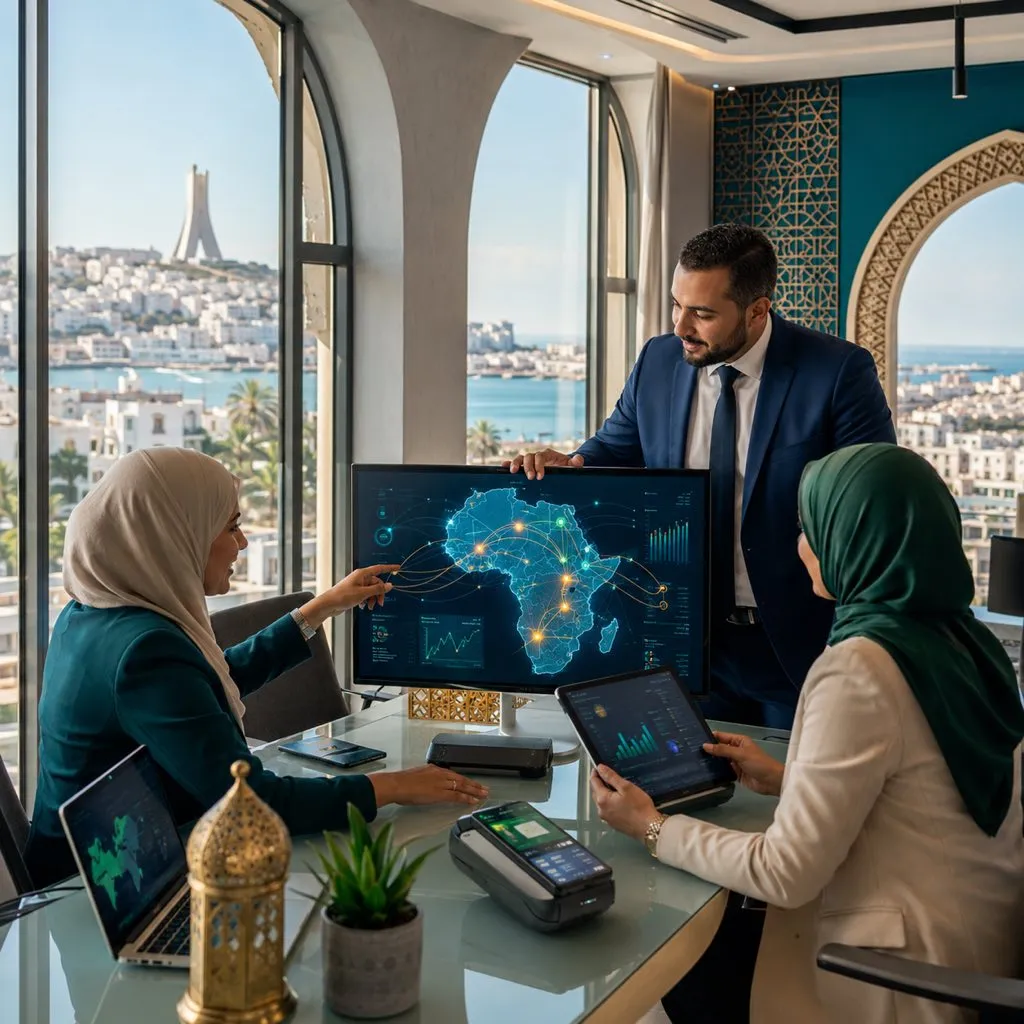
PAPSS was designed by the Afreximbank and the African Union specifically to break this architecture. The Pan-African Payment and Settlement System operates a centralized clearing house that allows commercial banks across 19 member countries to settle transactions directly in each other’s local currencies, bypassing the correspondent banking chain entirely.
What Algeria’s Accession Actually Enables
The Bank of Algeria formally joined PAPSS in 2025, giving Algerian commercial banks access to real-time payment corridors with all 19 PAPSS member countries. According to the Africa Fintech Network’s four-year review of PAPSS, the system processed $1.8 billion in transaction volume in its first four years of operation, with settlement times compressed to under 60 seconds for participating currency pairs.
For Algeria specifically, accession unlocks three priority corridors:
DZA-NGA corridor: Nigeria is Algeria’s largest potential West African trade partner, with a GDP of $363 billion and a manufacturing sector that imports significant pharmaceutical, construction material, and industrial equipment volumes. The corridor allows Algerian exporters to receive naira-denominated payment credited to their DZD account at the Bank of Algeria clearing rate, without requiring a dollar-denominated correspondent banking relationship.
DZA-SEN corridor: Senegal is Algeria’s most natural West African partner under AfCFTA, given shared Francophone commercial law and a growing bilateral diplomatic relationship. Dakar-Algiers trade in building materials, processed food, and manufactured goods can now settle same-day rather than in five business days.
DZA-XOF zone: The West African CFA franc zone (8 countries sharing the XOF currency) represents a unified payment corridor under PAPSS — Algerian exporters gain simultaneous access to Côte d’Ivoire, Mali, Burkina Faso, Niger, Benin, Togo, Guinea-Bissau, and Senegal through a single DZA-XOF corridor. This is the highest-volume opportunity, as the XOF zone collectively represents more than 150 million consumers.
The The Fintech Times’ 2026 Algeria briefing notes that Algeria’s PAPSS integration coincides with the AfCFTA Secretariat’s push to digitize rules-of-origin certification — meaning that within 12-18 months, the entire trade document and payment cycle for qualifying exports may be completable without a single correspondent bank or physical paper document.
Advertisement
What Algerian Exporters and SMEs Should Do Now
PAPSS access through Algerian commercial banks is live, but awareness among SME exporters is low and operational readiness varies significantly by bank. Here is the practical action map:
1. Confirm Your Bank Is a PAPSS Participant and Open a Trade Finance Account
Not all Algerian commercial banks have activated their PAPSS connectivity equally. The Bank of Algeria’s accession means the central bank is a PAPSS settlement member — but individual commercial banks must separately complete their integration with the clearing system. Exporters should contact their trade finance desk directly and request confirmation of PAPSS activation and the exact countries and currency pairs available. As of early 2026, BNA (Banque Nationale d’Algérie), BEA (Banque Extérieure d’Algérie), and BADR are expected to be the most advanced in PAPSS operational readiness. Any exporter planning to use PAPSS corridors in 2026 should open or activate a trade finance account — PAPSS settlement typically runs through commercial trade finance structures, not standard current accounts.
2. Price Your African Market Exports in Local Currencies, Not USD
The PAPSS corridor eliminates the USD bottleneck. Algerian exporters who historically priced in USD to manage FX exposure now have the option to price in the buyer’s local currency (NGN, XOF, GHS) with settlement in DZD through the PAPSS conversion mechanism. This is commercially significant: many West African SME buyers prefer local-currency invoicing because it eliminates their own FX risk. According to the Ecofinagency analysis of Algeria’s broader digital trade strategy, local-currency pricing in target African markets has been shown to increase win rates for comparable products by 15-25% versus USD pricing, because it removes the buyer’s FX exposure entirely. Update your export pricing templates, contract templates, and pro-forma invoice formats to accommodate local-currency denomination.
3. Prepare Documentation for AfCFTA Preferential Tariffs Before Payments Scale
PAPSS and AfCFTA are designed to work together. PAPSS handles the payment layer; AfCFTA’s preferential tariff schedule handles the commercial layer. Algerian exporters who qualify for AfCFTA preferential treatment (typically requiring 30-60% local value-added content depending on product category) can reduce import duties for their products in PAPSS member countries significantly — in some categories, reducing tariffs from 10-25% to zero over the transition period. However, claiming those preferential tariffs requires rules-of-origin certification from Algeria’s Ministry of Commerce. TechCabal’s analysis notes that the AfCFTA Secretariat is working toward digital rules-of-origin certificates that can be transmitted alongside PAPSS payment instructions — making the combined PAPSS + AfCFTA package far simpler to use than the current paper-based certification process.
The Bigger Picture: Algeria as a North-South Corridor
Algeria’s geographic position is uniquely advantageous for the PAPSS ecosystem. It is the only country with both a Mediterranean coast (connecting to European trade networks) and a Saharan border with four sub-Saharan PAPSS members (Mali, Niger, Mauritania, and indirectly Chad and Nigeria via road transport). This positions Algeria as a potential transshipment corridor for European goods entering West Africa — not just an exporter of Algerian products.
The Africa Fintech Network analysis of PAPSS’s four-year trajectory shows that transaction volume growth is accelerating — from $200 million per quarter in 2023 to over $600 million per quarter in Q1 2026. The countries capturing the most intra-African trade growth are those whose businesses moved earliest to operationalize PAPSS corridors, open local-currency export pricing, and train their trade finance teams on the new settlement mechanics.
Algeria joined PAPSS at the right time. The system is past its technical teething phase, volumes are growing fast, and the 19-country network is large enough to represent real trade opportunity. The question is not whether the infrastructure works — it does. The question is how quickly Algerian exporters, banks, and logistics companies move to use it before competitors in Egypt, Morocco, and Tunisia (all also PAPSS members or accession candidates) establish similar corridor relationships with the same West African buyers.
Frequently Asked Questions
How does PAPSS work for a typical Algerian export transaction?
Under PAPSS, an Algerian exporter invoices their West African buyer in the buyer’s local currency (e.g., naira or CFA franc). The buyer pays in local currency through their commercial bank, which submits the payment to the PAPSS clearing system. PAPSS converts and settles the equivalent amount in Algerian dinars to the exporter’s Algerian bank within seconds to minutes, at the prevailing Bank of Algeria exchange rate. The exporter never holds foreign currency, and the buyer never holds USD. Both parties avoid the 3-5% correspondent banking fees and 5-7 day clearing delay of the traditional system.
Which Algerian banks have activated PAPSS connectivity?
The Bank of Algeria’s accession means the central bank participates in PAPSS settlement. Individual commercial banks must separately activate their connectivity. As of early 2026, BNA, BEA, and BADR are expected to be the most operationally ready for PAPSS-based trade finance. Exporters should confirm directly with their trade finance desk, as activation timelines vary. Banks that have not yet activated will likely complete integration during 2026 as the Bank of Algeria rolls out implementation support.
Does PAPSS replace traditional letters of credit for larger export transactions?
No — PAPSS handles the payment settlement layer, not the trade finance guarantee layer. For large or first-time export transactions (typically above $100,000), letters of credit from an importing bank remain the standard risk mitigation tool. PAPSS makes the settlement of those letters of credit faster and cheaper by removing the correspondent banking chain. For established buyer relationships and smaller transactions (typically below $50,000), PAPSS enables open-account trading — where the exporter ships on trust and the buyer pays via PAPSS without requiring a letter of credit at all — because settlement is instant and guaranteed by the PAPSS clearing mechanism.
—
Sources & Further Reading
🔗 Related Intelligence

Algeria Joins PAPSS: What Pan-African Payments Mean for Cross-Border Trade
Algeria Joins PAPSS: How Pan-African Instant Payments Could Unlock the Dinar’s Continental Potential
Algeria + PAPSS + AfCFTA: The Cross-Border Payment Rail Algerian SMEs Can Use Right Now
Algeria Joins PAPSS: What Pan-African Settlement Means for Exporters and Diaspora Remittances in 2026