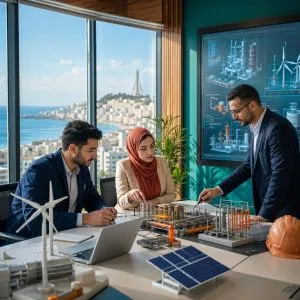
The Industrial Digitalization Wave That Is Creating These Roles
Algeria’s energy sector — built around Sonatrach’s oil and gas operations concentrated in Hassi Messaoud, Hassi R’Mel, and In Salah — has historically operated on aging distributed control systems (DCS) and supervisory control and data acquisition (SCADA) platforms. These systems monitored pipeline pressure, valve states, and compressor performance, but they generated data in siloed formats that could not be connected to modern analytics platforms.
That architecture is changing. Sonatrach’s documented technology investments now include IoT platforms, AI and Machine Learning for predictive maintenance, and Autonomous Database — all of which require engineers who can bridge the gap between physical field instrumentation and software-layer data pipelines. The 5th International Conference on Applied Automation and Industrial Diagnostics (ICAAID 2025), hosted by the University of Djelfa at the University of Ghardaïa in November 2025, specifically focused on “latest advancements in industrial automation systems, diagnostics, and reliability engineering” — a clear signal that Algeria’s academic and industrial communities are treating automation engineering as a priority domain.
The evolution of digital twin technology and automated control loops has redefined what an instrumentation technician or embedded engineer does. These roles have moved from basic calibration of sensors and transmitters to the management of sophisticated DCS and Emergency Shutdown (ESD) frameworks that feed real-time data into cloud-connected dashboards. Engineers in Hassi Messaoud today work alongside SCADA platforms that integrate with enterprise resource planning systems — managing not just the sensor hardware but the entire data pipeline from field device to operator console.
The influx of green hydrogen pilots, hybrid solar-gas plants, and expanded pipeline infrastructure adds another dimension. Electrical and instrumentation engineers must increasingly manage high-voltage substations that are digitized, meaning their role includes configuring IoT edge devices, writing firmware for programmable logic controllers (PLCs), and commissioning communication protocols like Modbus, PROFIBUS, and OPC-UA that connect field instruments to centralized SCADA.
What “Embedded & IoT Engineer” Actually Means in Algeria’s Industrial Context
The terminology confusion is real: “embedded systems” means different things in a consumer electronics company and an oil-and-gas field. For Algerian graduates considering this career lane, clarity about the specific skills and environment matters.
In Algeria’s energy and manufacturing context, embedded and IoT engineering means:
Programmable Logic Controller (PLC) programming. PLCs from Siemens (SIMATIC), Schneider Electric (Modicon), and Allen-Bradley (Rockwell) are the workhorses of Algerian industrial automation. Programming them requires knowledge of Ladder Logic, Function Block Diagram (FBD), or Structured Text (ST) — IEC 61131-3 languages that are distinct from Python or Java but learnable in three to six months with focused effort. PLCs control everything from compressor start-stop sequences to emergency shutdown valves at Sonatrach facilities.
SCADA system configuration. Platforms like Wonderware (now AVEVA), Ignition, and Siemens WinCC are used at Algerian facilities to create operator interfaces that display real-time field data. Engineers configure tags (data points mapped to physical instruments), build alarm management systems, and set up historian databases that archive process data for trend analysis and regulatory reporting.
IoT connectivity protocols. Connecting legacy field instruments to modern data platforms requires knowledge of industrial communication standards: Modbus RTU/TCP for older sensors, PROFIBUS/PROFINET for Siemens equipment, OPC-UA as the modern interoperability layer that allows SCADA systems to publish data to cloud platforms. Engineers who can configure OPC-UA servers and connect them to Azure IoT Hub or AWS IoT Core are bridging the gap between the plant floor and the data science layer.
Edge computing and firmware. For remote sites (pipeline pumping stations, wellhead monitoring points far from central facilities), edge devices run firmware that preprocesses sensor data locally before transmitting summaries over low-bandwidth connections. This requires C or C++ programming, familiarity with microcontrollers (STM32, ESP32, Raspberry Pi CM4 in lighter-duty monitoring applications), and protocols like MQTT for IoT messaging.
Advertisement
What Algerian Embedded and IoT Engineers Should Do to Enter This Market
The structured pathway into this career lane is less well-defined than in pure software roles — there is no equivalent of “complete Bootcamp X and get a developer job.” But the steps are clear for engineers who approach the preparation systematically.
1. Ground the University Foundation in the Right Electives Before Graduating
For students at Algeria’s universities of science and technology — USTHB, ENP, USTO-MB, Badji Mokhtar Annaba — the most relevant elective tracks are industrial electronics, control systems, and signal processing rather than software engineering or web development. The signal processing and control theory taught in these programs maps directly to the DCS and SCADA environment. Students who have taken courses in instrumentation, actuators, and feedback control systems already have 30-40% of the domain knowledge needed; they need to add the software connectivity layer on top of an existing hardware foundation. Algeria’s 65% skills-based screening rate in tech hiring (Indeed/iMocha 2026 data) means practical demonstration of PLC and SCADA competence — not just academic credentials — determines who passes a technical screen for industrial automation roles.
2. Build Practical PLC and SCADA Competence Through Simulation Before the Field
The challenge for graduates without industry experience is that PLC systems are expensive — a real Siemens SIMATIC S7-1500 rack costs several thousand euros. The solution is simulation: Siemens TIA Portal (the programming environment for SIMATIC PLCs) offers a free trial that includes PLCSIM, a software simulator allowing graduates to write and test Ladder Logic programs without hardware. Similarly, Inductive Automation’s Ignition SCADA platform offers a free trial mode without time limits on local servers. A graduate who has built five to ten PLC programs in TIA Portal simulation, documented them on GitHub, and configured a simulated Ignition SCADA project has a portfolio that hiring managers at engineering contractors working with Sonatrach can evaluate directly.
3. Target Engineering Contractors Before Targeting Sonatrach Directly
Sonatrach’s direct hiring pipeline favors candidates with existing industry experience. The practical entry point is the ecosystem of Algerian and international engineering contractors that execute Sonatrach projects: Saipem (awarded major Sonatrach contracts in 2025, including the Front End Engineering Design for the Phosphate Integrated project), Technip, and local EPC firms. These contractors hire junior instrumentation and automation engineers for commissioning and site support roles at active Algerian construction and operational sites. Three to four years at a contractor — working on PLC commissioning, SCADA configuration, and field instrument calibration — produces the operational credibility that allows transition to a permanent Sonatrach or Sonelgaz role.
Where This Fits in Algeria’s 2026 Industrial Landscape
The embedded and IoT career lane matters for Algeria’s broader economic trajectory in a specific way. Algeria’s oil and gas revenue — the foundation of national budget planning — depends on maintaining and expanding production from aging fields while managing operational costs. Digital transformation of those fields through IoT sensors, predictive maintenance algorithms fed by SCADA historian data, and AI-assisted anomaly detection is not optional modernization; it is the mechanism by which Sonatrach extends the productive life of mature assets and improves safety margins at high-hazard sites.
The engineers who build that digital layer sit at a unique intersection: too hardware-focused to be recruited by software companies, too software-aware to be replaced by traditional mechanical or electrical technicians. That positioning — niche but structurally necessary — creates career stability that pure software roles in Algeria cannot match during periods of global tech layoffs. When a software product loses its market, engineers are displaced. When Hassi Messaoud needs a compressor SCADA upgrade, the instrumentation engineer on-site is irreplaceable by anyone not standing next to the physical equipment.
For universities in Oran, Constantine, Annaba, and Béjaïa — close to industrial zones and manufacturing clusters that are not concentrated in Algiers — this career lane offers graduates a path that starts locally, builds genuine industry expertise, and does not require the capital-city migration that pure software and BI roles currently favor.
Frequently Asked Questions
What is the difference between embedded systems engineering and regular software development in Algeria’s job market?
Embedded systems and IoT engineering in Algeria’s industrial context involves programming PLCs and microcontrollers, configuring SCADA systems, and connecting field sensors to data networks — all of which require interaction with physical hardware in industrial environments. This is fundamentally different from web or mobile software development. The tools are different (IEC 61131-3 languages, TIA Portal, Ignition vs. Python, React, Node.js), the environment is different (plant floor vs. office), and the employer base is different (Sonatrach, Sonelgaz, engineering contractors vs. startups and software houses). Both careers are valid; they serve entirely different markets.
Which Algerian universities offer the best preparation for industrial IoT and automation careers?
The national polytechnic schools — École Nationale Polytechnique (ENP Algiers) and École Nationale Polytechnique d’Oran (ENPO) — offer the strongest control systems and industrial electronics curricula. Badji Mokhtar Annaba University has a strong electrical engineering department with industrial electronics courses. USTHB’s electronics and computer engineering programs provide relevant foundations. The key is selecting electives in control theory, industrial automation, and instrumentation rather than defaulting to the software engineering track. University proximity to industrial zones (Oran near petrochemical industry, Annaba near El Hadjar steel complex) also provides internship access.
Do I need to relocate to Hassi Messaoud to work in Algeria’s energy sector IoT roles?
Not necessarily for all roles. While operational field positions at oil and gas facilities in the Saharan south require on-site presence (typically rotation schedules of 28 days on / 28 days off), SCADA system design, PLC programming for new projects, and engineering contractor office roles are often based in Algiers, Oran, or Constantine. The design and configuration phase of industrial automation projects happens in engineering offices; the commissioning phase requires temporary field presence. As remote monitoring capabilities improve, some Sonatrach digital transformation roles may also be based at northern regional offices rather than at wellhead sites.
Sources & Further Reading
- Algeria Launches 12-Week AI Training Programme for Advanced Skills Development — TechAfrica News
- Sonatrach Digital Transformation Software Investments — AppsRunTheWorld
- Saipem Awarded Sonatrach Contract for Phosphate Integrated Project — Saipem Press Release
- Algeria Launches National AI Training Program — EcoFin Agency
- Tech Hiring Trends 2026 — iMocha
- Tech Careers in 2026: AI, Cloud and Emerging Roles — Charter Global