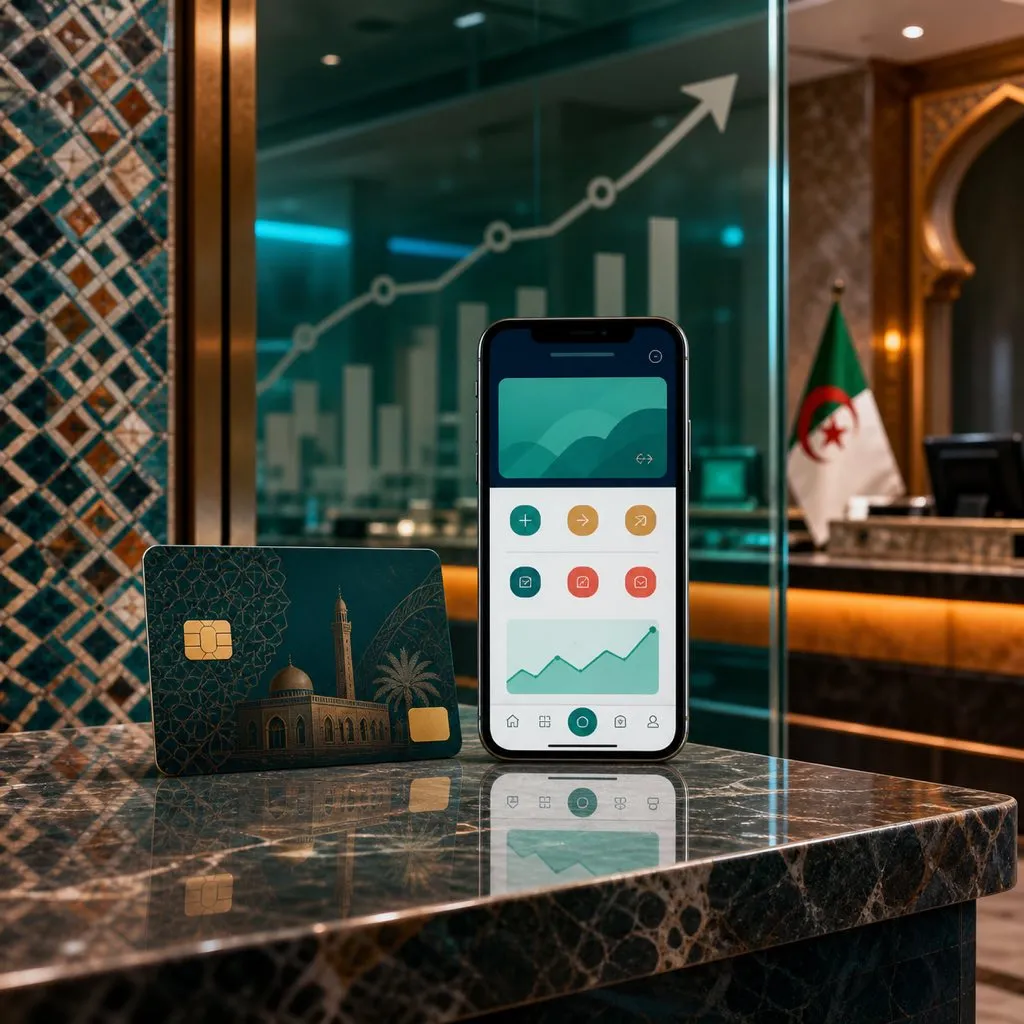
The Gap Between the Target and the Baseline
Algeria has set itself an ambitious goal: transition from a predominantly cash economy to one where half of all financial transactions flow through digital channels by 2030. The Bank of Algeria’s governor has been even more direct, pointing to 2028 as the target year for a cashless society transition. These targets are not aspirational abstractions — they have institutional backing in the Fintech Strategy 2024–2030 and financial backing through the 2025 Finance Law, which introduced stamp duty exemptions for electronic payments and waived VAT and customs duties on payment terminal assembly kits through December 2027.
The gap between that target and the current baseline is, however, substantial. As of 2025, 57% of Algerian adults remain unbanked — one of the highest rates in the Mediterranean and MENA region. Digital financial transactions grew 71% in Q1 2024, indicating strong momentum, but from a low base. The EDAHABIA card — Algeria’s national prepaid debit card, a product of Algérie Poste — grew its user base to 14.3 million by end of 2024, representing a more than doubling from previous years. That 14.3 million figure is significant: it defines the existing addressable market for digital payment services, a population that already has a payment instrument but does not yet use it for the full range of financial services.
Closing the gap between a 14.3 million EDAHABIA base and the 50% cashless target requires more than regulatory incentives and tax exemptions. It requires AI.
Why AI Is the Structural Enabler — Not an Optional Add-On
The conventional framing of Algeria’s digital payments challenge is a coverage problem: build more infrastructure, sign more merchants, issue more cards. That framing is incomplete. Algeria’s payment coverage problem is partly infrastructure and partly behavioral — a large share of the unbanked population has either poor digital literacy, intermittent connectivity, or deep distrust of formal financial institutions rooted in historical crises (the 1990s banking sector collapses remain in collective memory). These are not problems that more POS terminals solve.
AI addresses the three layers of the problem simultaneously:
Onboarding friction: Traditional bank account opening in Algeria involves branch visits, physical documentation, and manual identity verification processes that can take days. AI-powered eKYC (electronic Know Your Customer) — using facial recognition against civil registry records and document OCR — can reduce onboarding to under 10 minutes on a smartphone. The 30–35 fintech startups operating in Algeria in 2026, including Banxy (Algeria’s first fully mobile banking platform), Digital Finance Algeria (DFA), and ESREF Pay, are building onboarding flows that depend on this AI layer.
Fraud detection at scale: Every digital transaction expansion creates a corresponding fraud surface. Algeria’s low baseline of digital transaction infrastructure means that fraud detection models have historically been under-developed relative to the volume expansion now occurring. AI-based transaction monitoring — which analyzes behavioral patterns, device fingerprints, and network signals in real time — is the only fraud detection approach that scales with the 71% transaction growth rates that Algeria’s digital payment infrastructure is handling.
Language and accessibility: Algeria’s EDAHABIA cardholders include a significant population of users who are more comfortable in Darija or Tamazight than in formal Arabic or French. An AI-powered Darija-language payment interface, help system, or mobile banking app reduces the activation friction for users who would otherwise leave their EDAHABIA cards dormant. This is not a niche concern — it is a structural requirement for reaching the 57% unbanked population, the majority of whom are not digital natives.
Advertisement
What Fintech Founders and Banking Technology Teams Should Build in 2026
The Fintech Strategy 2024–2030’s regulatory sandbox — targeted to open by 2026 and designed to allow at least 20 fintech startups to test innovations annually — creates a defined entry window for AI-enabled financial services. The window is narrow because sandbox slots are competitive, and the teams that arrive with working prototypes and structured data on user behavior will have an advantage over teams that arrive with concepts.
1. Build the eKYC Stack Before the Sandbox Opens — Not After
The most common mistake Algerian fintech teams make is treating eKYC as an infrastructure problem to solve later. The Bank of Algeria’s sandbox framework will evaluate teams in part on their ability to demonstrate responsible identity verification. Teams should have a working eKYC prototype — integrating with Algeria’s civil registry (CNRC) where legally possible, using facial liveness detection, and document authenticity scoring — before submitting a sandbox application. The technology stack is available through global providers (Jumio, Onfido, Smile Identity all have MENA coverage) and can be integrated into a mobile onboarding flow in 8–12 weeks of development time.
2. Use PAPSS Integration as a Competitive Differentiator, Not a Compliance Checkbox
The Bank of Algeria joined the Pan-African Payment and Settlement System (PAPSS) in 2025, enabling interoperable cross-border payments across member countries without dollar intermediation. For Algerian fintech startups targeting the diaspora remittance corridor — an estimated $1.5 billion to $2 billion in annual flows — PAPSS integration is an immediate revenue opportunity. The startups that integrate PAPSS capability in 2026 will have a 12–18 month head start over those that treat it as a future compliance item. The AI layer here is foreign exchange risk management and real-time fraud scoring on cross-border transactions.
3. Target the EDAHABIA Merchant Activation Problem, Not the Cardholder Acquisition Problem
Algeria already has 14.3 million EDAHABIA cardholders. The binding constraint is not cardholder supply — it is merchant activation. Fewer than 15% of Algerian merchants currently accept electronic payments [VERIFY: precise merchant POS penetration figure]. An AI-powered merchant onboarding tool — QR code-based, no hardware required, with Darija-language interface and automated transaction reconciliation — is the highest-leverage product opportunity in Algeria’s fintech market right now. Several of Algeria’s 30–35 active fintech startups have identified this gap; the first to build a reliable, well-supported merchant tool at low cost will capture a structurally advantaged position.
4. Document AI Decision Trails for the Regulatory Audit Layer
This is the most under-discussed requirement in Algerian fintech development. When the Bank of Algeria’s sandbox framework formalizes AI governance requirements — which is expected to happen in parallel with the sandbox launch — it will ask for evidence that AI credit scoring, fraud flagging, and onboarding decisions are explainable and auditable. Fintech teams that build with explainable AI (XAI) frameworks from day one — logging decision inputs, model versions, and outcome tracking — will be able to respond to that requirement in days rather than months. Teams that have trained black-box models with no audit infrastructure will face a retroactive compliance rebuild.
Where This Fits in Algeria’s 2026 Ecosystem
Algeria’s Fintech Strategy 2024–2030 is structurally well-designed: it combines a cashless target (50% by 2030), a demand stimulus (tax incentives on electronic payments), a regulatory pathway (sandbox), and an infrastructure anchor (PAPSS). What the strategy document does not make explicit — but what the operational reality of reaching 57% of unbanked adults requires — is that AI is not an optional enhancement to these levers. It is the mechanism that makes them work at Algerian scale.
The 30–35 fintech startups currently active in Algeria represent an early-stage ecosystem rather than a mature one. Most are in the payments and mobile banking verticals; fewer are building the AI infrastructure layer (eKYC, fraud scoring, credit decisioning) that will underpin the next wave. The sandbox launch is the signal that the infrastructure window is open. Founders who use the 6–12 months before sandbox applications open to build working AI prototypes with real user data — even at small scale, even imperfectly — will be in a categorically different position than those who wait for the sandbox to define what is permissible.
Frequently Asked Questions
What is Algeria’s Fintech Strategy 2024–2030 and what are its main targets?
Algeria’s Fintech Strategy 2024–2030 is a national framework to accelerate digital financial services adoption. Its primary targets are 50% of all transactions cashless by 2030 (with the Bank of Algeria governor citing 2028 as the aspirational cashless transition date), plus the establishment of a regulatory sandbox by 2026 that will allow at least 20 fintech startups to test innovations annually. The 2025 Finance Law provides tax incentives including stamp duty exemptions on electronic payments and waived VAT on payment terminal assembly kits through December 2027.
How many Algerians are unbanked and what is EDAHABIA?
As of 2025, approximately 57% of Algerian adults — roughly 20 million people — remain unbanked, one of the highest rates in the Mediterranean and MENA region. EDAHABIA is Algeria’s national prepaid debit card issued by Algérie Poste, which grew to 14.3 million cardholders by end of 2024 (more than doubling from prior years). EDAHABIA represents the primary digital payment instrument for non-bank users and is the key distribution channel for reaching the unbanked population.
How many fintech startups are active in Algeria, and what AI capabilities do they need?
Approximately 30–35 fintech startups operate in Algeria as of 2026, concentrated in digital payments, mobile banking, and financial infrastructure. Key players include Banxy (Algeria’s first fully mobile banking platform), Digital Finance Algeria (DFA), ESREF Pay, UbexPay, and Yassir (regional super-app). The core AI capabilities these startups need — and that create competitive differentiation — are eKYC (electronic identity verification), Darija-language NLP for customer interfaces, real-time fraud detection, and explainable credit scoring models.
—
Sources & Further Reading
- Algeria’s Fintech Ecosystem in 2026: Building Momentum — The Fintech Times
- Algeria’s New Digital Payment Law: 57% Unbanked at Stake — AlgeriaTech
- Algeria Launches First Fintech Regulation for PSPs — Startup Researcher
- Algeria Pushes for Ambitious Cashless Economy by 2028 — North Africa Monitor
- FinTech Adoption in the Algerian Banking Sector: Reality and Challenges — ASJP Research