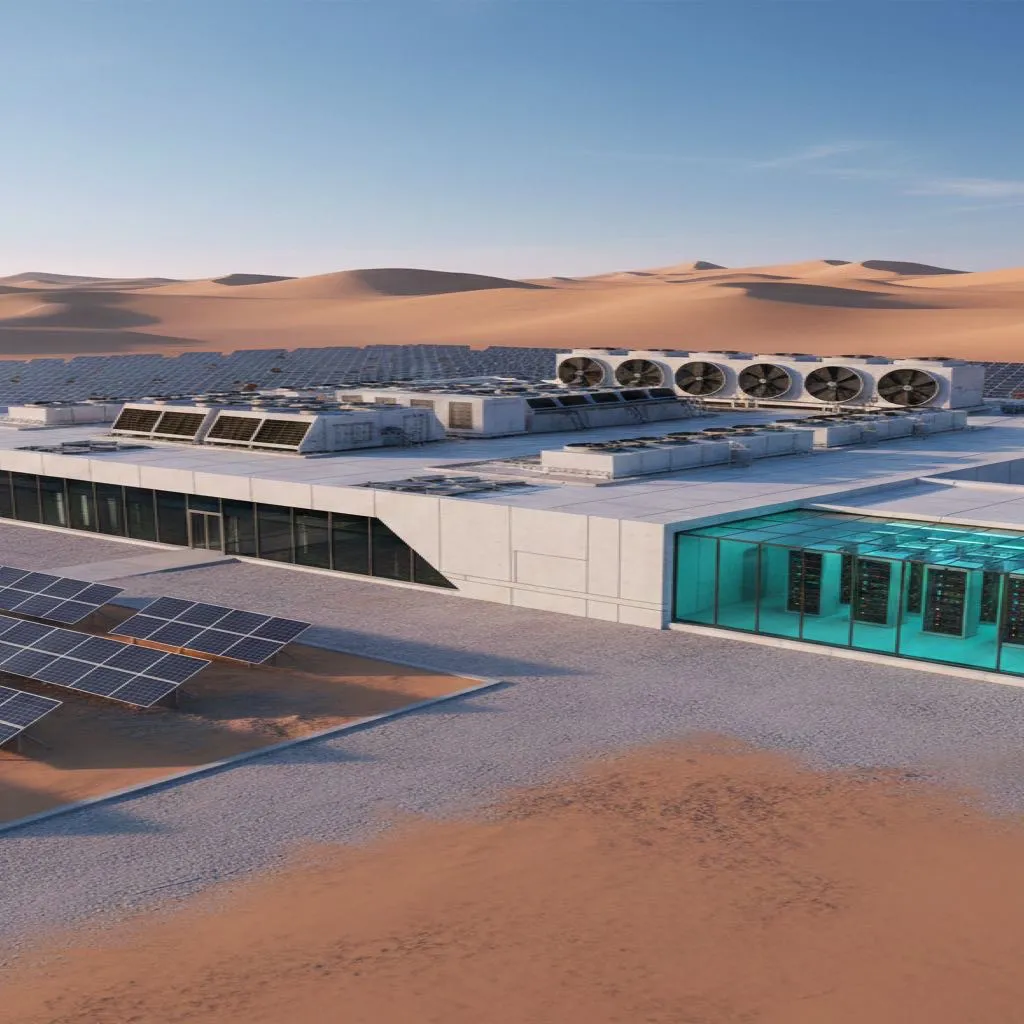
Quick Take: Algeria’s cheap energy gives it a genuine data center cost advantage, but only if paired with modern cooling technology. Defaulting to brute-force air conditioning would waste both energy and the country’s competitive positioning. The smartest move is to mandate PUE targets for new facilities and invest in liquid cooling expertise now, before the next wave of construction begins.
The Heat Problem No One Is Talking About
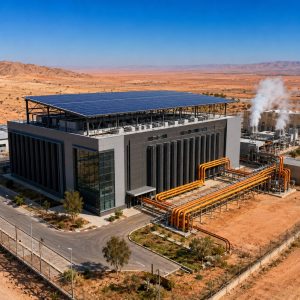
Algeria is building data centers. Facilities in Algiers and Oran are expanding, and government plans call for additional capacity across the country to support digitization goals. But there is a fundamental engineering problem that rarely makes headlines: how do you keep servers cool when the ambient temperature outside regularly exceeds 45 degrees Celsius?
In northern Algeria — where most current data center capacity is concentrated — summer temperatures routinely hit 40 degrees. Move south toward the Sahara, where land is cheap and renewable energy potential is enormous, and the mercury climbs past 50 degrees. Traditional air-cooled data centers, the global default, are designed for temperate climates where free cooling from outside air can supplement mechanical systems for much of the year. In Algeria’s south, free cooling is essentially unavailable for six months or more.
The issue is not theoretical. Power Usage Effectiveness (PUE) — the industry’s standard metric for data center energy efficiency — degrades significantly in hot climates. A facility that achieves a PUE of 1.3 in Frankfurt or Amsterdam might see that number climb to 1.8 or higher in a desert environment, meaning nearly as much energy goes to cooling as to actual computing. When Algeria’s data center ambitions scale up, cooling will become the single largest operational cost driver.
Cooling Technologies: What Works in Extreme Heat
The global data center industry has developed several approaches for hot-climate operations, each with distinct tradeoffs for Algeria’s context. Direct evaporative cooling, used extensively in the Middle East, works by passing air over water-saturated media. It is energy-efficient and can reduce inlet temperatures by 10-15 degrees Celsius, but it consumes significant water — a critical constraint in a country where water scarcity is already an existential challenge. Facilities in northern Algeria must weigh water consumption against energy savings carefully, while southern deployments may find water too scarce for evaporative approaches entirely.
Liquid cooling — where coolant circulates directly to server components — is emerging as the leading technology for hot-climate data centers. Direct-to-chip liquid cooling can remove heat roughly 1,000 times more efficiently than air, and rear-door heat exchangers can supplement existing air-cooled infrastructure. Companies like Equinix and Google have deployed liquid cooling in their most thermally challenging environments. For Algeria, liquid cooling offers a path to building data centers in the south without astronomical energy bills, though it requires different server hardware and maintenance expertise.
Immersion cooling, where entire servers are submerged in dielectric fluid, represents the most radical approach. Companies like GRC (Green Revolution Cooling) and LiquidCool Solutions have deployed systems in the Gulf states that maintain PUE values below 1.1 even in extreme heat. Saudi Arabia’s NEOM project and the UAE’s Khazna Data Centers have validated immersion cooling at scale. The technology eliminates the need for raised floors, CRAC units, and humidity control — simplifying facility design significantly. However, an estimated upfront cost premium over traditional builds and the specialized maintenance requirements present barriers for Algeria’s nascent data center market.
Advertisement
Algeria’s Paradoxical Energy Advantage
Here is where Algeria’s data center story gets interesting. The country sits on the third-largest natural gas reserves in Africa and produces electricity at some of the lowest costs on the continent. As of mid-2025, Sonelgaz — the state utility that dominates electricity supply through its four regional subsidiaries — charges businesses approximately $0.036 per kWh according to GlobalPetrolPrices data. This compares to $0.10-0.15 per kWh in most European markets. Cheap energy is, paradoxically, both a curse and a blessing for data center efficiency.
On one hand, low electricity costs reduce the financial incentive to optimize PUE aggressively. When power is cheap, operators may default to brute-force air conditioning rather than investing in advanced cooling. This is exactly what happened in parts of the Gulf states during their first wave of data center construction in the 2010s — facilities with PUE values above 2.0 were commercially viable simply because energy was nearly free. Algeria risks repeating this pattern if efficiency standards are not established early.
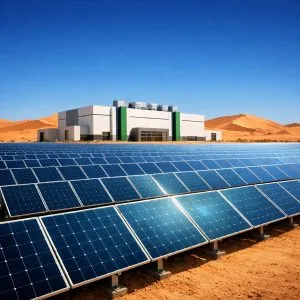
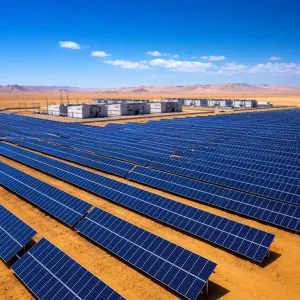
On the other hand, cheap energy makes Algeria genuinely competitive as a data center location for compute-intensive workloads. AI training, high-performance computing, and similar energy-hungry applications are all dominated by power cost as the largest operational expense. If Algeria can pair its energy cost advantage with modern cooling technology to achieve reasonable PUE values — say, 1.4 or below — the total cost of ownership could significantly undercut European facilities. This is the same logic driving Microsoft’s investments in data centers in Sweden and Finland, where cold climates and cheap hydropower create natural advantages. Algeria’s advantage would come from cheap gas rather than cold air, but the economic math follows the same pattern.
Lessons from Hot-Climate Operators
Algeria does not need to solve the desert data center problem from scratch. Operators across the Gulf, India, and Africa have accumulated a decade of experience building and running facilities in extreme heat, and their lessons are directly transferable.
In the UAE, Khazna Data Centers operates facilities in Abu Dhabi where summer temperatures mirror Algeria’s southern regions. Their approach combines indirect evaporative cooling with hot/cold aisle containment and elevated server inlet temperatures — running servers at 35 degrees rather than the traditional 18-27 degree range. ASHRAE’s expanded thermal guidelines (TC 9.9), which now permit inlet temperatures up to 40 degrees for short durations, have been critical in making hot-climate operations feasible without exotic cooling technology.
India’s data center boom offers particularly relevant lessons. Facilities in Rajasthan and other hot regions have deployed hybrid cooling architectures — evaporative cooling during dry months, mechanical chillers during humid periods — that adapt to seasonal climate variation. Algeria’s climate is similarly varied: the coastal north is Mediterranean with humid summers, while the south is arid year-round. A one-size-fits-all cooling strategy will not work; facility design must account for regional climate profiles.
Africa’s own data center expansion, led by companies like Africa Data Centres (now owned by Cassava Technologies) and Raxio, provides lessons in building infrastructure with constrained supply chains. These operators have learned to design for reliability in environments where replacement parts may take weeks to arrive, backup power must account for grid instability, and skilled HVAC technicians are scarce. Algeria’s data center operators will face identical challenges, particularly for facilities outside Algiers and Oran.
Frequently Asked Questions
What is data center cooling in a desert nation?
Data Center Cooling in a Desert Nation: Algeria’s Unique Infrastructure Challenge covers the essential aspects of this topic, examining current trends, key players, and practical implications for professionals and organizations in 2026.
Why does data center cooling in a desert nation matter?
This topic matters because it directly impacts how organizations plan their technology strategy, allocate resources, and position themselves in a rapidly evolving landscape. The article provides actionable analysis to help decision-makers navigate these changes.
How does cooling technologies: what works in extreme heat work?
The article examines this through the lens of cooling technologies: what works in extreme heat, providing detailed analysis of the mechanisms, trade-offs, and practical implications for stakeholders.
Sources & Further Reading
- Algeria Electricity Prices — GlobalPetrolPrices.com
- ASHRAE TC 9.9: Thermal Guidelines for Data Processing Environments — ASHRAE
- Khazna Data Centers — DatacenterDynamics
- GRC Immersion Cooling Technology — Green Revolution Cooling
- Africa Data Centres Expansion — Cassava Technologies
- Algeria Energy Profile — International Energy Agency
- Data Center Cooling Best Practices — Uptime Institute
- Raxio Data Centers Africa — Raxio Group