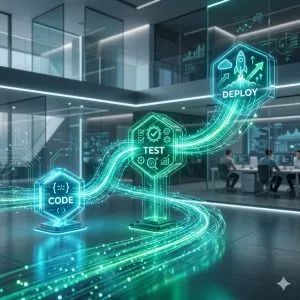
Why OpenAI is reframing its enterprise pitch
In its April 8 post, “The next phase of enterprise AI,” OpenAI argued that companies are tired of bolt-on AI features and want a unified operating layer with AI coworkers that are grounded in company context, connected to internal and external systems, and governed by the right permissions. Two announcements anchor this narrative. First, Workspace Agents in ChatGPT, introduced in research preview for Business, Enterprise, Edu, and Teachers plans, let teams design or pick from agent templates that operate across Slack, Google Drive, Microsoft 365, Salesforce, and Notion with org controls, approvals, memory, and analytics built in. Second, the updated Agents SDK, covered by TechCrunch on April 15, gives developers tools to build agents that can inspect files, run commands, edit code, and execute long-horizon tasks inside controlled sandbox environments.
Underneath this product surface sits Frontier, OpenAI’s term for the intelligence layer governing all of an enterprise’s agents, and a Stateful Runtime Environment being built with AWS so agents can keep context, remember prior work, and operate across business tools without restarting from zero each time.
The infrastructure stack is consolidating around persistent agents
The OpenAI-Cloudflare collaboration, announced jointly in April 2026, is the clearest infrastructure expression of this shift. Cloudflare Agent Cloud is being positioned as a runtime for long-running agents that need persistent state, durable execution, and global edge presence. That matters because most production-grade agent workflows fail not on model quality but on plumbing: timeouts, lost sessions, retry logic, and the absence of a stable place to store agent memory between tasks. By pairing OpenAI’s models with Cloudflare’s edge runtime and AWS’s stateful environment, OpenAI is conceding that no single vendor will own the full agent stack and that enterprise buyers want interoperability.
This also explains the $122 billion megaround OpenAI closed in Q1 2026, reported by Crunchbase. That capital is funding compute, but it is just as much funding the engineering work needed to make agents production-safe at enterprise scale: observability, role-based access control, audit trails, and approval flows.
Governance has become a first-class product feature
The most underappreciated detail in OpenAI’s April announcements is how prominently governance language now appears. Workspace Agents ship with org controls, approvals, memory boundaries, and analytics as named features, not afterthoughts. That is a meaningful change from the 2024-2025 era when many AI tools were sold on raw capability and governance was assumed to be the customer’s problem.
Three forces are pushing this change. Regulatory pressure from the EU AI Act and the OECD’s February 2026 due-diligence guidance now treats AI risk management as a board-level concern. Enterprise buyers, burned by shadow-AI sprawl, are demanding centralized policy enforcement before they expand pilots. And the agent itself, by acting on behalf of users across systems, creates a new class of insider-risk surface that traditional identity tools were not built to handle.
Advertisement
What buyers are actually evaluating in 2026
The conversation among enterprise CIOs has shifted from “which copilot is best?” to a more architectural set of questions. How does the platform handle identity propagation across tools? Can agents be sandboxed, observed, and rolled back? What happens to memory when an employee leaves? How are approvals routed for high-stakes actions like sending email, creating invoices, or pushing code?
Vendors that cannot answer these questions cleanly are losing pilots. Vendors that can, including OpenAI with Workspace Agents, Anthropic with its Claude for Enterprise tier, Google with Gemini Enterprise, and Microsoft with Copilot Studio, are increasingly being judged on the same operating-layer criteria. The differentiation is moving up the stack from model benchmarks to workflow design, integration depth, and governance posture.
What Enterprise CIOs and Engineering Leaders Should Do About It
OpenAI’s $122 billion Q1 2026 megaround, reported by Crunchbase, signals that the coordination era is coming whether enterprises are ready or not. The practical window for preparation is 12–18 months before governed agent platforms become standard procurement expectations. These four actions separate organizations that will run agents safely from those that will run them expensively.
1. Inventory Existing AI Tools and Identify Governance Gaps
Before adding another platform, map every AI tool currently in use across the organization. The 2024–2025 shadow-AI sprawl documented by Gartner — where individual teams adopted tools outside IT visibility — is now the biggest barrier to operating-layer adoption because it means identity propagation, audit trails, and approval workflows were never designed. A tool inventory takes two to four weeks and reveals how many data-access permissions were granted informally. Start with the systems that touch customer data, finance records, or employee data: those are the highest-risk surfaces for the insider-risk exposure that OpenAI’s Workspace Agents governance language is explicitly designed to address.
2. Define Governance Before Selecting a Platform
The vendors now competing for enterprise AI operating-layer contracts — OpenAI with Workspace Agents, Anthropic with Claude for Enterprise, Google with Gemini Enterprise, Microsoft with Copilot Studio — are differentiating on governance posture, not model benchmarks. Before issuing an RFP, define internal governance requirements: which approval workflows need human-in-the-loop, what the rollback procedure is for an agent action that causes an error, how memory is handled when an employee leaves, and which systems agents are prohibited from touching without dual-party authorization. Organizations that define these requirements first will select the right platform once; those that select first and govern later will replace their platform within 24 months.
3. Pick One Cross-Functional Workflow as the Proving Ground
The two- to three-year migration toward a unified operating layer works best when anchored in a single high-visibility workflow that spans at least two departments. Customer support and finance close are the two most common proving grounds because they have measurable cycle times, documented handoffs, and clear success metrics. The Cloudflare Agent Cloud partnership — designed for long-running agents with persistent state and durable execution — is well-suited to exactly these workflows: multi-step processes that run across tools like Slack, Salesforce, and Notion without needing manual re-initiation. Define the workflow in BPMN or a simple swimlane diagram before writing a line of agent configuration; the documentation step reveals the approval gates that the agent will need to navigate or escalate.
4. Build the Technical Readiness That Agent Platforms Assume
OpenAI’s Stateful Runtime Environment being built with AWS, and Cloudflare’s persistent-state runtime, both assume the enterprise has clean identity systems, role-based access control, and documented system-of-record boundaries. Without those foundations, deploying agents creates new compliance gaps faster than it closes operational ones. The pre-requisites are not exotic: single sign-on enforced across all SaaS tools, an identity lifecycle process that deprovisions access when employees change roles, and a data classification policy that tells an agent which documents it can read, which it can act on, and which are off-limits. Teams that complete this foundation in 2026 will activate governed agents in 2027 with much shorter security-review cycles.
The Bigger Picture
The coordination era reframes what enterprise software competition actually looks like. From 2015 to 2023, the SaaS market rewarded point-solution specialists — the best CRM, the best analytics tool, the best project management app — because enterprises were buying capability one workflow at a time. The operating-layer shift inverts that logic. The vendor that governs identity, memory, and approval routing across the widest range of enterprise tools owns the most defensible position, because switching costs accrue at the integration layer, not the model layer.
That is why OpenAI’s $122 billion Q1 2026 megaround is not primarily a bet on GPT-5 or GPT-6. It is a bet on whether OpenAI can become the infrastructure layer that routes agent work across Salesforce, Slack, Google Drive, and Notion before any of those platforms builds their own equivalent. Anthropic, Google, and Microsoft are running the same race with different assets. The outcome over the next three years will be determined less by which model scores highest on benchmarks and more by which platform earns the trust of enterprise security and compliance teams — the buyers who now control the purchasing decision for any AI tool that touches production data.
For organizations that have not started this work, the window to define their own governance posture before a vendor defines it for them is closing. Platforms that arrive with pre-built governance will carry that governance as a constraint, not a choice. The enterprises that define their requirements first will spend the next decade choosing among governed options; those that defer will spend it unpicking the governance choices someone else made on their behalf.
Frequently Asked Questions
What does an enterprise AI operating layer mean?
An enterprise AI operating layer means AI systems that are grounded in company context, connected to internal systems like Slack, Salesforce, and Notion, and governed by shared permissions and controls. The goal is to coordinate work across teams rather than deploy isolated assistants in each department.
Why are point solutions becoming a problem?
Point solutions can create fragmented data access, duplicated workflows, inconsistent governance, and weak learning across teams. Once dozens of AI tools spread through an organization, the hard problem becomes coordination, identity propagation, and audit-readiness rather than basic adoption.
How should Algerian enterprises prepare for this shift?
Algerian enterprises should map their most repeated cross-functional workflows and identify where data access, approvals, and handoffs break down. They should then standardize identity, logging, and governance before scaling agents across systems.
Sources & Further Reading
- The next phase of enterprise AI — OpenAI
- OpenAI unveils Workspace Agents — VentureBeat
- OpenAI updates its Agents SDK to help enterprises build safer, more capable agents — TechCrunch
- Cloudflare Expands its Agent Cloud to Power the Next Generation of Agents — Cloudflare
- Sector snapshot: Venture funding to foundational AI startups in Q1 was double all of 2025 — Crunchbase