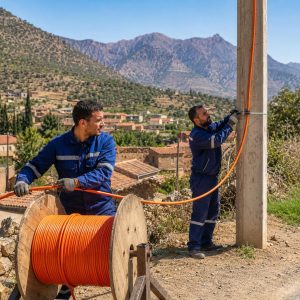
Algeria’s fixed-broadband map has been redrawn in under six years. Algerie Telecom (AT) crossed the three-million FTTH-connected-homes mark in early 2026, up from roughly 53,000 subscribers at the start of 2020. The operator paired the scale-up with a 1.6 Gbps residential fiber tier launched in August 2025 and a survey to map remaining coverage gaps. For the first time, Algerian SaaS founders, remote-first teams, and cloud-native startups outside Algiers can design for domestic gigabit bandwidth as a baseline rather than an exception.
From 53,000 to 3,000,000 FTTH homes
The jump is one of the sharpest fiber-to-the-home expansions documented on the African continent. AT has been pushing a national fiber backbone that now reaches all 58 wilayas, with last-mile deployments concentrated in Algiers, Oran, Constantine, Setif, Annaba, and Blida. A 2026 coverage-gap survey is actively geolocating households that still sit on ADSL or 4G-fixed-wireless so rollout teams can prioritize them.
The 1.6 Gbps tier, launched in August 2025 and branded “Idoom Fibre Giga+”, positions AT’s top residential product on par with offerings in Paris, Dubai, or Singapore. Mid-tier plans at 300 Mbps and 500 Mbps are where most new connections are landing, which is still transformative compared to the 8-20 Mbps ADSL that dominated 2020-2022.
Why fiber unlocks a different startup math
Algerian founders have spent years architecting around bandwidth scarcity: minimizing asset sizes, deferring heavy workloads to off-peak hours, and routing video calls through compressed third-party bridges. Gigabit-class FTTH inverts those constraints.
- Remote work becomes location-agnostic. Developers in Tlemcen or Ouargla can now participate in international engineering teams without bandwidth-induced UX degradation. The pool of employable remote engineers widens beyond the Algiers metropolitan area.
- Cloud-native architectures become viable. Pushing CI/CD pipelines to AWS, GCP, or Azure was painful on ADSL. On symmetric fiber, build artifacts, container images, and dataset transfers move in seconds instead of hours.
- Video-heavy products can be built locally. Telemedicine, e-learning, live-commerce, and gaming startups no longer need to host exclusively abroad to reach Algerian customers with acceptable latency.
- AI workflows become testable. Downloading 20GB model weights or uploading training data to remote GPUs is no longer a weekend-long exercise.
The data-center layer catching up
Fiber at the home is only half the story. AT inaugurated a new data center in 2024 and is expanding capacity to host sovereign workloads, government systems, and commercial cloud tenants. The company’s announced strategy is to layer IaaS and PaaS services on top of the fiber footprint, which would let Algerian startups keep data in-country for regulatory or latency reasons while still tapping modern cloud primitives.
According to Statista’s Algeria data-center outlook, network infrastructure spend is projected to keep rising through 2027 as carriers upgrade transport layers to match access-layer speeds. The U.S. Trade Administration’s digital-economy country guide similarly flags fiber and data centers as the two infrastructure pillars underpinning Algeria’s 2025-2030 digital strategy.
Advertisement
What still needs to happen
Three gaps separate “3 million connected homes” from a truly mature broadband market:
- SLA maturity for business customers. Residential FTTH is excellent; enterprise-grade dedicated-fiber contracts with uptime guarantees, symmetric speeds, and response-time commitments remain thinner.
- IXP and peering density. More local interconnection between AT, Mobilis, Ooredoo, Djezzy, and content-delivery networks would cut international-transit costs and improve latency to local hosts.
- IPv6 rollout. Broader IPv6 deployment would future-proof the network for IoT and mobile-first applications.
None of these are blockers for founders starting today, but they are the edges where the next two years of work will show up.
Bottom line
Algeria now has the access-layer foundation for a cloud-native, remote-capable tech economy. The product-market-fit question for Algerian startups is no longer “can our users load the app?” — it is “what do we build now that they can?”
What Algerian Builders Should Redesign Now That Gigabit Is the Baseline
The shift from ADSL-era assumptions to gigabit-era capabilities is not gradual — it is architectural. Decisions made in 2020 about asset compression, video resolution, sync frequency, and geographic distribution were rational constraints for a specific infrastructure reality. Many of those constraints are now wrong assumptions. The following prescriptions are ordered by the magnitude of the product redesign opportunity they unlock.
1. Rebuild the Video Layer You Compromised for ADSL
Every Algerian product team that reduced video quality, dropped live-streaming features, or chose server-side video rendering to protect bandwidth-limited users should now run A/B tests with higher-quality video as the default. Telemedicine, e-learning, live-commerce, and customer-support products in particular made deliberate tradeoffs against video fidelity that hurt user experience and conversion. With 3 million FTTH homes at 300 Mbps to 1.6 Gbps, those tradeoffs no longer protect a meaningful user segment. Statista’s Algeria broadband outlook projects mid-tier fiber adoption continuing to expand through 2027, meaning the ADSL segment is a shrinking tail, not the median user. Teams that keep catering to ADSL assumptions will build a worse product for the growing majority of gigabit users while failing to grow the feature set that attracts them.
2. Move CI/CD and Development Infrastructure to Cloud-Native Without the ADSL Workarounds
Algerian engineering teams spent years compressing Docker images, pre-fetching dependencies, and batching container pushes to work around the 8-20 Mbps ADSL ceilings that made cloud-native development painful outside Algiers. On symmetric fiber, a 4GB container image pushes in under 30 seconds. A full CI/CD pipeline running on AWS CodePipeline, GitHub Actions, or Google Cloud Build is now viable from any wilaya with FTTH coverage. The consequence is that distributed engineering teams — developers in Oran, Setif, Annaba, and Tlemcen working on the same codebase with the same toolchain as the Algiers team — are operationally feasible without the friction-reduction engineering that used to consume 10-15% of infrastructure team bandwidth. Algerian SaaS founders scaling their engineering organisations should revisit the geographic hiring constraints they imposed for bandwidth reasons and reopen roles to the full 58-wilaya coverage footprint.
3. Design AI Workflows That Depend on Fast Upstream Bandwidth
Training data upload, model weight download, and inference API latency are the three bandwidth constraints that have limited how Algerian AI teams experimented with large models. A 20GB model weight file that took six to eight hours to download on ADSL downloads in roughly two minutes on Idoom Fibre Giga+. That changes the economics of model evaluation: teams can now run experiments on full-sized models rather than compressed variants, upload training datasets to managed cloud services rather than processing locally, and run inference pipelines that call cloud-hosted models in near-real-time rather than batching. For Algerian startups building vertical AI products on rented foundation model infrastructure — the most capital-efficient path identified by Crunchbase’s Q1 2026 analysis of emerging-market AI companies — gigabit FTTH removes the last major on-ramp barrier that was specific to the local infrastructure context.
The Bigger Picture
The three redesign priorities — rebuilding the video layer, moving CI/CD infrastructure to cloud-native without ADSL workarounds, and designing AI workflows around fast upstream bandwidth — add up to a single architectural revision: the constraints that shaped Algerian product decisions between 2020 and 2024 are no longer valid for the median user. Continuing to honor them is not caution; it is building a worse product for a user base that has already outgrown it.
Algerie Telecom’s crossing of the three-million FTTH mark is not the end of the buildout — the 2026 coverage-gap survey is actively geolocating remaining ADSL households, and the data-center layer is expanding in parallel to give locally hosted cloud primitives the same quality as international alternatives. For Algerian founders, the compounding effect of gigabit access plus sovereign cloud capacity plus a 3-million-home subscriber base is the infrastructure precondition for a genuinely domestic cloud-native market, not just a market that uses international infrastructure for Algerian users.
The Idoom Fibre Giga+ launch at 1.6 Gbps is a signal about where the ceiling has moved. The practical question for every engineering team and product organization building in Algeria today is not whether their users have fiber, but whether their architecture has kept pace with users who do.
Frequently Asked Questions
How fast is the fastest Algerie Telecom residential fiber plan?
The top Idoom Fibre Giga+ tier, launched in August 2025, delivers up to 1.6 Gbps, putting it on par with premium residential fiber offerings in major European capitals.
Is FTTH available outside the major cities?
Yes, coverage now spans all 58 wilayas, though density remains highest in Algiers, Oran, Constantine, Setif, Annaba, and Blida. AT’s 2026 coverage-gap survey is specifically designed to identify and prioritize underserved areas.
Can Algerian startups rely on local fiber for cloud-native workloads?
For most workloads, yes. Residential and SME-grade fiber is now suitable for CI/CD, container pulls, video conferencing, and AI dataset transfers. For mission-critical workloads, enterprise dedicated-fiber contracts with SLAs are still the safer choice.