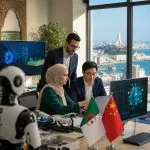
A Structured AI Training Track Backed by a Chinese Tech Giant
Algeria’s Ministry of Vocational Education and Training has signed a memorandum of understanding with Huawei that will, starting September 2026, push artificial intelligence, cloud computing, and cybersecurity into the heart of the country’s vocational system. The agreement — a memorandum with three underlying protocols — was covered by Radio Algérienne, Horizons, Observ Algérie, and regional tech outlets SAMENA Daily News and Startup3lmashi.
The text frames the deal as part of Algeria’s broader push to modernize vocational training by integrating AI and cloud technologies, and it sits alongside parallel engagements between Huawei and the Ministry of Higher Education. Officials have positioned Algeria-China cooperation as a pillar of digital sovereignty, even as the bulk of the technical transfer flows through a single vendor.
The Three Institutions Hosting the Program
The memorandum names three host institutions, each with a specific role. The National Specialized Institute for ICT in Rahmania (Sidi Abdellah tech corridor, near Algiers) handles the ICT skills base. The National Institute for Vocational Training (INSFP) in Boushmaïl is the ICT and telecoms-focused arm. The African Institute for Vocational Training in Boumerdès extends the pipeline to a pan-African audience, reflecting Algeria’s positioning as a regional training hub for neighboring African countries.
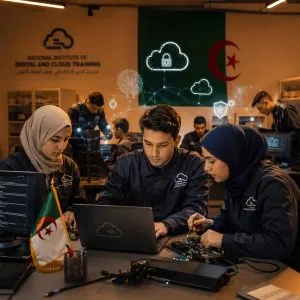
What trainees get, according to SAMENA’s reporting on the signature ceremony, is a multi-track curriculum culminating in a joint diploma issued by the Ministry and Huawei. The four anchor domains are cloud computing, cybersecurity, artificial intelligence, and telecommunications — the same mix that underpins Huawei’s global ICT Academy network. Algeria already has a documented 8,000 students who have been through Huawei-linked programs; this MoU formalizes what was until now a patchwork.
Advertisement
Why the Timing Matters
September 2026 is not a random start date. It aligns with three overlapping developments: the ongoing construction of the Oran AI compute center (groundbreaking March 2025); the launch of Algérie Télécom’s 1.5 billion DZD AI investment fund; and Huawei’s broader ICT Academy and ICT Competition footprint in Algeria. In April 2026, the Minister of Knowledge Economy, Startups and Micro-enterprises received the newly appointed CEO of Huawei Algeria to discuss deeper cooperation on the digital economy, AI solutions, and the startup ecosystem.
In parallel, ENSIA (Algeria’s National Higher School of AI) and Chinese partners have announced a China-Algeria Joint Laboratory for AI, anchoring the university-research side of the same pipeline. The training MoU and the joint lab together imply a two-tier model: vocational pathways for thousands of practitioners, and a research lab for model and applied AI work.
Strategic Tradeoffs for Algeria
Vendor-led training always comes with tradeoffs. The upside is scale and speed: a global vendor can stand up standardized AI, cloud, and cybersecurity tracks in months, certifications are recognizable to employers, and the diploma is co-signed by the Ministry — which gives graduates institutional cover. The tradeoff is tooling gravity: trainees learn on Huawei stacks (HarmonyOS, Huawei Cloud, MindSpore, HCIA/HCIP certifications) that are underrepresented in global job markets outside China-aligned firms.
For students, that is not necessarily bad — the fundamentals of Linux networks, cloud architecture, Python ML, and security operations transfer across vendors. But Algerian planners should pair the Huawei track with exposure to open-source tooling and the broader hyperscaler ecosystem so graduates are portable. The September 2026 cohort will be the first test of that balance.
Frequently Asked Questions
When does the Algeria-Huawei AI training program start?
The training tracks launch in September 2026 under a memorandum of understanding signed between Algeria’s Ministry of Vocational Education and Training and Huawei. The MoU is structured around three protocols and covers cloud computing, cybersecurity, and artificial intelligence.
Where will the training take place?
Three Algerian institutions are hosting the program: the National Specialized Institute for ICT in Rahmania (Sidi Abdellah), the National Institute for Vocational Training (INSFP) in Boushmaïl, and the African Institute for Vocational Training in Boumerdès. The Boumerdès site is also positioned to receive trainees from other African countries.
What credential do graduates receive?
Graduates receive a diploma jointly issued by Algeria’s Ministry of Vocational Education and Training and Huawei. Over 8,000 Algerian students have already passed through Huawei-linked programs in the country, and this MoU formalizes a more structured vocational pathway with a recognized national-plus-vendor credential.
Sources & Further Reading
- Signature d’un mémorandum d’entente entre le secteur de la Formation et de l’Enseignement professionnels et la société Huawei — Radio Algérienne
- Algeria Partners with Huawei to Launch Digital Training Academies — Startup3lmashi
- Algeria and Huawei forge strategic partnership to modernize vocational training in ICT — SAMENA Daily News
- Ouadah reçoit le PDG de Huawei Algérie — Horizons
- L’Algérie et Chine renforcent leur coopération numérique — Agence Ecofin
- China-Algeria Joint Laboratory for Artificial Intelligence — ENSIA
- Algeria Launches Specialized Digital Technology Training Academies in Partnership with Huawei — Dzair Tube